



“Doctor, there must be some mistake in arriving at the diagnosis of my husband.” The young woman sitting across the consultation table looked anxious.
Beside her was her husband, a 34-year-old software engineer who had been suffering from a persistent cough for months. Several consultations, multiple investigations, and finally a CT scan had revealed a suspicious lesion in his lung.
“But he has never smoked,” she continued. “Not even once in his life. How can this happen, doctor?” The question lingered in the room.
This may be the same dilemma among many non-smokers. For decades, smoking has been synonymous with lung disease. Public awareness campaigns, cigarette pack warnings, and health education programs have repeatedly emphasized the dangers of tobacco.
While these efforts have undoubtedly saved lives, they have also created a common misconception—that only smokers develop serious lung diseases, particularly lung cancer. Today, physicians across the world are increasingly encountering patients with significant respiratory illnesses despite no history of smoking.
According to the World Health Organization (WHO), air pollution is emerging as one of the most important environmental threats to human health and a significant contributor to respiratory and cardiovascular diseases.
The Air We Breathe Is Changing. Unlike smoking, air pollution is not a choice. We do not consciously decide to inhale polluted air. It accompanies us during our morning walk, our daily commute, our workday, and sometimes even within our homes. It is often invisible, making it easy to ignore.
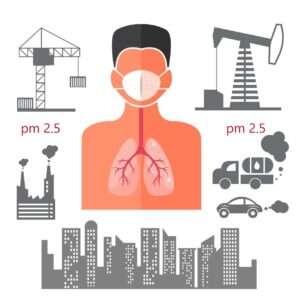
Yet its impact on health is profound. The average adult breathes approximately 20,000 times every day. Each breath carries life-sustaining oxygen into the lungs. Unfortunately, it may also carry harmful pollutants, including particulate matter, nitrogen dioxide, sulfur dioxide, ozone, and other toxic substances generated by vehicle emissions, industrial activities, construction dust, biomass burning, and fossil fuel combustion.
Among these pollutants, fine particulate matter known as PM2.5 has attracted particular concern. These particles are so small that nearly thirty of them lined up side by side would equal the width of a human hair. A landmark scientific statement by Brook and colleagues published in the journal Circulation in 2010 demonstrated that these particulate matter can travel deep into the lungs, reach the air sacs responsible for oxygen exchange, and even enter the bloodstream. Once inside the body, these particles trigger inflammation and oxidative stress.
Over time, this ongoing injury can contribute to a wide range of diseases. The human respiratory system is remarkably resilient. The nose acts as a filter, mucus traps contaminants, tiny hair-like structures called cilia sweep away debris, and immune cells constantly patrol the airways. However, when exposure to pollutants becomes excessive or prolonged, these protective mechanisms can become overwhelmed. More Than Just a Lung Problem Air pollution has been linked to asthma, chronic obstructive pulmonary disease (COPD), respiratory infections, cardiovascular disease, stroke, diabetes, and several forms of cancer.
The Global Burden of Disease Study 2021, published in The Lancet in 2024, identified air pollution as one of the leading environmental risk factors contributing to illness and premature death worldwide. Children are among the most vulnerable victims of polluted air. Their lungs are still developing, and they breathe more rapidly than adults, increasing their exposure to airborne pollutants.
A study by Gauderman and colleagues published in the New England Journal of Medicine in 2015 showed that improvements in air quality were associated with significant improvements in lung growth and development among children. The elderly face similar risks. Individuals with asthma, COPD, heart disease, or diabetes often experience worsening symptoms during periods of poor air quality. According to WHO estimates, exposure to ambient and household air pollution contributes to nearly seven million premature deaths worldwide every year.
A comprehensive review by Münzel and colleagues published in the European Heart Journal in 2024 highlighted the role of air pollution in heart attacks, strokes, and cardiovascular mortality. In other words, air pollution is not merely a respiratory problem—it is a whole-body health problem.
Perhaps the most concerning development in recent years has been the growing evidence linking air pollution to lung cancer in individuals who have never smoked. In 2013, the International Agency for Research on Cancer (IARC), the cancer research arm of the World Health Organization, classified outdoor air pollution and particulate matter as carcinogenic to humans after reviewing extensive scientific evidence linking pollution to lung cancer. A Public Health Challenge We Cannot Ignore
The challenge is particularly relevant in rapidly developing countries. Urbanization, increasing vehicle density, industrial growth, construction activity, and energy demands have all contributed to declining air quality in many regions. While development brings economic opportunities, it must be balanced with measures that protect public health. Addressing air pollution requires collective responsibility.
Governments must strengthen environmental regulations, improve air-quality monitoring systems, promote cleaner energy sources, and invest in sustainable transportation. Industries must adopt cleaner technologies and environmentally responsible practices. At an individual level, people can stay informed about local air-quality indices, avoid strenuous outdoor activities during periods of severe pollution, reduce exposure to indoor smoke, support green initiatives, and advocate for cleaner environments.
As physicians, we spend much of our time diagnosing and treating disease. Yet some of the most effective health interventions occur long before a patient enters a clinic or hospital. Clean air is one such intervention. It requires no prescription, no procedure, and no hospitalization.
The young woman who asked whether a non-smoker could develop lung cancer is not alone. Across the world, millions continue to associate lung cancer exclusively with tobacco use. The reality is more complicated. While smoking remains the single most important preventable cause of lung cancer, it is not the only one. The air we breathe matters. Increasingly, scientific evidence suggests that environmental exposures are shaping the health of present and future generations.
The next time we take a deep breath, perhaps we should ask ourselves a simple question: Is the air sustaining our health, or silently threatening it? Before we worry about the air outside, perhaps we should also examine the air inside our homes. How harmful is passive smoking? Are kitchen fumes and incense smoke affecting our lungs? Can indoor air sometimes be more dangerous than outdoor air? Most importantly, what practical steps can we take to protect our families?
We will explore these questions in the next issue.

