



This is an article series. Please read all previous articles before reading this article. The URLs for all previous articles are located in the SPECIAL THOUGHTS section.
Continuing on the topic of Bhaarati Devi and her Avataara as Draupadi Devi, let’s now ponder over the incident of Draupadi Vastra Apahaara attempt by the evil Dushaasana.
Shree Krishna states:
yad-yad aacharati shreshta: tat tat eva itaro jana:
sa yat pramaanam kurute loka: tat anuvartate
(Bhagavad Gita, Chapter 3, Verse 21)
In the above verse, Shree Krishna teaches us a basic lesson in human psychology. Anyone who is regarded as a Shreshta in society will always need to be watchful of their conduct, their words and their thoughts. The word Shreshta can be applicable to those who are well known, celebrated, public figures, socialites, people with a huge number of followers in social media. The above verse is especially true in the current day and age as everyone has a smartphone with cameras. And there are security cameras in almost every street, every home front, and drones flying all over. We never know who is recording us when and where. Even if the Shreshta individual is not doing anything wrong, it may get captured on camera and go viral in an instant, leading to all kinds of misinterpretation and causing reputational harm, police cases, court battles, and so on.
One such incident pertaining to Draupadi has been captured in the great epic of Mahaabhaarata. The Paandava-s built a wonderful Palace in their new land named “Indraprasta”. The Palace is said to have had great architecture and appearances which deceived common sense. Once such deceitful appearance was a highly polished reflective floor which looked to be a pond. So, the visitors kept themselves away from it as they didn’t want to get wet. They were amazed when they realized that the water-like surface was actually solid ground, giving everyone an experience of what it would be like to walk ok water. Having learnt from this deceitful appearance, the visitors – especially Duryodhana – abandoned their common sense the next time they saw a reflective surface. Not wanting to be outsmarted by deceitful appearances, Duryodhana assumed that it was solid ground and casually attempted to walk on it, only to realize seconds later that it was not solid ground. Thus, he ended up falling into the water. Bheema, Arjuna, Nakula, Sahadeva and many others laughed at Duryodhana. This caused Duryodhana to feel insulted and return to Hastinapura fuming and enraged. This incident sowed in Duryodhana’s mind the basic “seed of vengeance” and blew his hatred for them manyfold. What followed was a series of attempts to humiliate the Paandava-s, ultimately leading to the bloody and gory battle in Kurukshetra, which is indeed the worst battle to date, with over 200000 deaths per day, which is nearly 6 times the daily death count of World War 2.
Popular depiction in various movies, TV series and dramas is that Draupadi saw Duryodhana fall into the water from a balcony and laughed, saying “The blind man’s son is also blind” (referring to Duryodhana’s father who was born without eyesight). But the original Sanskrit text of Mahaabhaarata composed by Shree Vedavyaasa, does not state anything to this effect. In fact, the original Sanskrit text clearly states that neither Draupadi nor any other woman was present when this incident happened. What is stated is that when Duryodhana returned to Hastinapura and lamented about this incident to his father, he exaggerated the incident and stated that he became the laughingstock of women folk too, though there is no mention of Draupadi here either. What needs to be understood from the above incident is that women in our family become the easiest target when someone wants to humiliate us. Thus, Draupadi became the target of Duryodhana’s mistreatment by the Paandava-s at Indraprastha.
The popular depiction of Dushaasana’s attempt to disrobe Draupadi, as seen in most dance performances, dramas, movies and TV series is highly flawed. What we see is Dushaasana pulling hundreds of yards of Draupadi’s saree while Draupadi is turning anti-clockwise and thus fully cooperating with Dushaasana’s attempt to disrobe her… and the inexhaustible robe emanating from Krishna’s hands continuing to cover Draupadi’s honour. Honestly, this is completely false and a stupid & completely ridiculous depiction. It reduces many great lessons of Vedic philosophy into a mere “magic show”. The reality is as below:
Most of us will’ve seen how women come out of the shower or the pool or in the beach, covering their torsos with one big towel. Draupadi, who was menstruating at that time, was wearing just a single robe as described above. Dushaasana pulled her by her hair into the Sabhaa Bhavana. Philosophically, hair on one’s head represents one’s focus. Untied hair represents focus on every aspect of “Iha Loka” (worldly focus) and tied hair represents all aspects tied together to focus on “para” (Godly focus). What Dushaasana did here was highly offensive to a Devata of extremely high order. This only implies that when a Devata of the stature of Bhaarati Devi too is unsafe on earth when she takes an Avataara, then mere mortal women’s plight is extremely vulnerable. And therefore, Draupadi resolves to address this basic concern by vowing to keep her focus on Dharma Samsthaapanaa (re-establishment of Dharma in the society). And this commitment is what was symbolized by her gory vow to keep her hair untied until her hair is drenched by the blood of Dushaasana’s blood.
Further, as described previously, Draupadi is an Avataara of a Para Shukla Traya Devata, who had full clarity of her abilities and the purpose of her Avataara. Her intrinsic abilities are so strong that a mere scornful glance through the corner of her eyes is enough to annihilate the entire universe, let alone Dushaasana. However, the problem was that… through her inner voice, she seemed to know clearly that she did not have the Lord’s permission to do so. And therefore, she had to play along with the Lord’s plan. As stated earlier, the famous/well-known should set an example for everyone to follow. Mere mortal women, who suffer abuse situations very commonly, won’t have the superlative intrinsic abilities of the stature of Draupadi. Such women need to have some example and guidance on what they can do under abusive circumstances. Therefore, as a first step, Draupadi attempts to reason with all the elderly in the assembly. But soon she realizes that their reasoning has been compromised by their self-interests and/or burdensome oaths. So, finally she turns to the Lord himself with palms joined together, eyes closed and with complete surrender, praying that the purpose of her Avataara be served and for the Lord’s will to prevail. This is when Dushaasana pulls her robe, hoping to expose Draupadi’s honour. But, to Dushaasana’s surprise, and to the surprise of everyone assembled, even though the robe he pulled falls to the floor… Draupadi has another robe inside the first covering her honour. So, Dushaasana makes a second attempt and pulls out the second robe. This robe too falls, but Draupadi is seen covered by yet another robe inside. Dushaasana pulls the third robe too, only to find that Draupadi is covered by a fourth robe. This goes on and on for so long that it was ultimately Dushaasana’s muscular arms that fell out of fatigue, but Draupadi’s womanly, supple arms lifted up in complete surrender to the Lord did not fall until the ordeal was over. The above incident opens up so many lessons to be learnt in philosophy and human psychology.
- As has already been explained several times in the past, Shree Krishna hints at the two human traits, namely Buddhi (rationale) and Bhaavanaa (compassion) in Bhagavad Gita, Chapter 2, Verse 66. By default, masculine traits are more oriented towards rationale. Similarly, by default, feminine traits are more oriented towards compassion. Excessive emphasis on Buddhi makes a person dispassionate and even ruthless, which is what Dushaasana had become. This is what we see in most men today. As has been explained earlier, Buddhi originated from Shiva’s Raajasa Ahankaara, and therefore, it is can swing towards Raajasik and Taamasik mindset by default. For example, a person can go to great lengths to plan a party to make it great fun for everyone. Similarly, a crook can plan out a crime in great detail, cover up and wipe out all evidence so as to not get caught. But most people, especially men, do not invest their Buddhi to plan a Pooja or Homa at their home, because this requires a Saatvik mindset. Buddhi can turn towards Saatvik mindset only through focussed effort. Dushaasana invested perhaps zero effort in this direction, which is evident from the fact that he attempted to disrobe his own sister-in-law in front of his father, grandfather, Guru and in front of her 5 husbands. This is what we see today in society, where women are subjected to unmentionable abuse in front of their own parents, in-laws, husbands, brothers, children and in public. Abusers even live stream their abuse, thinking that it is a great accomplishment. In the end, all such perpetrators and those who support them too shall meet the same fate as Dushaasana.
From Draupadi’s perspective, all her husbands, except Yudhishtira, became dispassionate when their cousin fell into the water. Yudhishtira was extremely graceful, respectful, and compassionate. He made every attempt to ensure that Duryodhana didn’t take offence. Men who are Saatvik by their intrinsic nature tend to learn from their mistakes. But Duryodhana was not such a man. He is the Avataara of Kali, who is the very meaning of the word “Evil”. Such men with a Taamasik mindset will never learn lessons from their mistakes, but instead… they become filled with hatred and plan to go to any extent to exact revenge, which is what Duryodhana did. He started by lying to his father, Dhrutaraashtra, that he became the laughingstock of women. It didn’t matter that neither Draupadi nor any other women were around when Duryodhana fell into the water. Draupadi became the target of abuse. For this reason, women are always cautious. They know at a subconscious level that they are always vulnerable. Therefore, they are naturally endowed with a very high sense of surrender to the Lord. The most important lesson that Draupadi learnt from this incident was that neither her 5 husbands nor the elders in the family came to her rescue when she was being abused. She learnt that approaching them would be a waste of time. The only one who helped her at the vulnerable moment was the Lord himself. Therefore, from then on, she made it a point to go directly to the Lord. She even taught this to her daughter-in-law Uttaraa, who was Garbhavati with Abhimanyu’s son, when Ashvatthaama directed the Brahmaastra towards Uttaraa’s Garbha. Uttaraa had no husband to turn to as Abhimanyu was already dead. Draupadi told Uttaraa not to waste time seeking help with the elders in the family or anyone else, and advised her to go straight to the Lord. And the Lord did help. This is the lesson that women should take from the Draupadi Vastra Apahaara incident.
2. Men have it relatively easy in “Iha Loka” (in the world we live in). Women have it extremely hard in the “Iha Loka”. For example, growing up in Bhaarat, I’m sure we’ve all seen at least one man who consumed way too much alcohol beyond his capacity and fell on the footpath. The pain of his bones pressing against the hard pavement didn’t wake him up, nor the hunger, nor the mosquitoes, nor the cold. He woke up when the effect of alcohol subsided the next morning and walked away. He may’ve been grumpy, but was pretty much unharmed. Now, can you imagine what would happen if a woman were to be intoxicated beyond her capacity and fell on the footpath? That should explain how I meant “men have it relatively easy in Iha Loka”. It is for this reason that men do not feel that vulnerable, and therefore, they don’t feel the necessity to turn towards philosophy and spirituality. They don’t feel like going to the temple, or to do any Pooja at home, or bow down to do Namaskaara or learn to chant any Stotra-s, or listen to any Pravachana-s or even read this article. In familial life, men need to invest some energy in spirituality. When that doesn’t happen, women are left with no choice but to pick up this task as well. And they do so because of the vulnerability they experience subconsciously. If I have to say it with an example, women usually don’t have the muscular strength in their forearms to twist open the lid of a jar. They try a couple of times and then they call out their husband or grown-up son to help out. But if there are no men at home, it becomes a worrisome effort every time a jar’s lid needs to be opened. So, they have to invest time to build up enough muscle strength to be able to twist open a jar’s lid. And as a result, her forearms start looking more muscular and less feminine. Learning from this example, when women have to pick up the effort to build the spiritual rationale necessary for the family, they either become more and more spiritual, which sets their spiritual mindset much different from that of their husbands. This gradually increases disparity between them.
On the other hand, it is the women have it much easier in the “Para Loka” and men have it pretty hard in the “Para Loka” (in the world past death). For example, a woman earns huge amounts of Punya when she gives birth to a child, as she puts her very life in line of danger to give life to another Jeevaatma. And this Punya itself should be enough to send her to Swarga. A man can pretty much never earn this much Punya in a life time. Gruhastha men are to share 50% of the Punya they earn. And it is for this reason that men ought to invest their time and energy in spiritual matters. Women depend on this extra Punya because they are naturally more vulnerable and easier targets for abuse. As we learnt earlier, Punya is like the money in the bank account. And Bhaagya is like the money we withdraw at the ATM. When money in the account runs out, no money can be drawn from the ATM. Thus, Punya is what gets encashed as Bhaagya. As has been elaborately described in a previous article, when Punya runs out, Bhaagya too runs out. And when Bhaagya runs out, women suffer abuse. In the case of Draupadi, she was getting 50% Punya from each of her husbands, who were all Avataara-s of various Devata-s. And yet, it appeared as though her Bhaagya ran out amidst hundreds of evil elements who also took Avataara at the same time. And thus, though Draupadi Devi is the Avataara of a Devata of extremely high stature and therefore her Bhaagya can never really run out, she ended up having to pretend to be abused at the hands of Dushaasana. All this is to be taken as Darshana Bhaashaa, which too has been explained in an article earlier.
3. There is a good bit of philosophy to learn from Vastra (cloth). Even when we do Pooja, we offer Vastra to Paramaatma and the Devata-s. At a shallow level, this may be simply interpreted as us treating the Devata-s like how we treat other guests who visit our home. But when we think slightly deeper, we understand that Vastra (cloth) is made of yarn. Simply spinning several yarns together makes it a rope and not Vastra. A rope can only help us pull ourselves up, or pull water from a well or tie up things. But we can’t wear a rope to protect ourselves and our honour. For the yarn to become cloth, it has to be woven. Weaving a cloth involves several yarns which are set “along” parallel to each other covering a certain width, and a yarn going “across” perpendicular to these parallelly set yarns. The yarns set “along” are to be tied at the ends to hold the entire weave in place. That is when the yarn becomes Vastra (cloth).
The yarn that goes “along” is symbolic for all the Saatvik people in the society coming together with the same philosophical mindset and holding hands together in harnessing the Raajasik and Taamasik so as to form the “fabric of society”. And this is what the Saatvik people offer to Paramaatma and the Devata-s during Pooja. And it is this Vastra, the fabric of society, which protects the women, the children, the elderly, the weak, the vulnerable, the downtrodden and the wise. When Dushaasana attempted to disrobe Draupadi, he was basically attempting to remove the very fabric of society. This is why Draupadi had to vow to destroy him to protect the fabric of society for the future.
There are a few more things to elaborate on of Draupadi. We’ll ponder over them and also over the depiction of Sarasvati next.
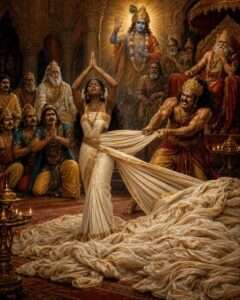
Picture generated through AI by Karthik Dinesh


Thank you