

There is a particular kind of frustration every serious investor eventually meets. The price-to-earnings ratio looks reasonable, the balance sheet is clean, the discounted cash flow model says the stock is undervalued, and the market still refuses to cooperate. Sentiment turns sour for no visible reason, volatility spikes without a headline to explain it, and the usual financial toolkit goes quiet exactly when clarity is needed most. It is at this point that many investors start looking past the spreadsheet, and for over a century a small but persistent body of research has been asking a genuinely strange question: does the sun itself, and the Earth’s response to it, leave a fingerprint on financial markets?
A century and a half of curiosity
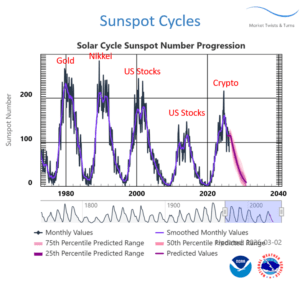
The idea is older than modern portfolio theory itself. In 1875, the economist William Stanley Jevons proposed that the roughly eleven-year sunspot cycle affected weather patterns, which affected agricultural harvests, which in turn affected prices and business activity. He traced the logic all the way back to the South Sea Bubble of 1720. A generation later, the Russian scientist Alexander Chizhevsky went further, cataloguing wars, revolutions, and mass social unrest across two thousand years of history and finding a striking concentration of upheaval around solar maximums. He paid a heavy personal price for the theory, spending years in a Soviet labour camp partly because his explanation for the 1917 Russian Revolution did not sit well with the official one.
This is not fringe curiosity confined to the nineteenth century. NASA’s own solar physicists now openly discuss how space weather forecasting may eventually sit alongside meteorological forecasting as a factor economies plan around, given how much modern infrastructure, from satellites to power grids to trading systems, is exposed to solar activity.
Where the evidence actually holds up
The most rigorous test of this idea did not come from a market newsletter. It came from the Federal Reserve Bank of Atlanta. In 2003, researchers Anna Krivelyova and Cesare Robotti published a working paper, later carried in the Review of Finance, examining geomagnetic storms, the disturbances in Earth’s magnetic field caused by solar activity, against stock returns across multiple countries. They found that unusually high geomagnetic activity in one week had a negative, statistically significant effect on returns the following week, with an annualised return gap of roughly fourteen percent between calm and stormy periods.
The explanation was not mystical. It rested on a well established idea in behavioural finance called misattribution of mood. Geomagnetic storms have a documented effect on human mood and sleep, and the theory holds that investors experiencing that low grade unease misread it as a signal about the economy rather than the weather in the atmosphere above them, and sell accordingly. Related literature on temperature, rainfall, and even cloud cover around exchange locations has found similar, smaller sentiment effects. None of this claims the sun is pulling levers on corporate earnings. It claims something more modest and, frankly, more useful for an investor: that the people setting prices are human, and humans are measurably affected by their physical environment in ways that show up in short-term trading behaviour.
Where the discipline has to kick in
Here is where an investor has to be honest rather than enchanted. When a wider dataset later retested the geomagnetic storm effect across a broader set of countries, the relationship did not hold up with the same clarity. That is not a minor footnote. A finding that fails to survive a larger sample is one of the clearest warning signs in empirical finance that the original result may have been partly a product of the specific years and markets examined, rather than a durable law of behaviour.
The direct sunspot cycle-to-stock-market link fares even worse under scrutiny. A long-run study covering the S&P 500 from 1871 to 2018, spanning roughly fourteen full solar cycles, found correlations between sunspot activity and returns close to zero. That study also tested a well-known public claim, made repeatedly by a market forecaster who cited the sunspot cycle as his key indicator, that markets would top out with the 2013 solar peak. The crash did not arrive. Fourteen cycles is also, honestly, too small a sample to distinguish a genuine eleven-year rhythm from ordinary statistical noise, a point serious researchers in this field readily concede.
The right way to hold this knowledge
None of this means an investor should ignore these forces. It means they belong in a specific place in the process, not as a standalone trading signal, but as one more lens for reading crowd psychology when the fundamentals are silent. If markets are unusually jumpy during a period of elevated geomagnetic activity, that is useful context for interpreting a sharp, headline free sell off as sentiment driven rather than fundamentally justified, and potentially an opportunity rather than a warning. It is a tool for explaining mood, not for forecasting direction.
The deeper lesson is really about intellectual humility. Financial ratios describe a company. They say very little about the emotional state of the millions of people pricing that company’s stock on any given Tuesday. Behavioural finance has spent decades proving that fear, mood, and even the weather move markets in the short run, sometimes more than the numbers do. Solar and geomagnetic research simply extends that same insight outward, from the trading floor to the atmosphere above it. An investor who stays curious about these forces, while remaining disciplined about their limits, is simply doing what good investing has always required: understanding that markets are not only spreadsheets, they are also people, and people are shaped by more than they usually admit.