I have listened to several Independence Day speeches from the ramparts of the Red Fort over the years. Some were ceremonial, some political, some predictable, and a few genuinely memorable. But, having heard Prime Minister Narendra Modi’s address this year, I came away with a distinct feeling: this was not merely a speech to mark 80 years of Independence. It was an attempt to tell a young and aspirational Bharat what the next 20 years could look like.
What struck me most was Modi’s effort to connect with the younger generation. Today’s youth are impatient, ambitious and unwilling to inherit the limitations of the past. They want opportunities, not sermons; technology, not bureaucracy; and a level playing field, not privileges reserved for those who can afford them.
That is why his announcement of free online coaching for competitive and professional examinations, targeting one crore students, caught my attention. I found this particularly significant because the coaching industry has quietly become one of the biggest burdens on middle-class and poor families.
For many parents, preparing a child for a competitive examination has become an expensive undertaking. Coaching centres have mushroomed across the country, charging substantial fees and creating an ecosystem in which the ability to spend can sometimes become as important as the ability to compete. Worse, examination irregularities and question-paper leaks have added another layer of anxiety to students who have already invested years of their lives preparing for these examinations.
I therefore see considerable merit in the idea of a free, high-quality national online coaching platform. Of course, announcing one crore beneficiaries is easier than actually delivering quality education to one crore youngsters. The government will need competent teachers, credible content, technology, regular assessments and, above all, a system that students can trust. But the intention is undoubtedly right. If executed properly, it could become one of the most socially significant interventions in the education sector.
I could not help wondering, though, why such issues could not receive the kind of serious parliamentary discussion they deserved during the recently concluded Monsoon Session. Parliament should have been the natural forum to debate examination reforms, paper leaks and the growing coaching culture. Instead, much of the session was lost to political confrontation and disruptions. Whatever one’s political affiliation, that cannot be good for a democracy.
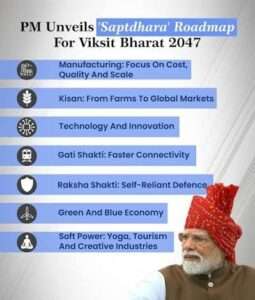
What I found equally interesting in Modi’s speech was that he did not confine himself to the immediate concerns of governance. He spoke about Viksit Bharat 2047, the ambition of making Bharat the world’s third-largest economy and the larger transformation he wants to see when the country completes 100 years of Independence.
His ‘Shakti Ki Sapt Dhara’—seven streams of strength covering manufacturing, agriculture, technology, Gati Shakti, the green and blue economies, defence capability and soft power—was, to my mind, an attempt to put an intellectual framework around that ambition.
I particularly liked the emphasis on self-reliance. The references to Made-in-India semiconductors, indigenous 6G, nuclear power, green hydrogen, drones, counter-drone systems and hypersonic technology were not merely technological announcements. They represented a larger message: Bharat cannot aspire to become a major global power while remaining dependent on others for critical technologies.
His reference to the proposed expansion of nuclear power capacity to 100 GW by 2047, alongside renewable energy, also showed that energy security is being viewed as an essential component of national power.
There was, of course, a political dimension to the speech. His appeal to all political parties to work towards Viksit Bharat, his push for implementation of the Nari Shakti Vandan Adhiniyam, and his emphasis on national security were unmistakable messages to the political class. But I thought the appeal to rise above partisan politics was worth noting. Nation-building cannot ultimately belong to one party or one Prime Minister.
I also noticed something else. Modi spoke repeatedly about confidence—confidence in our armed forces, our scientists, our entrepreneurs, our youth and, above all, in Bharat itself. His references to strategic autonomy and indigenous defence capabilities were clearly intended to convey that India should neither be bullied nor blackmailed by external powers.
And then came the Olympic dream—Bharat’s ambition to host the 2036 Olympics. For some, that may sound extravagant. For me, it represented the changing confidence of a country that once struggled to provide basic infrastructure but now talks about hosting the world’s biggest sporting spectacle.
Ultimately, speeches are judged by what follows them. Ambition is important, but delivery is everything. Announcements must become programmes, programmes must become outcomes and outcomes must touch ordinary lives.
Yet, listening to Modi this year, I felt he was speaking less about the Bharat of the past 80 years and more about the Bharat he wants to see at 100.
That is what stayed with me after the speech.
For once, I did not feel that I was merely listening to an Independence Day address. I felt I was being invited to imagine the next chapter.
And perhaps that is why, for me, this was not merely another Independence Day speech.
It was an inspiring speech.