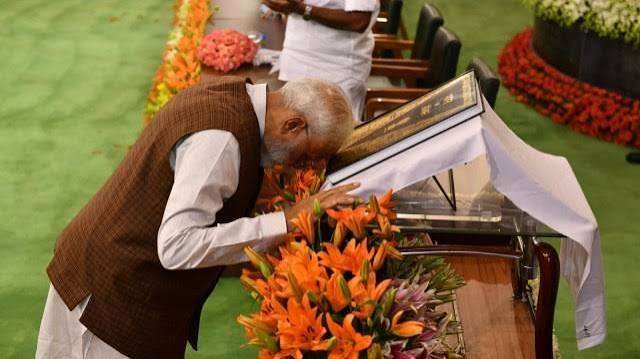
New Delhi: Prime Minister Narendra Modi said the Indian Constitution is integral to the lives of crores of citizens, including himself, and its extraordinary spirit has enabled even a child from a modest, unprivileged background to lead the world’s largest democracy.
Without naming the party, he accused the Congress of weakening the Constitution during its rule and credited his government in 2019 for “correcting a historical wrong” with the abrogation of Articles 370 and 35A, which, according to him, did not allow the full Constitution to be implemented in Jammu and Kashmir.
In a signed article that appeared in major newspapers on Thursday, Modi also said his government’s endeavour has been to deepen the Constitution’s connection with the collective consciousness of the people, especially the youth, and strengthen the spirit of unity essential to India’s bright future.
Modi said “our endeavour” has been to deepen the Constitution’s connect with the “collective consciousness” of the people, especially the youth, and strengthen the spirit of unity to ensure a bright future for the country.
The Prime Minister drew attention to the fact that his government decided over a decade ago that November 26 would be marked as Constitution Day.
He said the Constitution is an inseparable part of the lives of Indians. Modi pointed to the humble circumstances in which he grew up and the struggles that were a part of everyday life. The Prime Minister said his rise from modest means to the leader of the world’s largest democracy showed how extraordinary the Constitution was.
The Prime Minister highlighted a recent World Bank report that says nearly 50 crore Indians have been moved out of poverty.
The article referred to the following welfare schemes:
- The PM Awas Yojana, under which a pucca house is provided to each beneficiary. This has ensured the constitutional promise of dignity
- The Ujjwala Yojana, under which free LPG connections have been given to women from BPL families. This has freed mothers from the hardships of a smoke-filled kitchen and furthered the ideals of equality and well-being, Modi noted
- The Ayushman Bharat scheme, which enables a poor family to access quality healthcare without the fear of debt and ensures social justice
- The MUDRA and PM-SVANidhi schemes, which offer collateral-free credit to small entrepreneurs and street vendors. These schemes have delivered economic justice, Modi said
- Digital technology and platforms like UPI have transcended all divides and given to every citizen opportunities that were once available to a privileged few, thus ensuring inclusivity.
Modi also pointed to the amendments his government had introduced, such as the 101st Amendment that ushered in the GST, the 102nd Amendment that granted constitutional status to the National Commission for Backward Classes, the 103rd Amendment that provided reservation to Economically Weaker Sections.
Modi said an updated version of the Constitution is now available in all 22 languages under the Eighth Schedule, which has brought it closer to the people.
The Prime Minister said that through the Bharatiya Nyaya Sanhita, his government had tried to bring about a fundamental shift in the criminal justice system, moving from the colonial emphasis on punishment (dand) to a citizen-centric pursuit of justice (nyay).
The Prime Minister sounded a note of caution, pointing out that there have been occasions when those entrusted with upholding the Constitution had chosen to weaken it.
The article said 2026 marked 75 years of the First Amendment in 1951, when a government that was “not popularly elected used its majority in the Provisional Parliament to restrict fundamental freedoms”. The timing of the introduction of the First Amendment, only months before India’s first general election, proved that it was intended to influence the electoral process and stifle public opposition, the article added.
Modi said 2026 also marked 50 years of the implementation of the 42nd Amendment at the height of the Emergency. The amendment curtailed judicial review and fundamentally altered the balance of institutional powers, he said.
Modi also said Article 356, used to dismiss elected state governments, was troubling. He said “one party” had the “dubious record” of imposing Article 356 close to 100 times and that “one former Prime Minister” had done so 50 times.
The Prime Minister wrote about the problem of Naxalism that had blighted several parts of the country, particularly tribal areas. He highlighted how his government eliminated Naxalism this year, ensuring that the poorest of the poor can “finally exercise” their constitutional rights without fear.
Modi drew attention to how “Dimagi Naxals” were still active and were trying to derail the country’s growth trajectory.
Modi said the journey of the Constitution would be incomplete without recognising the remarkable women who helped shape it. He said it was shameful that a piece of legislation his government sought to bring to give women adequate representation in legislative bodies was disallowed from being passed “by the one Opposition party, once again showing its disdain for constitutional values”.
Modi sought to assure “the Nari Shakti of India” that his government would ensure that justice is done to them.