
Agam Rao
The recent debate on who ruined Indian cricket – cricketers, administrators or the judiciary – deserves a much wider perspective. It is to understand the historical evolution of Indian cricket, its financial transformation and how the enormous popularity and wealth generated by the game fundamentally changed cricket administration.
From Public Support to Financial Independence
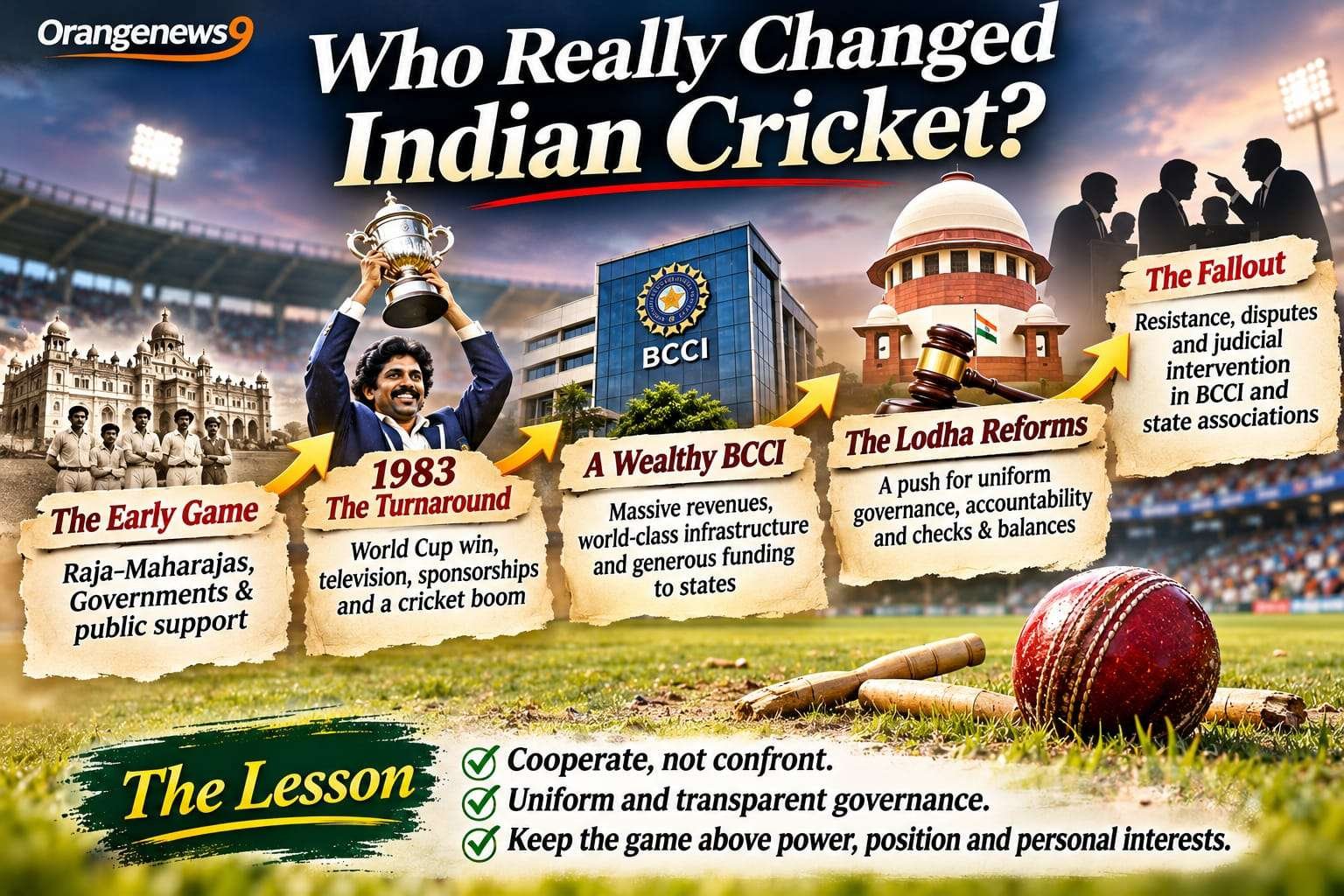
For several decades, Indian cricket depended substantially on the support of Raja-Maharajas, governments and public infrastructure. Cricket is an expensive sport, requiring large grounds, specialised facilities and considerable financial resources. Traditionally, matches extended over three to six days, making the game expensive to organise and commercially challenging.
The turning point came after India’s historic World Cup victory in 1983. Corporate sponsorships and private investments gradually transformed Indian cricket. The popularity of One-Day Internationals, coloured clothing, white balls, floodlights and day-night cricket made the game more attractive to television audiences and commercial sponsors.
Cricket became increasingly popular, more youngsters took up the game, and the BCCI started generating substantial revenues. It became financially stronger, invested in its own infrastructure across the country, and began funding state associations generously for cricket development. Eventually, the BCCI emerged as the world’s richest cricket board, with financial resources exceeding the sports budgets of many state governments.
When Wealth and Enormous popularity Changed Cricket Administration
Unfortunately, while cricket was transforming financially, its administrative structures were not evolving at the same pace. The BCCI and state associations largely functioned without uniform governance standards, proper control mechanisms or comprehensive bylaws. Each association followed its own rules, and some had inadequate administrative frameworks. The BCCI was managing its affiliated associations but was not effectively ensuring professional governance across the system.
Earlier, politicians, bureaucrats and influential personalities were welcomed into cricket administration because their connections and institutional support were considered necessary for developing the game.
Once cricket became enormously wealthy, the situation reversed. Cricket administration itself became attractive. Positions that were once occupied to support the game increasingly became coveted for the influence, prestige and opportunities they offered.
This fundamentally changed the dynamics of Indian cricket administration.
The Supreme Court and the Lodha Committee
Multiple disputes reached different courts, with some eventually reaching the Supreme Court. Recognising the importance of cricket as a sport involving enormous public interest, national pride and financial resources, the Supreme Court rightly felt that standardised governance principles were necessary.
The appointment of the Justice R. M. Lodha Committee was a well-intentioned initiative to introduce uniform governance standards, improve accountability, address conflicts of interest and establish appropriate checks and balances.
The objective was to ensure that cricket associations functioned professionally and in the larger interests of the game.
Also read: https://orangenews9.com/my-response-to-who-ruined-indian-cricket/
Where Things Actually Went Wrong
Unfortunately, the real problem began after the Lodha Committee was constituted.
Instead of cooperating with the Committee to develop a practical and uniform governance framework, the then-existing cricket establishment, including sections of the BCCI and state associations, strongly resisted the proposed reforms.
The existing administrators had an opportunity to explain practical difficulties, suggest workable alternatives and participate constructively in the reform process. Instead, the confrontation escalated, and the Committee’s experience of non-cooperation was brought before the Supreme Court.
Consequently, the Supreme Court adopted a more direct approach by appointing a Committee of Administrators to oversee the BCCI, assist in implementing the reforms and ensure their adoption by state associations.
In retrospect, this was a self-inflicted setback for Indian cricket administration. Had the BCCI and state associations cooperated constructively, more practical and reasonable recommendations could have emerged, potentially avoiding the extent of subsequent judicial intervention and supervision.
The cricket establishment failed to recognise that the absence of uniform governance and the serious conflicts of interest within the existing administrative structure were precisely the issues that needed to be addressed. Ultimately, the BCCI and state associations were required to adopt common governance rules based on the Lodha Committee recommendations.
Judicial Intervention: Cause or Consequence?
Can the judiciary be blamed for the present problems in cricket administration?
I believe that would oversimplify the issue. Courts do not ordinarily enter the administration of sporting bodies on their own. They intervene when disputes are brought before them and institutional failures require judicial consideration.
Individual judicial decisions, the extent of intervention and the duration of supervision can certainly be debated. However, blaming the judiciary for the entire situation ignores the circumstances that necessitated its intervention.
The more fundamental question is: Why did cricket administrators allow their institutions to reach a stage where judicial intervention became necessary?
Must read: https://orangenews9.com/who-ruined-indian-cricket-cricketers-or-judiciary/
The HCA Experience: Governance Reforms Must Strengthen Grassroots Cricket
At HCA, over the last ten years, three Apex Councils have been elected by the Association’s honourable members. Unfortunately, instead of concentrating on the state-wide development of cricket, bringing necessary amendments to the bylaws and ensuring adherence to a proper cricket calendar, these elected terms were often consumed by group politics and ego clashes. This contributed to recurring disputes and judicial intervention during each elected term. The HCA experience underlines the importance of elected representatives placing institutional responsibilities and the development of the game above individual and group interests.
The experience of the Hyderabad Cricket Association (HCA), the BCCI-recognised cricket association representing Telangana, is an important example of why governance reforms and institutional accountability matter. Over the years, district cricket, which had very limited representation and participation in HCA leagues, has expanded significantly. Today, hundreds of district cricketers participate in HCA league competitions across various age groups and divisions, alongside thousands participating in intra-district selection tournaments. This demonstrates that cricket administration must move beyond managing the interests of a few established centres and ensure wider opportunities, representation and development across the state.
At the same time, governance reforms should not become an instrument for prolonged administrative uncertainty or undermine the legitimate role of elected cricket representatives and district associations. Judicial intervention and independent supervision should help institutions resolve disputes, strengthen accountability and restore democratic functioning. The ultimate objective must be to ensure that governance structures serve cricket development, rather than cricket development becoming secondary to administrative and legal disputes.
Judicial Supervision and the Future of Cricket Administration
The appointment of retired judges to supervise or administer cricket associations should not automatically be viewed as an attempt to rehabilitate retired judicial officers. When institutions are embroiled in prolonged litigation, governance disputes and competing claims, an independent mechanism can provide the neutrality and credibility required to restore institutional functioning.
However, such supervision must have a clearly defined mandate, measurable objectives and an appropriate exit mechanism. Its ultimate purpose should be to restore accountable, transparent and democratically functioning cricket administration, not become a permanent substitute for it.
The fundamental issue is not whether cricketers, administrators or judges should govern cricket. It is whether our institutions are capable of putting the interests of the game above individual positions, power and vested interests. (The author is TG T20 Chairman)