


Your Orangenews9 article, “Who Ruined Indian Cricket?”, published in these columns on Monday, inviting all stakeholders of the game to speak their minds, has indeed received an encouraging response. As promised, we shall reproduce their responses unedited, except for minor grammatical corrections, if necessary, to provide stakeholders of the game an open platform to express their views, opinions and understanding of the issues confronting Indian cricket. — EDITOR

Prasanna Kumar
The need for institutional reforms, accountability and a strong grassroots cricket structure
Indian cricket today stands at an important crossroads. While the country has achieved extraordinary success on the international stage, the administration of cricket, particularly at the state and district levels, continues to face questions about transparency, accountability, leadership and institutional integrity.
The fundamental question is not whether cricketers or administrators are responsible for the present situation. It is whether our cricketing institutions are functioning in the best interests of the game and the thousands of aspiring young cricketers who look up to them.
The Lodha Committee Recommendations: A Missed Opportunity for Meaningful Reform
The Lodha Committee recommendations were originally intended to bring transparency, accountability, democratic functioning and administrative discipline into Indian cricket.
Unfortunately, several important safeguards were subsequently diluted during the implementation of these recommendations by the then senior BCCI administration. The dilution of tenure and cooling-off provisions, particularly the principle of a maximum nine-year tenure, raised legitimate questions about whether institutional reform was being compromised to protect existing administrative hierarchies and positions.
Reforms should never be designed to protect individuals or preserve established power structures. They must protect the institution.
The BCCI, being one of the most influential sporting organisations in the world, must demonstrate exemplary governance. Its leadership should be accountable, transparent and committed to strengthening cricket throughout the country.
Judicial intervention may be necessary when institutions fail to function properly. However, the ultimate objective must be to restore independent, democratic and professionally managed cricket administration rather than make judicial supervision a permanent feature of the system.
Andhra Cricket: The Strength of Indian Cricket Lies in Its Districts
The Andhra Cricket Association (ACA), established in 1953, has always recognised that the foundation of successful state cricket lies in its district associations.
From Srikakulam to Chittoor and from Chittoor to Kurnool, the 13 district cricket associations of Andhra Pradesh have played an invaluable role in identifying, nurturing and producing talented cricketers.
The district associations have developed their own infrastructure, grounds and facilities, creating an environment where young cricketers can develop their skills and compete at different levels.
Andhra’s cricketing strength is not built merely through the selection of established players. It is built through years of hard work at the district level, where natural talent is identified and nurtured.
Our districts have consistently contributed promising men’s and women’s cricketers to the state teams. This decentralised model of cricket development deserves recognition and further encouragement.
The real success of a state cricket association should be measured by how many talented youngsters it discovers, how many opportunities it provides and how effectively it develops the next generation of cricketers.
Must read: https://orangenews9.com/who-ruined-indian-cricket-cricketers-or-judiciary/
A Commendable Initiative by Andhra Cricket Association
The Andhra Cricket Association has now initiated an important exercise to identify promising young cricketers at the grassroots level.
The appointment of an Observers’ Committee to monitor individual players, assess their talent and potential, and submit observations to the Hon. Secretary and Director of Cricket Operations is a welcome initiative.
This mechanism can help the association identify natural talent beyond conventional selection processes and create a stronger bench of players for the future.
Such observations must be based on merit, consistency, temperament, fitness, technical ability, and future potential.
The objective must be to ensure that no deserving youngster is overlooked simply because he or she comes from a remote district or lacks access to influential people.
This initiative deserves encouragement and, more importantly, consistent implementation with complete transparency.
Can Cricketers Alone Become Good Administrators?
This is an important question that Indian cricket must honestly address.
Being an outstanding international or domestic cricketer does not automatically make someone a capable cricket administrator.
Playing the game and administering the game require different skills, experience, temperament and responsibilities.
Former international and senior cricketers undoubtedly possess invaluable knowledge of the game. Their experience should be utilised constructively to advise the Hon. Secretary, elected office-bearers and the Director of Cricket Operations.
Their inputs on coaching, player development, selection standards, infrastructure and cricketing strategies can be extremely valuable.
However, administration requires much more than cricketing knowledge. It demands organisational skills, financial accountability, institutional experience, leadership, diplomacy and the ability to work collectively.
Cricketers should be respected for their contribution to the game, but administrative positions must be based on competence, commitment and the ability to serve the institution.
The Emerging Danger: Personal Interests Replacing Cricketing Interests
One of the unfortunate developments in cricket administration is the emergence of individuals who use their association with senior cricketers or influential administrators to advance personal interests.
There may be instances where some senior cricketers, instead of providing impartial guidance, become influenced by vested interests, personal relationships and individual ambitions.
When this happens, they risk misleading district associations and state cricket administrators.
Such conduct damages the credibility of the institution and creates unnecessary divisions within cricketing bodies.
No individual, however accomplished as a cricketer, should be allowed to become bigger than the institution.
Senior cricketers must act as mentors, not power centres. They must provide unbiased advice, encourage deserving talent and protect the interests of the game without favouritism or prejudice.
This culture must change.
What Reforms Does Indian Cricket Need?
The future of Indian cricket requires a comprehensive governance framework at both BCCI and state association levels.
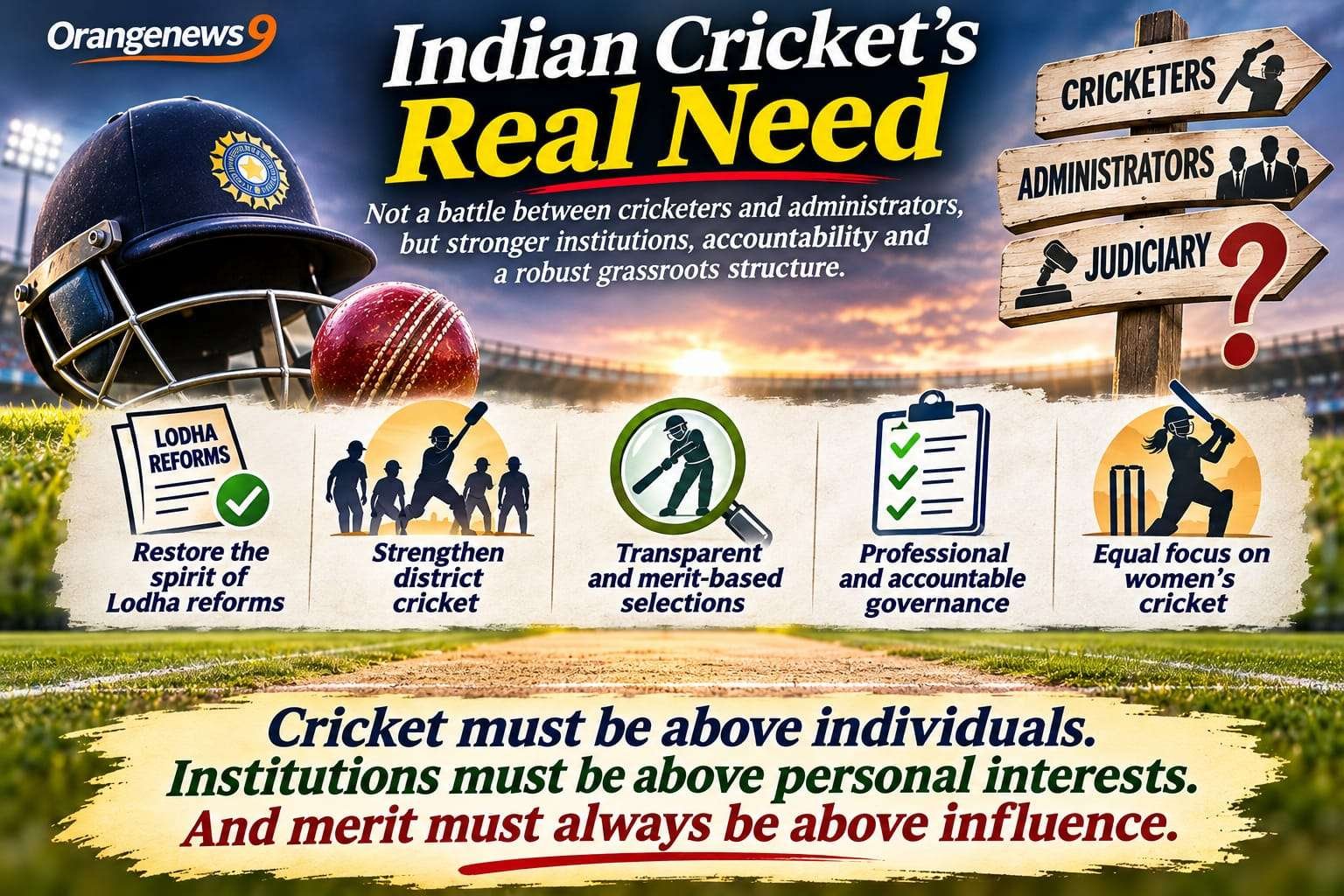
- Restore the Spirit of the Lodha Reforms
The original objectives of institutional accountability, reasonable tenure limits, cooling-off safeguards and democratic governance must be respected. Rules should not be diluted to accommodate individuals or existing power structures.
- Strengthen District Cricket Associations
District associations must receive adequate financial support, infrastructure assistance, coaching facilities and competitive opportunities. They are the foundation of state cricket and should never be treated as subordinate institutions without a meaningful voice.
- Transparent and Merit-Based Selections
Selection procedures must be clearly documented. Independent observers, qualified selectors and performance-based assessments should ensure that talent, rather than influence, determines opportunities.
- Separate Cricketing Advice from Administrative Authority
Former cricketers should have meaningful advisory roles. Their experience should strengthen cricketing decisions, while elected administrators and professionally qualified personnel should remain accountable for governance and operations.
- Professionalise Cricket Administration
State associations and BCCI should adopt professional standards in finance, infrastructure management, human resources, contracts, procurement and compliance. Independent audits and publicly accessible annual reports should become standard practice.
- Establish Independent Grievance Mechanisms
Players, district associations, coaches and officials must have a fair mechanism to report discrimination, selection irregularities, conflicts of interest and administrative misconduct without fear of retaliation.
- Give Equal Importance to Women’s Cricket
Women’s cricket must receive the same seriousness in infrastructure development, coaching, district competitions, scouting and long-term player development.
- Build a Sustainable Grassroots Talent Identification System
Every state association should establish a structured scouting network covering every district. Talent identification should begin at school and age-group levels, with continuous monitoring and development of promising players.
- Protect Institutional Independence
Neither political influence, personal relationships nor individual ambitions should interfere with the independent functioning of cricket associations. Elected bodies must be accountable to their members and the game.
- Make Leadership Answerable to the Next Generation
Every cricket association should periodically evaluate its contribution to grassroots cricket, player development, infrastructure and the overall progress of the game. Leadership should be judged by its achievements, not merely by the number of years it occupies office.
The Way Forward: Put Cricket Above Individuals
Indian cricket does not suffer from a shortage of talent. It does not suffer from a shortage of resources. What it needs is a stronger institutional culture built on integrity, transparency, accountability and collective responsibility.
The BCCI must lead by example, and state associations must follow governance practices that strengthen district cricket and create opportunities for deserving youngsters.
The Andhra Cricket Association’s renewed emphasis on district-level talent identification is a positive example of how a state association can look beyond immediate results and invest in its future.
Our responsibility is not merely to produce the next Ranji Trophy player or an international cricketer. It is to create an environment in which thousands of youngsters receive a fair opportunity to realise their potential.
Senior cricketers must guide, administrators must administer, selectors must select without prejudice, and district associations must be empowered to develop the game.
No cricketer, administrator or office-bearer is bigger than the institution. No personal ambition should be allowed to undermine the interests of Indian cricket.
The time has come to move away from personality-driven cricket administration towards institution-driven governance.
Ultimately, the real winners must be Indian cricket and the young cricketers who represent its future.
Cricket must be above individuals; institutions must be above personal interests, and merit must always be above influence. (The author is a former Andhra Ranji Trophy cricketer and is presently a member of the Association’s Observers Committee for the 2026–27 season.)


Congrats Pras …Your article has been forthright and thought provoking on Indian Cricket administration and you have expressed in no uncertains the various steps BCCI should take either to revamp or improve the structure of cricket at district levels which is neglected ..Let’s hope with the suggestions you have mentioned in your article ..BCCI must start on a war footing to carry out an effective administration in the years ahead and hopefully in the best interest of the game.
mr Prasanna your. article has opened. the hidden loopholes in not only in the cricket administration and hierarchy..the nucleus surrounds on district associations which Andhra revolved around..differing from hyderabad cricket association which never looked that there are districts after formation of telangana…mentioning other cricket associations like erstwhile Mumbai cricket association..Tamilnadu..cricket association…I was in vizag for 5 yrs and toured vnagaram Srikakulam..cuddapah…Tirupati.. Kakinada as commentator and. witnessed excellent conduct of ranji trophy matches…it was just flawless..and a word about mr venkat Rao.. former ACA secretary..who established good norms for the administration…and thereafter whomsoever heade the association not only maintained but developed…without a flaw..the beautiful stadium..madhuravada .vizag stands an example
finally congratulations Prasanna for ur excellent article drsangram former cricket commentator…