



Vaisampayana said to King Janamejaya: “After hearing the anguished appeal of the gods, who had long suffered under the relentless tyranny of the mighty demon Tārakāsura, the valiant Kumāraswāmy resolved to free the worlds from the burden of evil. Surrounded by his celestial hosts, the youthful commander of the divine armies marched forth with unwavering determination. Tārakāsura, fully prepared and accompanied by vast demonic legions, stood waiting upon the battlefield. The clash that followed between the celestial and demonic forces was beyond description, shaking heaven, earth, and the regions in between.”
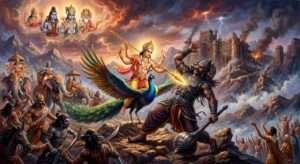
As the terrible conflict intensified, Tārakāsura confronted Kumāraswāmy face to face. The son of Śiva raised the divine Śakti, the invincible spear bestowed with immeasurable celestial power, and hurled it against the enemy. The brilliance of that sacred weapon multiplied into countless streams of irresistible energy, producing innumerable manifestations that swept through the ranks of the demons. Fiery orbs, born from its divine radiance, blazed across the battlefield, consuming the demonic armies with terrifying force. Inspired by the unconquerable courage of their commander, the hosts of the gods advanced with renewed enthusiasm, destroying the enemy on every side. Such was the glory of the sacred Śakti that, having completed its destined task, it unfailingly returned to the hand of its divine wielder.
Overwhelmed by the destruction of his armies, Tārakāsura charged in furious desperation against Kumāraswāmy. Once again the celestial commander released the divine Śakti. It pierced the mighty demon with irresistible precision, ending his reign of terror in a single instant before returning triumphantly to its master’s hand. The heavens resounded with cries of victory as Kumāraswāmy stood radiant upon the battlefield. The gods rejoiced with boundless delight, celebrating their deliverance from long years of oppression under the dreadful Tāraka.
Soon thereafter another formidable menace arose. Bāṇa, the mighty son of the great Bali, established his dominion upon Mount Krauñcha and spread fear throughout the three worlds. His unmatched strength and relentless cruelty made him another scourge of the celestial realms. Kumāraswāmy once more marched against the enemy. A fierce and terrible battle ensued, ending with the destruction of Bāṇa by the divine warrior. The celestial beings showered fragrant flowers from the heavens while divine music echoed across the skies, glorifying Kumāraswāmy as the protector of righteousness and the destroyer of demonic power. His victories restored peace and filled the three worlds with joy and security.
Vaiśampāyana continued, “O illustrious Janamejaya, whoever listens with devotion to these sacred exploits of Kumāraswāmy earns immeasurable merit. Having completed this narration, let me now recount the holy pilgrimage of Balarāma.”
Balarāma arrived at the sacred shrine dedicated to Kumāraswāmy. Reverently circumambulating the holy sanctuary, he listened to the venerable sages narrate the divine coronation of the celestial commander and his glorious victories over the demons. Filled with reverence, he proceeded to the renowned Agni Tīrtha.
In ancient times, Agni, the divine lord of fire, stood immersed within those sacred waters while receiving holy oblations. There the gods assembled before him. Because of Sage Bhṛgu’s curse, Agni had become destined to consume everything indiscriminately. Yet the gods comforted him, declaring, “Despite this curse, you shall forever remain the foremost recipient of sacrificial worship among all the deities.” Sanctified by their worship, the place came to be revered eternally as Agni Tīrtha. Balarāma bathed there with profound devotion before continuing his sacred journey.
Thereafter he visited Kubera Tīrtha, where Kubera had performed severe austerities and attained immense prosperity, inexhaustible wealth, and the sovereignty of riches through the fruits of his penance. After offering his worship, Balarāma proceeded to the holy Badarī Pācana Tīrtha.
At this sacred place, the virtuous daughter of Prabhāvatī undertook severe austerities with the sole desire of obtaining Indra as her husband. The lord of the gods, wishing to test the depth of her devotion, approached her disguised as the sage Vasiṣṭha. She welcomed him with profound reverence and declared that she would accept no husband other than Indra. Deeply moved by her unwavering resolve, the disguised deity handed her a few wild plums and instructed her to cook them until they ripened, while he withdrew to observe from a distance.
The devoted maiden bathed according to sacred custom, placed the fruits in a vessel of boiling water, and tended the fire with unwavering patience. Though all the firewood was exhausted, the fruits remained unchanged. Determined not to interrupt her sacred task, she placed her own leg into the fire as fuel rather than abandon the cooking. Witnessing such extraordinary devotion, Indra could no longer conceal himself. Appearing in his divine form, he declared, “O noble maiden, your steadfastness has delighted me beyond measure. Your wish is fulfilled. Abandon this mortal body and ascend to heaven as my eternal consort. This sacred place shall forever wash away the sins of all who visit it, and its glory shall endure throughout the three worlds.” Thus the devoted ascetic attained the celestial realm and became the beloved queen of Indra.
From there Balarāma journeyed to Indra Tīrtha, where the king of the gods had performed one hundred magnificent sacrifices and attained his exalted sovereignty over the celestial kingdom. He next reached Rāma Tīrtha, where the warrior-sage Paraśurāma, after destroying countless oppressive kings, sought atonement through the performance of the Rājasūya and Aśvamedha sacrifices before donating the entire earth to Sage Kaśyapa.
Continuing onward, Balarāma visited Yamunā Tīrtha, where Varuṇa had once conducted a great sacrifice. Upon its completion, a fierce war erupted between the gods and the demons. Following the victory of the gods, sacred oblations were offered there, making the place supremely holy. Thereafter he proceeded to Sūrya Tīrtha, where the Sun God had performed a great yajña, thereby surpassing all radiant celestial bodies in brilliance. This sacred region was also sanctified by the profound yogic austerities of Vyāsa, Śuka, Kṛṣṇa Dvaipāyana, Jaimini, Devala, Jaigiṣavya, and many other illustrious sages.
Balarāma then arrived at the sacred Sarasvata-Vasiṣṭha Tīrtha. Here the venerable Sage Dadhīci performed severe austerities that astonished even the gods. Indra, suspecting the increasing spiritual power of the sage, sent the celestial maiden Alambuṣā to test his self-control. For a brief moment the sage’s mind wavered, and his seed fell into the sacred waters of the Sarasvatī. The compassionate river preserved it, from which a beautiful child was born. Bringing the infant to Dadhīci, Sarasvatī said, “O revered sage, this is your son. I preserved your seed so that it should not be rendered fruitless.” Receiving the child with joy, Dadhīci blessed the holy river, proclaiming that offerings made with her sacred waters would forever delight the gods, the Pitṛs, the Viśvedevas, and the Gandharvas. Naming the child Sarasvata, he foretold that during a devastating twelve-year famine the boy would preserve the Vedas by teaching their sacred hymns to sixty thousand sages while sustaining them through the nourishment provided by Mother Sarasvatī.
In due course another devastating war arose between the gods and the demons. Though Indra employed every celestial weapon, victory remained beyond his reach. The gods then revealed that only a thunderbolt fashioned from the bones of Sage Dadhīci could destroy the enemy. Indra approached the sage with humility and explained the desperate plight of the celestial hosts. Dadhīci willingly surrendered his mortal body for the welfare of the universe, attaining the eternal spiritual realm. From his sacred bones Viśvakarma forged the mighty Vajra, with which Indra shattered the demonic armies and restored peace to the heavens.
Having bathed at that supremely sacred tīrtha, Balarāma travelled onward to Vṛddha Kanyāśrama. Long ago, a sage of the Garga lineage named Khani had begotten a daughter through the power of his austerities before ascending to the higher worlds. She remained in lifelong celibacy, absorbed in severe penance until old age overtook her. At that time the divine sage Nārada visited her hermitage and gently advised, “O noble lady, unmarried women do not attain the highest celestial worlds. Seek marriage by whatever righteous means may be possible.”
Obeying his counsel, the aged ascetic bestowed half the merit of her penance upon the virtuous son of Sage Gālava and accepted him as her husband, upon the condition that their marriage would endure for only a single night. By divine grace she was instantly transformed into a youthful maiden of extraordinary beauty, while the young sage too rejoiced in her celestial radiance. At dawn she reminded him that their solemn vow had been fulfilled and expressed her desire to ascend to the heavenly realms. Before departing, the grateful sage blessed the holy place, declaring that anyone who observed a day’s fast and bathed there would receive the spiritual merit equal to fifty years of celibacy and austerity. Thereafter the noble lady abandoned her mortal form and ascended to the celestial worlds.
Vaiśampāyana continued, “O jewel of the Kuru dynasty, while Balarāma was thus engaged in his sacred pilgrimage, he heard the sorrowful news that King Śalya had fallen upon the battlefield of Kurukṣetra. Filled with grief, he journeyed to Samantapañcaka and respectfully questioned the assembled sages regarding the supreme sanctity of Kurukṣetra.”
The sages replied, “This sacred land is the northern altar of Brahmā, where countless gods have performed magnificent sacrifices since ancient times. In former ages King Kuru himself ploughed this holy region with great devotion, and from that sacred act it came to be celebrated throughout the worlds as Kurukṣetra.”
Deeply moved by this revelation, Balarāma desired to learn the profound purpose that had inspired King Kuru to consecrate the land through his sacred ploughing. Perceiving his earnest curiosity, Vaiśampāyana prepared to unfold the glorious history and unparalleled sanctity of Kurukṣetra in the narrative that was to follow.

