



Vaishampayana continued his sacred narration to King Janamejaya, unfolding the immeasurable glory of the holy places sanctified by sages, gods, and divine events. Every sacred tirtha was not merely a place of pilgrimage but a living fountain of spiritual strength, where austerity, devotion, repentance, and divine grace transformed the destiny of both mortals and immortals.
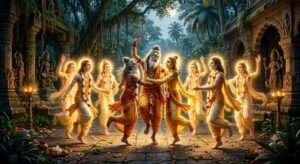
Once, the great sage Mankana was taking his ritual bath in the holy waters of the River Saraswati. At that moment, his eyes accidentally fell upon a celestial woman bathing in the river. Overpowered by a momentary human frailty, his seed fell upon the earth and divided into seven portions, from which seven noble beings were born, destined to become illustrious ancestors among the divine races. Filled with overwhelming joy at this miraculous event, the sage began to dance in ecstatic delight. Such was the spiritual potency of his penance that his joyous dance disturbed the balance of the universe, causing the worlds themselves to tremble.
The gods and great sages, unable to restore cosmic harmony, approached Lord Shiva and sought His refuge. Hearing their plea, the Supreme Lord visited the hermitage of Mankana. Looking compassionately upon the dancing sage, Shiva gently asked, “Is this the true fruit of penance? Restrain your delight.” To reveal the insignificance of worldly marvels before divine reality, the Lord pressed His sacred thumb, from which emerged holy Bhasma instead of ordinary matter. Realizing the immeasurable greatness of Mahadeva, Sage Mankana was overwhelmed with humility. Falling prostrate before the Lord, he declared, “While meditating, I have realized that You alone are the Supreme Lord, the eternal source and support of all creation. Every movement in the universe proceeds by Your command alone. You alone dispense the fruits of merit. Be gracious unto me and protect me forever.” Pleased by his sincere repentance and profound devotion, Lord Shiva blessed him that the merits of his penance would never perish. The moment Mankana ceased his dance, peace and harmony returned to the universe.
Balarama then visited that sacred pilgrimage where the power of Shiva’s grace had restored cosmic balance. In ancient times, the mighty demon Mahodara had been slain there by Lord Rama of the Raghu dynasty. Long afterward, the demon’s skull accidentally adhered to the foot of a sage, refusing to detach despite every effort. The elders advised him to visit the holy Ousana Tirtha, where Indra himself had performed severe penance and attained purification from his sins. The instant the sage entered that sanctified land, the skull fell away and vanished forever. Since then, the sacred place has been celebrated throughout the ages as Kapala Mochana, the Redeemer from the Sin of the Skull.
Proceeding further, Balarama reached the revered Prithudaka Tirtha, one of the holiest sanctuaries on earth. There, Vaishampayana recounted the inspiring transformation of the illustrious Vishwamitra. Born as the son of King Gadhi, Vishwamitra was a powerful monarch who once marched with his vast army to subdue the demons tormenting his subjects. During that expedition, his soldiers entered the hermitage of Sage Vasishta and behaved disrespectfully. In response, Vasishta merely invoked the divine powers of his sacred Kamadhenu, the celestial cow of sacrifice. Instantly, mighty warriors emerged from her divine energy and effortlessly drove away the royal army. Witnessing this astonishing miracle, Vishwamitra realized that the spiritual power born of penance far surpassed the might of kings and armies. Renouncing worldly sovereignty, he undertook severe austerities at Prithudaka. Though Indra repeatedly sought to obstruct his penance, Vishwamitra remained unwavering. At last, Lord Brahma appeared before him and conferred upon him the supreme title of Brahmarshi, crowning his long spiritual journey with immortal glory.
From there, Balarama arrived at the hermitage of Sage Baka. Once, King Dhritarashtra had insulted and rejected the noble sage. Deeply hurt, Baka performed an extraordinary sacrificial rite, offering flesh and clarified butter with the sole intention of bringing destruction upon the arrogant king. The immense spiritual force generated by his sacrifice spread terror throughout the kingdom. Alarmed by the growing calamity, the elders advised the king to seek the sage’s forgiveness. Filled with remorse, Dhritarashtra approached Baka, fell at his feet, and begged pardon with complete humility. Repenting sincerely for his offensive conduct, he presented the sage with vast herds of cows as an offering of reconciliation. The sage accepted his repentance, withdrew the destructive power of the sacrifice, and peace was restored throughout the kingdom.
Leaving Baka’s hermitage, Balarama reached the sacred Yayati Tirtha, where the illustrious King Yayati had once performed magnificent sacrifices. During those sacred ceremonies, the divine River Goddess Saraswati herself lovingly provided milk, clarified butter, delicious food, and every necessity for the Brahmins conducting the yajnas as well as for the countless pilgrims assembled there. She served every guest with boundless compassion and maternal affection. It is said that whoever visits this holy tirtha attains complete satisfaction, contentment, and spiritual fulfillment.
Thereafter, Balarama came to the renowned Vasishta Tirtha, forever associated with the legendary rivalry between the great sages Vasishta and Vishwamitra. Consumed by old enmity, Vishwamitra once resolved to destroy Vasishta. He summoned the River Goddess Saraswati and commanded her to bring Vasishta before him. The goddess trembled, for both sages possessed immeasurable spiritual power. She approached Vasishta with folded hands and explained Vishwamitra’s command. The compassionate sage calmly replied, “If you refuse, Vishwamitra will certainly curse you. Therefore, do not hesitate. Fulfil his command.”
Obeying his instruction, Saraswati gently eroded her own riverbank and carried the meditating Vasishta upon her flowing waters toward Vishwamitra’s hermitage. While Vishwamitra contemplated how to slay his ancient rival, the compassionate river suddenly released Vasishta into the swift current, carrying him safely away. Realizing that he had been outwitted, Vishwamitra became furious and cursed the sacred stream to flow with blood instead of pure water. Throughout this dreadful period, Vasishta continuously protected Saraswati by reciting the sacred Angirasa mantras. For an entire year, demons inhabited and drank from the blood-red stream. Eventually, compassionate sages visited the afflicted river, learned the cause of her suffering, bathed in her waters, and performed sacred rites. Their accumulated spiritual merit dissolved the terrible curse, restoring Saraswati’s waters to their original crystal-clear purity.
Nearby dwelt several cursed demons who humbly appealed to the assembled sages for deliverance. The sages prayed earnestly to the compassionate River Goddess. Knowing that the sacred Aruna River had likewise been cursed to flow red, Saraswati mercifully united its waters with her own and instructed the demons to bathe at the confluence. As soon as they obeyed, their dreadful forms disappeared, their sins were washed away, and they ascended to the higher celestial worlds. Even Indra came to this sanctified confluence and bathed in its holy waters, thereby freeing himself from the terrible sin of Brahmahatya incurred after slaying the mighty Namuchi.
From that supremely sacred region, Balarama journeyed to Soma Tirtha. There, the Moon God Chandra had performed the glorious Rajasuya sacrifice. It was at this very holy place that the assembled gods ceremonially anointed the divine Kumaraswamy as the Commander-in-Chief of the celestial armies. Endowed with irresistible valor and divine power, Kumaraswamy marched against the mighty demon Tarakasura and annihilated him along with his formidable hosts, restoring righteousness throughout the three worlds.
Vaishampayana concluded this portion of his sacred narration by addressing King Janamejaya, saying, “O jewel of the Kuru dynasty, thus have I narrated the sanctity of these immortal tirthas and the divine history culminating in the glorious manifestation of Lord Kumaraswamy, whose birth and heroic deeds became an everlasting source of protection for the gods and inspiration for all generations.” Balarama’s Sacred Pilgrimage Through the Eternal Tirthas and the Divine Birth of Kumaraswamy
Vaishampayana continued his sacred narration to King Janamejaya, unfolding the immeasurable glory of the holy places sanctified by sages, gods, and divine events. Every sacred tirtha was not merely a place of pilgrimage but a living fountain of spiritual strength, where austerity, devotion, repentance, and divine grace transformed the destiny of both mortals and immortals.
Once, the great sage Mankana was taking his ritual bath in the holy waters of the River Saraswati. At that moment, his eyes accidentally fell upon a celestial woman bathing in the river. Overpowered by a momentary human frailty, his seed fell upon the earth and divided into seven portions, from which seven noble beings were born, destined to become illustrious ancestors among the divine races. Filled with overwhelming joy at this miraculous event, the sage began to dance in ecstatic delight. Such was the spiritual potency of his penance that his joyous dance disturbed the balance of the universe, causing the worlds themselves to tremble.
The gods and great sages, unable to restore cosmic harmony, approached Lord Shiva and sought His refuge. Hearing their plea, the Supreme Lord visited the hermitage of Mankana. Looking compassionately upon the dancing sage, Shiva gently asked, “Is this the true fruit of penance? Restrain your delight.” To reveal the insignificance of worldly marvels before divine reality, the Lord pressed His sacred thumb, from which emerged holy Bhasma instead of ordinary matter. Realizing the immeasurable greatness of Mahadeva, Sage Mankana was overwhelmed with humility. Falling prostrate before the Lord, he declared, “While meditating, I have realized that You alone are the Supreme Lord, the eternal source and support of all creation. Every movement in the universe proceeds by Your command alone. You alone dispense the fruits of merit. Be gracious unto me and protect me forever.” Pleased by his sincere repentance and profound devotion, Lord Shiva blessed him that the merits of his penance would never perish. The moment Mankana ceased his dance, peace and harmony returned to the universe.
Balarama then visited that sacred pilgrimage where the power of Shiva’s grace had restored cosmic balance. In ancient times, the mighty demon Mahodara had been slain there by Lord Rama of the Raghu dynasty. Long afterward, the demon’s skull accidentally adhered to the foot of a sage, refusing to detach despite every effort. The elders advised him to visit the holy Ousana Tirtha, where Indra himself had performed severe penance and attained purification from his sins. The instant the sage entered that sanctified land, the skull fell away and vanished forever. Since then, the sacred place has been celebrated throughout the ages as Kapala Mochana, the Redeemer from the Sin of the Skull.
Proceeding further, Balarama reached the revered Prithudaka Tirtha, one of the holiest sanctuaries on earth. There, Vaishampayana recounted the inspiring transformation of the illustrious Vishwamitra. Born as the son of King Gadhi, Vishwamitra was a powerful monarch who once marched with his vast army to subdue the demons tormenting his subjects. During that expedition, his soldiers entered the hermitage of Sage Vasishta and behaved disrespectfully. In response, Vasishta merely invoked the divine powers of his sacred Kamadhenu, the celestial cow of sacrifice. Instantly, mighty warriors emerged from her divine energy and effortlessly drove away the royal army. Witnessing this astonishing miracle, Vishwamitra realized that the spiritual power born of penance far surpassed the might of kings and armies. Renouncing worldly sovereignty, he undertook severe austerities at Prithudaka. Though Indra repeatedly sought to obstruct his penance, Vishwamitra remained unwavering. At last, Lord Brahma appeared before him and conferred upon him the supreme title of Brahmarshi, crowning his long spiritual journey with immortal glory.
From there, Balarama arrived at the hermitage of Sage Baka. Once, King Dhritarashtra had insulted and rejected the noble sage. Deeply hurt, Baka performed an extraordinary sacrificial rite, offering flesh and clarified butter with the sole intention of bringing destruction upon the arrogant king. The immense spiritual force generated by his sacrifice spread terror throughout the kingdom. Alarmed by the growing calamity, the elders advised the king to seek the sage’s forgiveness. Filled with remorse, Dhritarashtra approached Baka, fell at his feet, and begged pardon with complete humility. Repenting sincerely for his offensive conduct, he presented the sage with vast herds of cows as an offering of reconciliation. The sage accepted his repentance, withdrew the destructive power of the sacrifice, and peace was restored throughout the kingdom.
Leaving Baka’s hermitage, Balarama reached the sacred Yayati Tirtha, where the illustrious King Yayati had once performed magnificent sacrifices. During those sacred ceremonies, the divine River Goddess Saraswati herself lovingly provided milk, clarified butter, delicious food, and every necessity for the Brahmins conducting the yajnas as well as for the countless pilgrims assembled there. She served every guest with boundless compassion and maternal affection. It is said that whoever visits this holy tirtha attains complete satisfaction, contentment, and spiritual fulfillment.
Thereafter, Balarama came to the renowned Vasishta Tirtha, forever associated with the legendary rivalry between the great sages Vasishta and Vishwamitra. Consumed by old enmity, Vishwamitra once resolved to destroy Vasishta. He summoned the River Goddess Saraswati and commanded her to bring Vasishta before him. The goddess trembled, for both sages possessed immeasurable spiritual power. She approached Vasishta with folded hands and explained Vishwamitra’s command. The compassionate sage calmly replied, “If you refuse, Vishwamitra will certainly curse you. Therefore, do not hesitate. Fulfil his command.”
Obeying his instruction, Saraswati gently eroded her own riverbank and carried the meditating Vasishta upon her flowing waters toward Vishwamitra’s hermitage. While Vishwamitra contemplated how to slay his ancient rival, the compassionate river suddenly released Vasishta into the swift current, carrying him safely away. Realizing that he had been outwitted, Vishwamitra became furious and cursed the sacred stream to flow with blood instead of pure water. Throughout this dreadful period, Vasishta continuously protected Saraswati by reciting the sacred Angirasa mantras. For an entire year, demons inhabited and drank from the blood-red stream. Eventually, compassionate sages visited the afflicted river, learned the cause of her suffering, bathed in her waters, and performed sacred rites. Their accumulated spiritual merit dissolved the terrible curse, restoring Saraswati’s waters to their original crystal-clear purity.
Nearby dwelt several cursed demons who humbly appealed to the assembled sages for deliverance. The sages prayed earnestly to the compassionate River Goddess. Knowing that the sacred Aruna River had likewise been cursed to flow red, Saraswati mercifully united its waters with her own and instructed the demons to bathe at the confluence. As soon as they obeyed, their dreadful forms disappeared, their sins were washed away, and they ascended to the higher celestial worlds. Even Indra came to this sanctified confluence and bathed in its holy waters, thereby freeing himself from the terrible sin of Brahmahatya incurred after slaying the mighty Namuchi.
From that supremely sacred region, Balarama journeyed to Soma Tirtha. There, the Moon God Chandra had performed the glorious Rajasuya sacrifice. It was at this very holy place that the assembled gods ceremonially anointed the divine Kumaraswamy as the Commander-in-Chief of the celestial armies. Endowed with irresistible valor and divine power, Kumaraswamy marched against the mighty demon Tarakasura and annihilated him along with his formidable hosts, restoring righteousness throughout the three worlds.
Vaishampayana concluded this portion of his sacred narration by addressing King Janamejaya, saying, “O jewel of the Kuru dynasty, thus have I narrated the sanctity of these immortal tirthas and the divine history culminating in the glorious manifestation of Lord Kumaraswamy, whose birth and heroic deeds became an everlasting source of protection for the gods and inspiration for all generations.”

