Lakshmanrao Upadhyayula
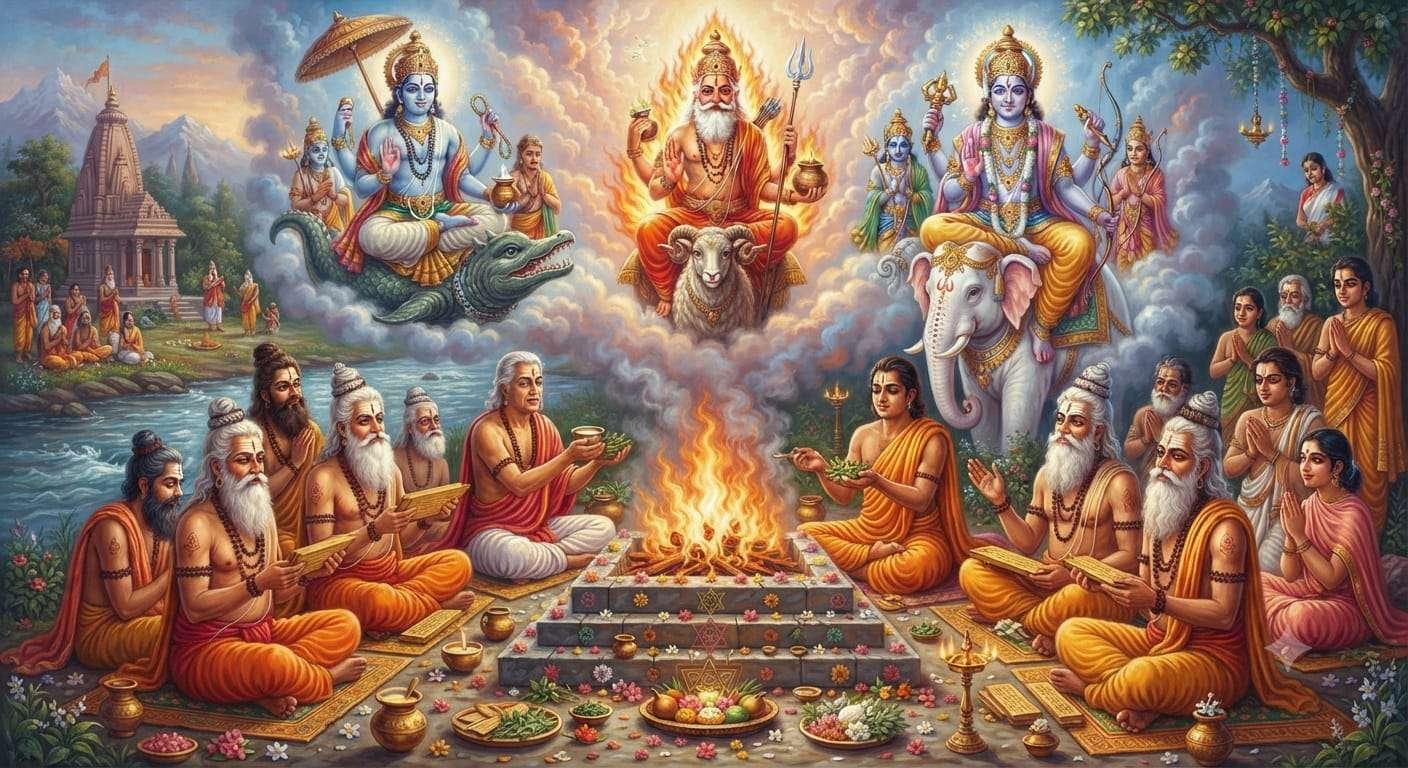
The Vāmadeva hymns composed in the majestic Triṣṭubh metre present Indra as the supreme guardian of cosmic harmony, whose greatness transcends all limits of human imagination. The sage approaches him with reverence, offering sacred hymns, oblations, Soma, and heartfelt prayers. These offerings are not merely ritual acts but profound expressions of gratitude, devotion, and the recognition that the forces governing nature respond to righteousness, discipline, and spiritual aspiration. Indra graciously accepts these offerings because they arise from purity of intention and unwavering faith.
Indra is celebrated as the inexhaustible reservoir of wealth, strength, and divine energy. Bearing the radiant Vajra, the celestial thunderbolt, he embodies irresistible power guided by truth and justice. His strength is never destructive for its own sake; it is exercised solely to uphold Dharma and protect creation. Whenever sacred rituals are performed with sincerity, Indra is invoked to descend into the sanctified altar, blessing the sacrifice with divine presence and ensuring that the aspirations of the worshippers bear fruitful results.
The Vajra held in Indra’s hands possesses profound symbolic significance. In Vedic understanding it represents concentrated energy, divine intelligence, and the irresistible force that removes obstacles to life. Its fourfold nature signifies its operation across the physical, atmospheric, psychological, and spiritual realms. Scientifically, the symbolism remarkably resembles the natural phenomenon of atmospheric electricity, where lightning releases immense energy, triggers rainfall, restores ecological balance, and renews the fertility of the earth. The Vedic seers transformed their observations of nature into timeless spiritual metaphors without separating science from sacred wisdom.
Indra’s leadership is described as incomparable because he governs through alertness, responsiveness, and unwavering commitment to cosmic order. Every movement of nature occurs under his vigilant supervision. He is praised as the Lord of sacred rituals because sacrifice, in the Vedic sense, is the harmonious cooperation between humanity and the universe. Through this sacred partnership, natural forces remain balanced and life flourishes.
The hymns beautifully recount Indra’s association with the sacred river Puruṣṇī. When the river’s flow was concealed or obstructed, Indra restored its free movement with wisdom and compassion. Rather than depicting mere physical intervention, the narrative illustrates the release of life’s sustaining energies from every form of bondage. Rivers symbolize knowledge, prosperity, vitality, and spiritual consciousness. Their unhindered flow represents the uninterrupted circulation of both natural resources and divine grace across the world.
Indra shines with unmatched radiance and generosity. From the moment of his divine birth, he is endowed with immeasurable strength, inexhaustible nourishment, and boundless vitality. Holding the Vajra firmly with both hands, he causes heaven and earth to tremble, signifying not violence but the awakening of dormant energies within the universe. Even the mighty mountains, vast oceans, the expansive heavens, and the earth itself acknowledge the supremacy of his power. This poetic imagery conveys that every force of nature ultimately operates under the universal law upheld by divine intelligence.
The Vedic sages further portray Indra as the cosmic sustainer who upholds heaven and earth while guiding the moving sun along its ordained path. The winds, inspired by his divine energy, resound like the voices of living beings, carrying life-giving breath across creation. Such descriptions reveal the remarkable observational insight of the seers, who recognized the interconnectedness of solar energy, atmospheric movement, rainfall, and the continuity of life. Their spiritual vision anticipated an ecological understanding in which every element functions in mutual dependence.
The hymns praise Indra’s maturity, omnipotence, and limitless capability. Every phase of the sacred ritual acknowledges his presence because he alone possesses the strength to sustain all the worlds. The confronting Vajra symbolizes decisive action against ignorance, injustice, and destructive tendencies. When Indra slays the mighty serpent Ahi or Vṛtra, the event signifies the triumph of order over chaos. Vṛtra represents every force that obstructs growth, whether it is drought in nature, fear within the mind, or ignorance in spiritual life.
Indra’s actions are repeatedly described as truthful and decisive. His blessings enable cows to yield abundant milk, symbolizing prosperity, nourishment, and sustainable abundance. Under his vigilant care, rivers flow swiftly and continuously, sustaining agriculture, civilization, and ecological balance. From a scientific perspective, this reflects an intuitive appreciation of the hydrological cycle, where rainfall, rivers, fertile lands, and food production exist within a unified system governed by natural laws.
The celebrated episode of Indra liberating the imprisoned rivers from Vṛtra represents one of the most profound ecological metaphors in the Ṛgveda. Waters confined for long periods are released through divine intervention, restoring fertility and life to the earth. The liberated rivers themselves praise Indra, acknowledging the restoration of their sacred mission. This poetic vision mirrors humanity’s dependence upon the uninterrupted circulation of water, a truth that remains central to environmental science even today.
The extraction of the joyful Soma signifies the awakening of purified consciousness rather than merely the preparation of a ritual offering. Soma symbolizes inspiration, bliss, vitality, and higher awareness. Just as disciplined horses are guided by reins toward their destination, the radiant hymns composed by enlightened minds must also be directed with devotion toward the Divine. The Vedic sages thus emphasize that disciplined thought, purified speech, and focused intention are essential for spiritual realization.
The sage finally invokes Indra as the embodiment of patience, endurance, and unconquerable strength. He prays that this noble strength may also become the inheritance of humanity, enabling righteous people to overcome adversity while restraining violence and injustice. The prayer seeks not the destruction of humanity but the disarming of destructive tendencies so that peace, justice, and harmony may prevail. Such ideals reveal the deeply ethical foundation of Vedic civilization.
The concluding invocation requests Indra to hear the sacred hymns, bestow abundant nourishment, enrich the intellect with divine inspiration, and grant flourishing herds of cattle that symbolize prosperity and social well-being. The prayer for inspired intellect reflects one of the highest aspirations of Vedic thought, where wisdom is regarded as humanity’s greatest wealth. The Vāmadeva hymns thus unite profound spirituality with careful observation of natural phenomena, portraying Indra as the cosmic governor whose power sustains the universe through truth, harmony, ecological balance, and enlightened consciousness. Through these timeless verses, the Ṛgveda presents a vision in which devotion, scientific temperament, ethical responsibility, and reverence for nature are woven into a single, magnificent tapestry of eternal wisdom.