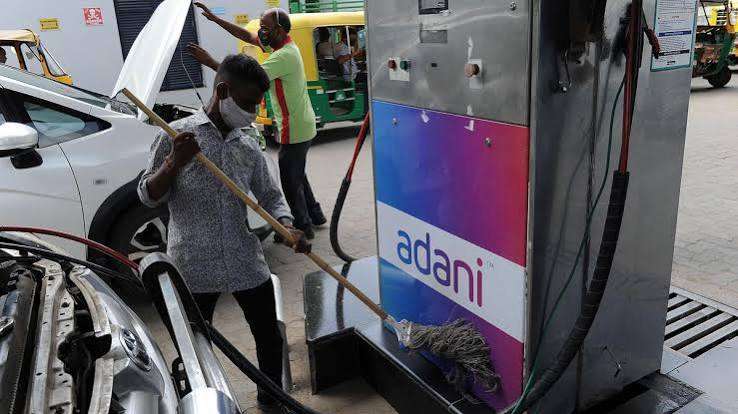
New Delhi: Adani Total Gas Ltd, a city gas distributor supplying CNG and piped natural gas across cities in states, including Gujarat and Uttar Pradesh, has raised Compressed Natural Gas (CNG) prices by Rs 4.45 per kg, citing higher procurement costs driven by surging international Liquefied Natural Gas (LNG) prices, reduced domestic gas availability and upstream supply curtailments.
CNG at ATGL outlets in Ahmedabad now costs Rs 98.47 per kg, while it is priced at Rs 102.60 per kg in Faridabad, Haryana and Rs 100 per kg in Jalandhar, according to information on the company website.
The revision comes as global spot LNG prices have risen to around USD 30 per million British Thermal Units (MMBtu), from USD 10-12 in February 2026, increasing the cost of imported gas, the company said in a media statement.
In Ahmedabad, CNG will now retail at ₹94.02 per kg, inclusive of all taxes, marking one of the steepest revisions in recent months. The increase is expected to raise fuel costs for thousands of private vehicle owners, auto-rickshaw operators and commercial transport fleets that have increasingly shifted to CNG. The hike has also widened the price gap with state-run Gujarat Energy Ltd (GEL), which retails CNG at ₹85.01 per kg in its operating areas.
Several Gujarat-based ATGL dealers, speaking on condition of anonymity, said ATGL has raised CNG prices for the fifth time since April 2026 when the prices stood at ₹81.36 per kilogram. After today’s hike there wouldnearly be a ₹9 per kg price differential between ATGL and GEL prices and it could adversely affect demand, particularly in rural markets where consumers can switch suppliers. “This way we will end up losing customers, especially in rural areas of the state where GEL is selling CNG at ₹85.01 per kilogram,” one dealer said.
Company cites higher gas sourcing costs
Defending the revision, an ATGL spokesperson said the company had been compelled to pass on part of the increase in input costs.”The revision in CNG prices has been necessitated by a significant increase in natural gas sourcing costs arising from reduced availability of domestic gas, supply curtailments, and elevated global gas prices due to geopolitical issues. Despite these challenges, ATGL continues to make every effort to minimise the impact on consumers while ensuring uninterrupted supply of CNG, which remains an economical and environmentally friendly fuel option,” the spokesperson stated.
According to the company, global LNG markets have witnessed exceptional volatility over the past six months. LNG prices, which were in the $10-13 per MMBTU range in February, surged after the outbreak of conflict in the Middle East disrupted LNG shipments through the Strait of Hormuz—a critical export route for Qatar and the UAE, which together accounted for nearly 59% of India’s LNG imports in 2025. Benchmark spot prices, including the Japan-Korea Marker (JKM) and the West India Marker (WIM), climbed to around $25 per MMBTU in early March before easing during April and June. However, prices remained well above pre-conflict levels and rose again to $19-22 per MMBTU in July amid renewed regional tensions and continued disruption to Hormuz transit.
Domestic gas shortages add to pricing pressure
The rise in imported LNG prices has coincided with lower availability of domestically produced natural gas, forcing city gas distribution companies to procure imported fuel at a higher cost. While the government allocates domestic gas to city gas distributors for priority segments such as CNG and piped natural gas (PNG), any reduction in these allocations raises procurement costs and puts pressure on retail pricing.
CNG demand remains resilient despite price hike
Despite the increase, demand for CNG has remained robust. During the June quarter, ATGL reported an 18% year-on-year increase in CNG sales volume to 218 million standard cubic metres (MMSCM), while overall gas sales volumes rose 13% to 303 MMSCM, driven by network expansion and higher throughput across multiple geographical areas. The company currently operates across 53 geographical areas spanning 125 districts in 18 states and three Union Territories, with a combined network of 1,167 CNG stations, including joint ventures. Six new CNG stations were added during the June quarter.