



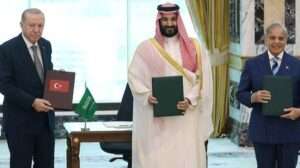
The Makkah Joint Defence Agreement signed by Saudi Arabia, Pakistan and Türkiye on August 7, declaring that an armed attack against any one of the three would be treated as an attack against all, was projected as a powerful demonstration of Islamic solidarity.
Yet, the unfolding security crisis in West Asia raises an uncomfortable question: how much substance lies behind such grand declarations when the real test of collective defence arrives? Saudi Arabia’s appeal to Western and regional allies for air-defence assistance against Houthi missile and drone attacks exposes the limitations of military posturing.
Reports indicate that Riyadh has sought assistance from Britain, France, Pakistan and Egypt amid concerns over dwindling interceptor stocks. The problem is not necessarily a shortage of soldiers or aircraft, but the availability of advanced interceptors, intelligence, surveillance and the technology required to track mobile launch platforms.
There is nothing inherently wrong in Saudi Arabia seeking assistance from its Western partners. National security demands pragmatism, not ideological purity. The kingdom has invested heavily in sophisticated defence systems, many of which depend on foreign suppliers, spare parts, technical support and intelligence-sharing. However, the contrast between proclamations of Islamic unity and dependence on Western military capabilities is impossible to ignore.
What, then, becomes of the oft-repeated boast that 57 Muslim-majority countries, represented by the Organisation of Islamic Cooperation (OIC), constitute a formidable collective force? The OIC is not a unified military alliance with an integrated command, common defence policy or automatic obligation to fight every member’s battles. National interests, rivalries and conflicting strategic priorities frequently override religious solidarity.
Numbers, oil wealth and rhetoric do not automatically translate into battlefield effectiveness. The more intriguing question concerns Pakistan, the nuclear-armed partner in the Makkah pact. For decades, its establishment has cultivated the image of nuclear capability as a strategic equaliser, occasionally accompanied by threatening rhetoric directed at Bharat, a country vastly larger in economic strength, technological capacity and conventional military resources.
Nuclear weapons are instruments of deterrence, not magic wands that guarantee victory in conventional conflicts or provide immunity from international pressure. Nor does possession of a nuclear arsenal automatically make a country a dependable security provider. If Pakistan is expected to help protect Saudi Arabia, the practical questions are straightforward: What capabilities can it deploy, how quickly can it deploy them, and can it sustain operations without outside assistance?
The uncomfortable reality is that Pakistan’s nuclear programme has never existed in a geopolitical vacuum. Its strategic relationship with China, its long history of military engagement with the United States, and the international controversies surrounding nuclear proliferation have all shaped its security posture. It would be inaccurate to claim that Pakistan’s nuclear weapons literally belong to America; they remain under Pakistani control.
Yet Washington’s historical relationship with Pakistan, including periods of military assistance and strategic accommodation, raises legitimate questions about the international calculations that helped shape Islamabad’s military establishment. Pakistan’s nuclear bluff, therefore, should be exposed through evidence, not exaggeration. Its arsenal may deter certain forms of aggression, but it cannot compensate for economic fragility, technological dependence or the limitations of conventional military power.
Against Bharat, nuclear threats are especially reckless because they invite escalation without offering a credible path to victory. Meanwhile, Iran’s reported offer to mediate between Riyadh and the Houthis presents another irony. Tehran has long been accused of supporting and arming the Yemeni movement, although the extent of its control over Houthi decisions remains contested.
A potential mediator with influence over an armed group may be useful diplomatically, but that influence also raises questions about responsibility for the conflict. Ultimately, the Makkah pact will be judged not by its religious symbolism or carefully worded declarations, but by what its signatories actually deliver. Saudi Arabia needs reliable defences, Pakistan must demonstrate credible capabilities, and Türkiye must translate its defence-industrial strength into practical cooperation.
For Bharat, the lesson is equally clear: never mistake nuclear rhetoric for national strength, or religious solidarity for an invincible military coalition. In modern warfare, technology, intelligence, industrial capacity and economic resilience matter far more than boasts. Nuclear weapons can create fear; they cannot manufacture credibility.

