Lakshmanrao Upadhyayula
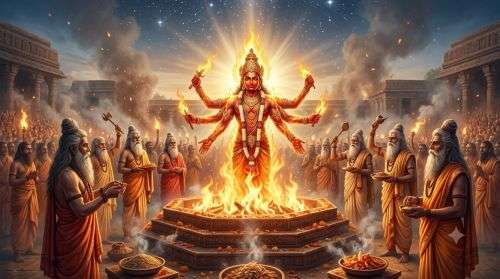
The sage Vāmadeva, inspired by divine wisdom, raises this profound Tristubh hymn to Vaiśvānara Agni, the Universal Fire celebrated in the Ṛgveda. The hymn begins with the humble declaration of devoted patrons who approach the Divine without pride or distinction, united in reverence and gratitude. Their hearts rejoice equally in the all-embracing presence of the sacred Fire, and they prepare to offer pure oblations to the radiant Bestower of cherished blessings. Vaiśvānara is not merely the visible sacrificial flame but the eternal principle of illumination that unites the physical, intellectual, and spiritual realms. Every offering placed into the sacred fire symbolizes the surrender of selfishness, transforming human aspiration into divine communion.
Vaiśvānara is compared to the central pillar that supports the roof of a great dwelling. Just as the unseen strength of a pillar sustains an entire structure, the Universal Fire upholds heaven, earth, and all the regions between them. This striking imagery reflects a profound Vedic understanding that the cosmos is sustained by an invisible principle of harmony. Modern scientific thought similarly recognizes that hidden forces maintain the balance of galaxies, stars, and atoms. The Vedic seers perceived this universal order as Agni, the cosmic energy permeating every form of existence while remaining eternally radiant and indivisible.
The priests who preserve sacred knowledge, the thoughtful patrons who sustain righteous works, and all sincere worshippers receive prosperity through the grace of Agni. He is immortal, wise, and endowed with unfailing intelligence. No one should speak ill of this divine Presence, for He is noble in conduct and majestic in authority. His brilliance shines equally in exalted and humble places, revealing that divinity is not confined to temples or rituals but fills every corner of creation. The omnipresent Fire illuminates both the external universe and the inner consciousness of humanity.
Vaiśvānara possesses immeasurable splendour and inexhaustible abundance. His mysteries are compared to the subtle imprint of a cow’s hoof upon the earth, simple in appearance yet containing profound meaning for those who seek with wisdom. Learned scholars are called not merely to recite the hymn but to understand its deeper significance and communicate its hidden truths. True scholarship in the Vedic tradition is measured not by memorization alone but by realization, contemplation, and the ability to guide others toward spiritual awakening.
The hymn declares that Agni consumes those who disrespect the steadfast righteousness upheld by Mitra and Varuṇa. Even intellectual accomplishment cannot protect one who abandons truth and reverence. Those who oppose sacred duties, reject honesty, and delight in falsehood descend into suffering through the natural consequences of their actions. The Vedic vision presents divine justice not as arbitrary punishment but as the inevitable operation of cosmic law, where every deed produces its corresponding result.
The worshippers affirm their unwavering commitment to Agni’s sacred ordinances. They declare that they will never abandon the path of sacrifice, gratitude, and discipline. Just as a strong person willingly carries a greater burden, they pray that Agni may grant them increasing wealth, not for selfish indulgence but for righteous living, generous giving, and the welfare of society. Prosperity, in the Vedic understanding, becomes meaningful only when it supports virtue, knowledge, compassion, and collective well-being.
The riches sought are described with remarkable precision. They should protect against hostile forces, nourish both body and spirit, remain secure from theft or corruption, be ever available for righteous purposes, and manifest in the sevenfold forms of prosperity celebrated throughout Vedic literature. These include material abundance, physical vitality, intellectual wisdom, moral strength, spiritual insight, harmonious relationships, and enduring peace. Such wealth uplifts individuals while strengthening families, communities, and future generations.
This sacred hymn radiates equal blessings toward all beings without partiality. Like waves spreading across a tranquil lake, its vibrations travel toward Vaiśvānara, ascending from the eastern horizon where the first light awakens creation. The movement from earth toward the luminous heavens symbolizes the ascent of human consciousness from ignorance to enlightenment. The Vedic sages recognized sound as a creative force capable of refining the mind, harmonizing the environment, and establishing communion with the universal intelligence.
The nourishing cows that yield life-sustaining milk symbolize divine knowledge flowing continuously into receptive hearts. The milk preserved within hidden caves represents wisdom safeguarded in the depths of consciousness until sincere seekers become prepared to receive it. Vaiśvānara protects these treasures, revealing them gradually to disciplined minds. The image beautifully illustrates that spiritual realization cannot be seized by force but unfolds naturally through purity, patience, and devotion.
Vaiśvānara traverses the vast expanses of the earth, seeking the finest dwelling place. A more profound expression of this truth is that He establishes His radiant presence within the purified heart, which becomes the supreme sanctuary. The most excellent abode of the Divine is not constructed by human hands but formed through truthfulness, compassion, self-control, and unwavering faith. The cosmic Fire finds its perfect residence where wisdom and righteousness flourish together.
The sacred cow serving the sacrificial rite symbolizes inexhaustible divine generosity. Her milk nourishes every sacred offering, while her hidden radiance reflects the eternal light preserved within creation. Vaiśvānara, identified with the soul of the Sun, manifests as both visible brilliance and invisible consciousness. The same luminous principle that shines in the heavens also awakens discernment within every sincere seeker, revealing the unity between the macrocosm and the microcosm.
Earth and Heaven are honoured as the universal Mother and Father embracing all existence. Between these two eternal principles spreads the boundless splendour of Vaiśvānara, linking the material and the spiritual worlds in perfect harmony. This vision reflects the Vedic understanding of an interconnected universe where every element participates in one sacred order. Scientific observation likewise reveals that life depends upon intricate relationships between celestial bodies, natural forces, and biological systems, echoing the ancient perception of cosmic unity.
The hymn lovingly invites Vaiśvānara to receive the pure milk of the nurturing cow, symbolizing the sincere devotion offered by humanity. This offering represents hearts purified by truth and actions sanctified by righteousness. The patrons testify with reverence that their words are truthful, their salutations genuine, and their intentions free from deceit. They pray that through this sacred hymn they may receive noble prosperity, while recognizing Agni alone as the sovereign Lord of all wealth throughout heaven and earth.
Acknowledging that the Divine alone knows where true riches reside, the worshippers seek guidance toward the highest treasure. They ask Agni to reveal the right paths, the hidden methods of wisdom, the eastern source of spiritual awakening, the essential nature of existence, and the harmony that binds all beautiful forms together. Like a swift horse advancing courageously into battle, they aspire to overcome ignorance, fear, and limitation through steadfast faith and enlightened understanding.
The immortal Dawn continually spreads her gentle radiance across every direction, renewing hope with each new day. Her unfailing light symbolizes the perpetual opportunity for inner awakening granted to every soul. Those who neglect sacred responsibilities and refuse the discipline of truth inevitably encounter hardship, while sincere devotion opens the way to lasting fulfilment. Even those burdened by want are invited to approach Agni with humility, for divine grace transforms despair into renewed purpose.
Vaiśvānara is celebrated as the prosperous Lord who fulfils worthy aspirations, grants secure dwellings, and illuminates every sacrificial hall with His resplendent light. His beauty shines through the brilliance that surrounds Him, protecting His devoted patrons and inspiring every sacred gathering. Like a mighty king advancing with a well-ordered fourfold army, Agni moves forward strengthened by the united hymns of enlightened priests and faithful worshippers. Through their harmonious voices, the eternal flame of wisdom continues to guide humanity toward truth, prosperity, scientific curiosity, moral excellence, and everlasting spiritual illumination.