



Political battles must be fought through constitutional institutions, not by turning the streets into an alternative Parliament. The debate over the Opposition’s strategy has entered a serious new phase. Statements attributed to Supreme Court advocate Prashant Bhushan and Congress leader Rahul Gandhi have brought the question of regime change, revolutionary politics and the limits of street mobilisation into sharp focus. According to media reports published on October 12, Bhushan was heard in a recorded online discussion referring to revolution as the only way to regain power and warning of possible bloodshed. The authenticity of the recording and its complete context have not been independently established in the reports available. These qualifications notwithstanding, the reported words raise questions that deserve serious public scrutiny. The controversy acquired another dimension when Rahul Gandhi, addressing the ongoing protests on October 12, reportedly said that the objective was to remove Chief Election Commissioner Gyanesh Kumar and then Prime Minister Narendra Modi. Seeking the Prime Minister’s removal through elections is a legitimate democratic objective. But when such political declarations are discussed alongside rhetoric about revolution and bloodshed, the distinction between constitutional change and extra-constitutional confrontation must be made unmistakably clear. The Congress and its INDIA bloc allies have repeatedly criticised the government and mobilised protests over alleged electoral irregularities. They are entitled to challenge the government, question the Election Commission and demand accountability. However, allegations of electoral malpractice must be established through evidence and pursued through legally available remedies. Political disagreement cannot, by itself, establish that constitutional institutions have been subverted. Nor should the public take lightly any political rhetoric that appears to glorify bloodshed as an instrument of change. Bharat has a constitutional framework for changing governments, replacing political leadership and holding public officials accountable. It does not require a revolution to remove an unpopular government; it requires the electorate to deliver its verdict. Recent upheavals in Bangladesh, Nepal and Sri Lanka have demonstrated how quickly political unrest can escalate and destabilise institutions. These countries have different histories and circumstances, and their experiences cannot simply be transplanted onto Bharat. Bharat, however, has strong armed forces and extensive paramilitary forces capable of safeguarding national security against serious threats. The developments in these neighbouring countries should serve as a warning to Prashant Bhushan, Prof Yogendra Yadav and Rahul Gandhi against treating mass mobilisation as an end in itself, without considering the potential consequences for public order, institutional stability and national security.
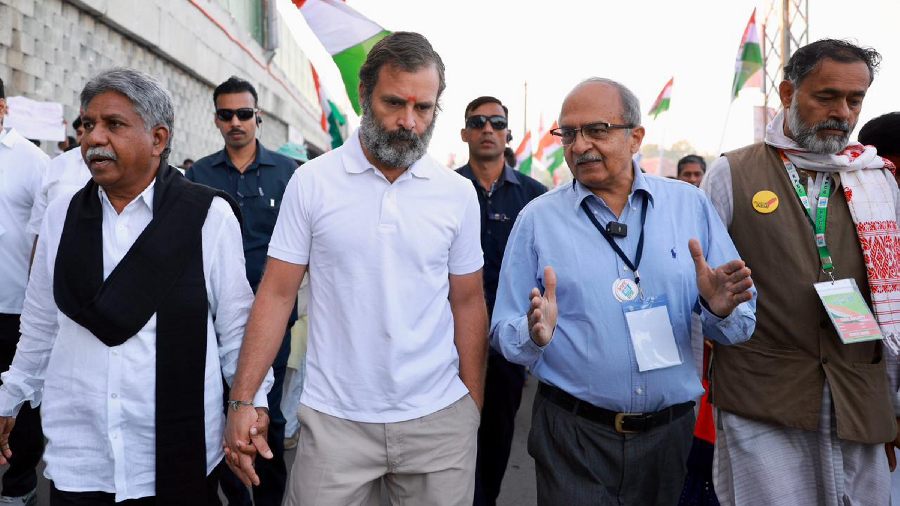
There is no justification for assuming that every protester seeks violence or that every call for political change amounts to a conspiracy. Peaceful protest is a fundamental democratic right. Equally, however, nobody should assume that rhetoric invoking bloodshed becomes harmless merely because it is uttered during a political discussion. The precise words, their context and the speaker’s intended meaning matter. If credible evidence establishes advocacy of unlawful violence, the appropriate authorities must examine it in accordance with law. Parliament exists to provide a forum for debate, scrutiny and accountability. Opposition parties can question ministers, demand discussions, expose alleged wrongdoing and seek a verdict from the people. They can approach courts when they have a legally sustainable case. They can organise peaceful demonstrations and campaign for a change of government. These constitutional avenues are not favours granted by the ruling establishment; they are essential features of a functioning democracy. The controversy also brings the judiciary’s institutional role into focus. The Chief Justice of India reportedly declined to meet Opposition representatives seeking intervention in their campaign. Such a response should not automatically be interpreted as either support for the government or rejection of the Opposition’s allegations. The judiciary must decide matters through established procedures, evidence and law, not become a participant in political mobilisation. Courts must protect fundamental rights, including freedom of expression and peaceful assembly. The police must maintain public order lawfully and proportionately. Neither responsibility overrides the other. The right to protest cannot be used to justify violence, while public-order concerns cannot become a pretext for suppressing legitimate dissent. Prashant Bhushan, as a practising Supreme Court advocate, and Rahul Gandhi, as Leader of the Opposition in the Lok Sabha, are entitled to articulate their political positions. Their words must nevertheless be judged in context, particularly when those words concern revolution, bloodshed or the removal of elected leadership. Public figures bear a responsibility to ensure that their rhetoric does not blur the line between democratic mobilisation and unlawful confrontation. The government of the day is neither permanent nor beyond criticism. It can be challenged, defeated and replaced. That is precisely what democracy guarantees. But the same constitutional rules must apply regardless of which party occupies power. Bharat cannot afford to confuse political opposition with an assault on constitutional order, or peaceful dissent with a licence for violence. Equally, no government should confuse criticism with sedition or peaceful mobilisation with an unlawful attempt to seize power. The ultimate test of democracy is not how loudly political leaders raise slogans, how many people gather in the streets or how aggressively they denounce their opponents. It is whether they respect the Constitution, accept lawful procedures and recognise the people’s mandate—even when the verdict goes against them. Truth must emerge from evidence, reasoned debate and the ballot box—not from bloodshed, intimidation or the belief that the streets can override the institutions of a constitutional republic.

