



Then those who have sought the Atman by penance, celibacy, shraddha (faith), and knowledge gain the sun, travelling the northern route. This is the home of all living creatures, the immortal, the fearless. This is the highest goal; from there they do not return; this is the end. For this, there is a mantra.
In mantra 10, the Guru qualifies the journey of Brahmacharya, celibacy, Tapas penance, Shraddha, faith, and Vidya, knowledge, to pursue the path of Ishtam. For achieving your goal, you should have shraddha, which is a profound intellectual quality. Every path has obstacles, impediments, and distractions. The spiritual path is very treacherous and unknown. You need enormous shraddha, blessings, and support of providence to carry on this journey. When you lead a life of Ishtam, you live a life of viveka discrimination and vairagya renunciation. Discrimination is to have a clear understanding between the pursuit of the higher (Self) and the lower (world). The shastras glorify the pursuit of Atman. Every other pursuit gets dwarfed, insignificant, meaningless, and trivial compared to the pursuit of self-realisation.
Mantra 11
पञ्चपादं पितरं द्वादशाकृतिं
दिव आहुः परे अर्धे पुरीषिणम् ।
अथेमे अन्य उ परे विचक्षणं
सप्तचक्रे षडर आहुरर्पितमिति ॥ १.११॥
pañcapādaṃ pitaraṃ dvādaśākṛtiṃ
diva āhuḥ pare ardhe purīṣiṇam .
atheme anya u pare vicakṣaṇaṃ
saptacakre ṣaḍara āhurarpitamiti.
They say that the Lord of rain — the father — having five feet and twelve forms, is higher than atmosphere. Others call him the all-wise, the one upon whom, like a chariot drawn by seven horses mounted and running on a wheel with six spokes, the (whole world) is founded.
The Guru is quoting the mantra from the Rig Veda. Two sets of metaphors are referred in this mantra. The sun, the path of prana, and energy is being identified with time. Sun is referred to as the father. If there is sun, there is rain and thereafter life. Similarly, it is the father who provides, sustains, and is compared to the sun.
Five feet refers to five seasons and twelve forms refer to twelve months. Time is measured by days, months, and the seasons.
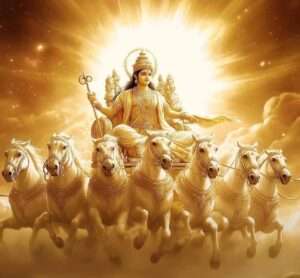
‘Others call him all wise’, here, others refers to another perspective of describing the sun. The sun moves as though like a chariot drawn by seven horses. The chariot and the seven horses refer to seven colours. When white light passes through a prism, we get the seven VIBGYOR colours. These colours are in the white light.

The master described the sun with a chariot drawn by seven horses and running on a wheel with six spokes. Wheel is the time and six spokes refer to the six seasons. When the wheel moves forward, there is no reverse. You can never get back the time that is lost.
The charioteer of sun god is Arunah. Before the sun rises, the darkness is dispelled by the sun’s rays, which is Arunah. Arunah, the charioteer of the Sun God, comes before the sun god arises. When the sun arises, it brings lustre, glory, brilliance, heat, luminosity. If the sun is referred to as self-realisation, Arunah, the initial rays, is compared to the initial sadhana we put in.
All your problems, obstacles, issues are taken care of by the initial sadhana itself before we come any close to self-realisation. If you are caught up in the mire of delusion, lost in maya, darkness, which is ignorance, it means even Arunah is not there in your life. You have not yet embarked on the journey of unfolding yourself. You are caught up in the negativities and imperfections. When Arunah comes, the tamasic and rajasic gunas will be removed. Once you are established in sattva, then you are ready to receive the Atma Vidya.
On Dasara, the 10th day, we burn the effigy of Ravana. The first three days, Goddess Durga is worshipped, which is the destruction of negativity and impurities. The next three days are for Goddess Lakshmi, which represents imbibing wealth of positive qualities. Negative qualities are annihilated, and positive qualities are highlighted. Once you are established in dharma, the last three days are for Goddess Saraswati, is worshipped as the dawn of Wisdom.
Even when gods and demons were churning the milky ocean, first came the poison, then Goddess Lakshmi and perks came, and finally the Amrutha nectar, which is immortality.
Mantra 12
मासो वै प्रजापतिस्तस्य कृष्णपक्ष एव रयिः शुक्लः प्रणस्तस्मादेत
ऋषयः शुक्ल इष्टं कुर्वन्तीतर इतरस्मिन् ॥ १.१२॥
māso vai prajāpatistasya kṛṣṇapakṣa eva rayiḥ śuklaḥ praṇastasmādeta
ṛṣayaḥ śukla iṣṭaṃ kurvantītara itarasmin .
The month is Prajapathi; its dark half is verily the matter, its bright half the prana. Therefore, these great rsis perform sacrifices in the half of the month, but others perform them in the dark.
Rishis perform sacrifices to gain a greater sense of motivation so that their actions are driven towards attainment of prana. Such extraordinary class of people’s actions are selfless Nishkama karma. Their actions are towards the goal of Atma Vidya, self-realisation, the path of the sun. They want to get out of motive-ridden action. When you perform unselfish actions, it comes under the category of Sakama karma, actions with desires, motive, and intent. This category of people are worshipping matter and are seeking benefit for themselves, either enjoyment or material gain. They worship in the dark. Darkness refers to devolutionary actions, the path of the moon. The Guru is repeating the same concept so that you reflect on it and it gets embedded in the system.
Mantra 13
अहोरात्रो वै प्रजापतिस्तस्याहरेव प्राणो रात्रिरेव रयिः प्राणं वा एते
प्रस्कन्दन्ति ये दिवा रत्या संयुज्यन्ते ब्रह्मचर्यमेव तद्यद्रात्रौ
रत्या संयुज्यन्ते ॥ १.१३॥
ahorātro vai prajāpatistasyāhareva prāṇo rātrireva rayiḥ prāṇaṃ vā ete
praskandanti ye divā ratyā saṃyujyante brahmacaryameva tadyadrātrau
ratyā saṃyujyante .
Day and night are verily the Prajapati, of which day is prana and night is matter. Those who unite in love during the day waste their prana. Those who unite in love at night are as good as celibacy.
The Guru is not diluting the concept of celibacy or brahmacharya in its purest form. A brahmachari practises celibacy. It does not mean spirituality is not meant for grihastha. Only a very small percentage of people are meant to be a brahmachari. The majority of people are grihastha. It is not decided by an individual to be a grihastha or brahmachari. It is your purva janma that decides for you to lead a particular life.
When you do not have a desire, there is no sacrifice in it. It is only when you have a desire and see its hollowness that you exhibit vairagya. You measure your degree of dispassion only in areas of your passion, not where you don’t have any passion. Eg: If you do not have desire for alcohol, yet you go to a pub and do not consume, there is no sacrifice nor any vairagya dispassion as you have no desire for it.
The Guru is giving a path for householders, grihastha. The scriptures are all-inclusive and not exclusive to a class of people.
Swami Rama Tirtha says, Vedanta is more demanding and challenging for a grihastha than a brahmachari. The challenges of a grihastha are much more than those of a brahmachari. In an ashram where society puts a brahmachari on a higher pedestal, it is relatively easy to practise Vedanta. But it demands practising spirituality in office, streets, and in every action you perform, not just in an ashram, a recluse or an ascetic life.
The conjugal relationship can be taken in literally meaning of a relationship of a man and a woman or, in general, taken to any indulgent activity which falls under rajasic and tamasic activity.
This mantra can be referred to the three gunas: sattva, rajas, tamas. It is more important to know the manifestation of gunas. Sattva guna manifests only between 4 am – 6 am. Rajas guna manifests from 6 am – 6 pm and Tamo guna from 6 pm to 4 am. This is the constitution for an individual and nature manifests itself.

