Lakshmanrao Upadhyayula
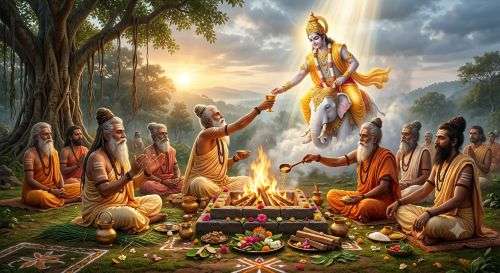
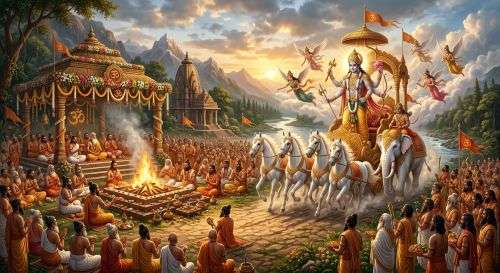
The revered sage Vishwamitra, invoking the majestic cadence of the Tristubh chandas in the hymns of the Rigveda, offers a profound invitation to Indra, the sovereign of divine strength, protector of righteousness, and guardian of cosmic harmony. The Vedic sacrifice is not merely an external ritual but a sacred communion between humanity and the universal order. Every mantra, every offering, and every act of devotion reflects the eternal aspiration of the human spirit to participate consciously in the rhythm of creation. The sage calls upon Indra to descend into the sacrificial assembly, not simply as a recipient of offerings, but as the divine presence whose arrival sanctifies the entire yajna.
The Soma, purified with the sacred utterance of the Swaha mantra and prepared according to the discipline of Vedic tradition, is lovingly dedicated to Indra alone. This consecrated offering symbolizes the essence of purified consciousness, spiritual delight, and divine vitality. The act of offering Soma is an expression of complete surrender, acknowledging that the highest blessings flow only through reverence and selfless devotion. The ritual demonstrates that the sanctification of every action transforms ordinary substances into vehicles of divine communion, revealing the Vedic understanding that purity of intention is the foundation of all sacred work.
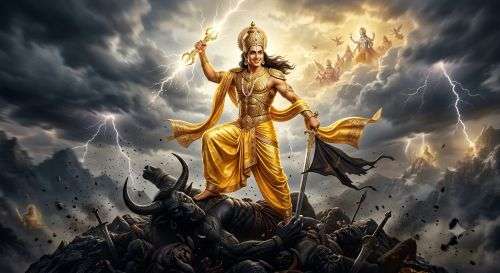
Indra is celebrated as the unconquerable destroyer of all forces that obstruct truth, righteousness, and spiritual progress. Every hostile power, whether external or hidden within the human heart as ignorance, fear, pride, or selfishness, is overcome by his irresistible strength. He is the generous bestower of blessings upon priests and seekers who faithfully preserve the sacred fire of knowledge through disciplined worship and unwavering dedication. Surrounded by the mighty Maruts, the radiant powers of dynamic energy and divine movement, Indra governs the harmonious forces of nature, demonstrating that the universe functions through cooperation between divine intelligence and cosmic law.
Though enthroned in celestial majesty, Indra is understood to be omnipresent, pervading every realm of existence. The oblations offered into the sacred fire become a bridge between the visible and the invisible, nourishing the divine order that continually sustains creation. The offerings are presented with the sincere prayer that they may completely satisfy the divine will, just as pure devotion fulfills the deepest longing of the human soul. In the Vedic vision, sacrifice is an eternal exchange of gratitude, where the giver and the receiver are united through sacred intention.
The sage declares that Indra’s magnificent horses have been carefully prepared, attended with reverence and eager anticipation. These celestial steeds symbolize disciplined energies guided by wisdom and purpose. Their swiftness represents the rapid movement of divine grace toward sincere aspiration. As the primordial Lord who comprehends every force of motion within creation, Indra is invited to let these noble horses carry him into the sanctified precincts of the yajna, where every altar, every hymn, and every offering awaits his glorious presence.
The purified Soma shines with crystal clarity before the Lord, inviting him to behold its perfection and partake of it with delight. The offering of Soma mixed with nourishing milk reflects the harmonious union of strength and compassion, discipline and abundance, devotion and divine nourishment. Indra, who is praised as the divine ordainer and sustainer of Soma’s sacred purpose, is lovingly requested to receive this immortal offering with joy. The chanting of the Vedic hymns accompanies every libation, affirming that sacred sound itself becomes an offering that pleases the divine and elevates the consciousness of all who participate.
The sage further prays that Indra may bless the devoted priests with abundant herds of cows, symbols of prosperity, wisdom, nourishment, and spiritual wealth. In the Vedic civilization, cows represented the sustaining foundation of sacrificial life, providing the milk, clarified butter, and resources essential for maintaining the sacred fires and supporting the continuity of worship. Such prosperity was never sought for personal indulgence but for preserving the eternal cycle of learning, service, generosity, and devotion that benefited the entire community.
Indra is glorified as the very source of nourishment, prosperity, noble leadership, and inspired wisdom. His immeasurable riches extend beyond material abundance into the realms of courage, discernment, and righteous governance. He awakens the hearts of seekers to receive the sacred hymns, becoming both their divine inspiration and their eternal hearer. His fierce commitment to righteousness reveals that true strength is inseparable from justice, compassion, and unwavering fidelity to cosmic order. As the victorious slayer of hostile powers in every battle, he remains the unfailing refuge of those who seek protection under divine grace. Thus the hymn of Vishwamitra becomes an everlasting testimony that sincere sacrifice, enlightened knowledge, disciplined devotion, and harmonious cooperation with the laws of the universe lead humanity toward enduring prosperity, spiritual illumination, and union with the eternal truth.