



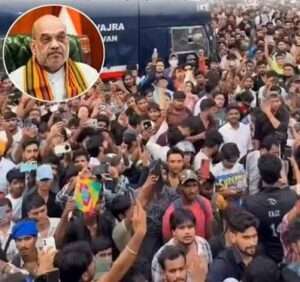
The Delhi Police appears to have learnt something from the Jantar Mantar experience. With more than 700 protesters detained on October 2 during the demonstration demanding the resignation of Chief Election Commissioner Gyanesh Kumar, the message is clear: the administration does not want a political protest to turn into a law-and-order challenge.
But the real test lies ahead. With Opposition parties and other groups planning a wider agitation, including protests across Bharat, the responsibility of the police and intelligence agencies is not merely to deploy more personnel. It is to anticipate trouble, identify potential troublemakers and, at the same time, protect the legitimate democratic right to dissent.
There is nothing unconstitutional about protesting against the Election Commission or demanding the resignation of the CEC. Peaceful assembly, slogans and political criticism are integral to democracy. But the right to protest cannot automatically become a right to threaten, abuse, intimidate or obstruct ordinary citizens. Political disagreement has constitutional protection; personal abuse and violence do not acquire legitimacy merely because they are shouted from a protest platform.
That distinction must be maintained firmly and impartially.
The SIR controversy itself deserves a more mature debate. The Election Commission says the exercise is intended to clean electoral rolls by identifying duplicate, deceased and otherwise ineligible entries. At the same time, reports and political complaints about genuine voters being affected cannot simply be dismissed. The answer is not to manufacture suspicion against the CEC, nor to treat every objection as politically motivated. The answer is verification, transparency, correction and an effective mechanism for genuine voters to have their names restored. The ECI itself provides facilities for electors to search their names and check earlier electoral-roll records.
And here lies an important institutional question that political parties should answer.
Booth Level Officers do not operate in some political vacuum. The electoral machinery involves personnel drawn from government establishments, while the Chief Electoral Officers function at the State level. If political parties in States such as Telangana and Karnataka have concerns about wrongful deletions, they should place specific cases and documentary evidence before the appropriate electoral authorities and demand accountability from the officials responsible. Blanket political accusations against the CEC cannot substitute for case-by-case verification.
Equally, State governments cannot wash their hands of the conduct of government personnel involved in the electoral process and then convert every disputed deletion into a political narrative.
The same principle applies to the emerging breed of social-media influencers and political formations. Youth participation is welcome. Gen Z engagement with public affairs is healthy. But social-media popularity cannot become a substitute for evidence, and virality cannot become a constitutional licence for abuse. The new political ecosystem, including the Cockroach Janata Party and its leader Abhijit Dipke, should be judged by the quality of its arguments and evidence—not merely the volume of its online mobilisation.
The administration too must exercise restraint. History-sheeters, repeat offenders and individuals facing serious criminal proceedings can legitimately attract closer preventive attention where law permits, but ordinary protesters must not be treated as criminals merely for disagreeing with the government or the Election Commission. Children, particularly those below 12, should never become political street instruments.
This is where Delhi Police and law-enforcement agencies across Bharat need to draw the line.
The October 2 experience should be treated not as a rehearsal for another confrontation but as a warning against one. Political parties have every right to mobilise. Citizens have every right to question institutions. Police have every right—and responsibility—to enforce lawful restrictions. But nobody benefits if Jantar Mantar becomes synonymous with confrontation rather than democratic dialogue.
The objective should therefore be simple: protest, yes; provocation, no. Criticism, yes; abuse, no. Dissent, yes; disorder, no.
The Centre, State governments, police forces and intelligence agencies must work within the Constitution and the law to ensure precisely that.
Avoiding a Jantar Mantar 2.0 is not about silencing dissent. It is about ensuring that dissent remains democratic.


“Avoid Jantar Mantar 2.0” Excellent Narration, Simple & Rythemativally Put Hard Words, message is Clear & Loud that Democratic Systems Can not be taken for Granted👏🏿👏🏿👏🏿