Lakshmanrao Upadhyayula
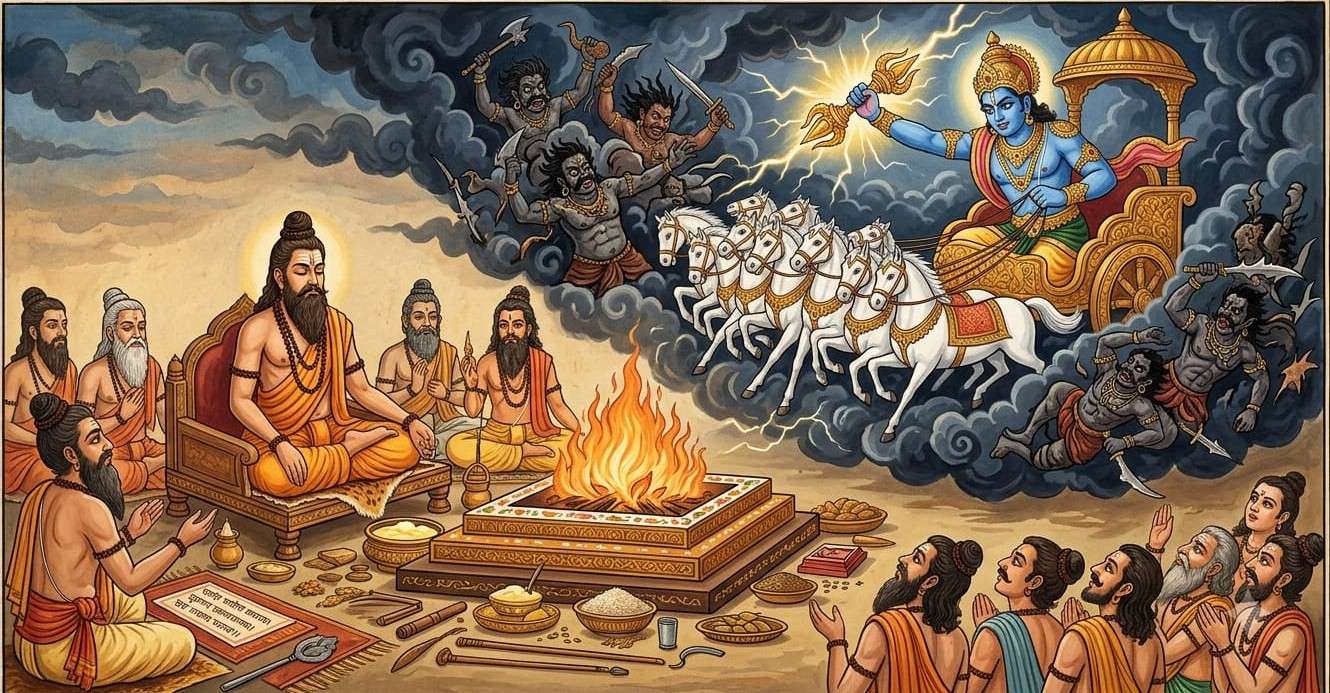
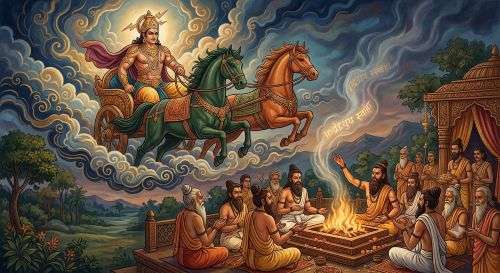
The sage Vishwamitra, standing within the sanctified atmosphere of the Vedic sacrifice, raises his voice in the majestic Tristubh metre of the Rigvedic hymns and invokes Indra, the lord of divine strength and victorious power. With reverence he calls upon the radiant deity to yoke the Hari horses to his celestial chariot. Just as the winds patiently await the harnessing of their swift Niyut steeds, the sage beseeches Indra to pause for a moment, prepare his noble steeds, and journey toward the sacred assembly. The sacrificial fires glow brightly, the priests chant the sacred Swaha mantras, and the Soma elixir is lovingly prepared so that the divine guest may partake of it with delight, serenity, and satisfaction.
Indra is the deity sought by many worlds and invoked by countless worshippers. Therefore, the sage urges him to come swiftly yet graciously to the sacrificial ground. The disciplined horses, steady in motion and perfectly harnessed, symbolize the ordered forces of nature moving according to cosmic law. The yajna is conducted with precision and fidelity to sacred tradition, reflecting the Vedic understanding that harmony in ritual mirrors harmony in the universe. The invitation extended to Indra is not merely ceremonial; it is a call for divine presence to enter the realm of human endeavor and bless it with prosperity, strength, and wisdom.
The twin Hari horses, golden and radiant, are requested to carry Indra to the holy precincts of sacrifice. These celestial steeds represent energy, movement, and the dynamic powers that sustain life. The patron of the yajna seeks divine protection, and therefore the sage implores Indra to direct these powerful forces toward the preservation of righteousness. The imagery of releasing the red-golden horses signifies the awakening of spiritual vigor and the mobilization of divine energies for noble purposes. In the Vedic vision, every force of nature becomes sacred when aligned with truth and cosmic order.
As the offerings prepared from barley and other consecrated substances are presented, Indra is invited to assume a form suitable for receiving the sacrifice. This profound symbolism reflects a central Vedic principle: the divine becomes accessible through sacred action and sincere devotion. The offerings are not merely material gifts but expressions of gratitude, discipline, and participation in the cosmic cycle of giving and receiving. Through yajna, humanity acknowledges its dependence upon the divine forces that sustain existence.
The priests chant Vedic hymns while ceremonially binding the horses to the chariot. This act carries deep spiritual meaning. The horses symbolize the senses, energies, and faculties of human life, while the chariot represents the disciplined vehicle of consciousness. The sacred mantras serve as instruments of alignment, directing power toward constructive and enlightened purposes. Indra, praised as a wise and discerning lord, is invited to mount the strong and comfortable chariot and proceed toward the Soma offering prepared in his honor.
The patron of the sacrifice seeks to gladden both Indra and his noble steeds through devotion and generosity. Sanctified Soma is offered as the essence of joy, vitality, and divine inspiration. The worshippers request that Indra favor their sacrifice above all others and come directly to their sacred gathering. Such prayers reveal the intimate relationship between deity and devotee in Vedic spirituality, where divine blessings are sought not only for material prosperity but also for moral strength and spiritual advancement.
The purified Soma awaits Indra. Sacred grass has been spread with care, creating a seat worthy of the celestial guest. The grains prepared for the Hari horses symbolize nourishment and abundance. Many worshippers call upon Indra because he is renowned as the bestower of boons and the protector of those who uphold righteousness. His association with the Maruts, the powerful storm deities, reflects his mastery over natural forces and his ability to channel them for the welfare of creation.
The Adhvaryu priest diligently purifies the Soma with water, milk, and honey while maintaining the sanctity of the ritual through precise recitation of Vedic mantras. This process reveals a remarkable scientific temperament embedded within Vedic culture. Purification, preparation, measurement, and orderly procedure are emphasized throughout the sacrifice. The blending of natural substances symbolizes the integration of various life-sustaining elements. The ritual demonstrates an ancient appreciation for observation, discipline, and the harmonious interaction of natural forces, all guided by spiritual purpose.
Indra is invited to listen to the hymns and receive the Soma with a joyful countenance. At the time of drinking Soma, he is also asked to honor the Maruts, whose companionship strengthens him in cosmic battles against disorder and obstruction. The Maruts symbolize dynamic energies that cooperate in sustaining balance within the universe. Their presence reminds worshippers that success arises through coordinated effort, divine cooperation, and harmonious relationships among all powers that serve the cosmic order.
The worshippers further request that Indra consume the purified Soma through the blazing tongue of Agni. In Vedic understanding, Agni serves as the sacred mediator who carries offerings from the human realm to the divine. Fire transforms material substances into subtle forms capable of reaching celestial beings. This symbolism reflects both spiritual insight and practical observation, revealing an ancient recognition of transformation through energy. Agni thus becomes the bridge between earthly aspiration and divine fulfillment.
Finally, Indra is praised as the source of nourishment, wealth, protection, and victory. He is the lover of hymns, the guardian of worshippers, and the conqueror of hostile forces that threaten righteousness. The devotees seek refuge beneath his protection, trusting in his strength and generosity. Through their prayers they affirm a fundamental Vedic truth: when disciplined action, sacred knowledge, devotion, and harmony with natural law unite, human life becomes aligned with the divine order. The hymn of Vishwamitra therefore stands as both a spiritual invocation and a profound reflection on the relationship between cosmic forces, human responsibility, and the eternal pursuit of truth.