A Vision of Divine Power, Cosmic Order, and Human Aspiration
Lakshmanrao Upadhyayula
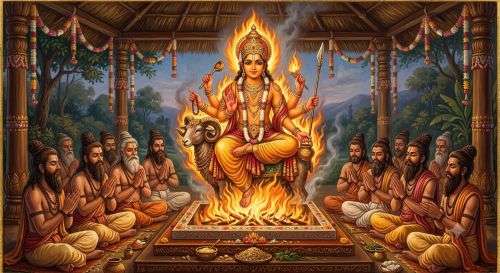
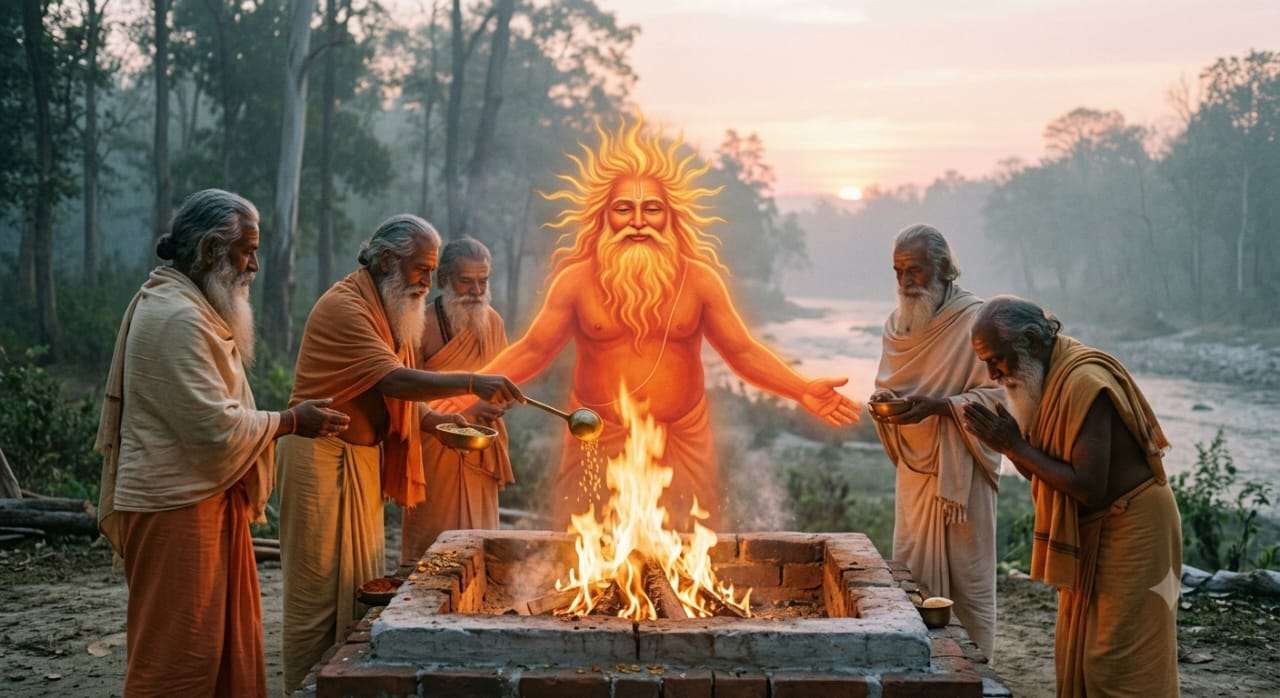
In the sacred tradition of the Rigveda, Sage Vishwamitra raises a profound and reverential prayer to Indra through the exalted meter of Trishtubh Chandas, one of the most powerful poetic forms of Vedic expression. These hymns emerge from the heart of the sacrificial arena where the ritvijas, the learned officiating priests entitled to prepare and offer Soma, invoke the mighty lord of celestial power. Their voices rise in unison with sacred chants, while devoted companions purify the Soma through carefully prescribed rituals. Other worshippers diligently prepare oblations for the sacred fire, enduring hardships, hostility, and opposition from adversarial forces. Amidst these solemn proceedings, a question naturally arises: who in the vast universe possesses a fame greater than that of Indra, the protector of cosmic order and the champion of the righteous?
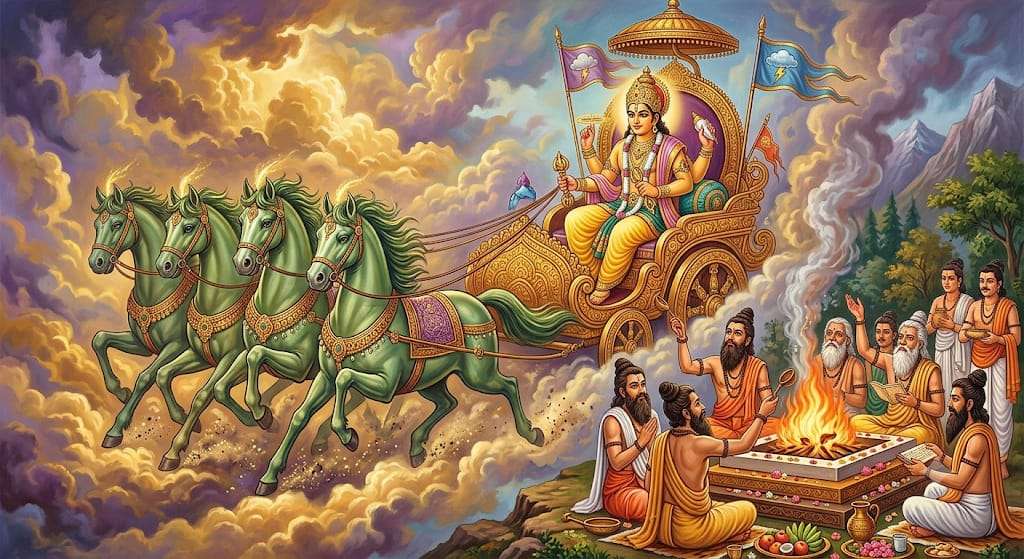
Indra is portrayed as the sovereign whose divine steeds, known as Hari, traverse immense distances with supernatural swiftness. To him, remote lands and nearby realms are equally accessible. The hymns call upon him to hasten to the sacrifice, drawn by his radiant horses, for the sacred ritual has been dedicated to his glory. Steadfast and unwavering, he is celebrated as the fulfiller of desires, the granter of prosperity, and the divine recipient of offerings. The sacrificial ground is prepared with meticulous care. Agni, the sacred fire, is adorned with holy grass, while bundles of purified kusa grass are arranged for the sanctification of Soma. These ritual elements symbolize the purification of thought, speech, and action, reflecting the Vedic understanding that spiritual attainment requires both inner and outer discipline.
The hymns praise Indra as the bestower of blessings, wealth, and abundance. His crown radiates supreme authority, while his presence shines with splendor and grace. He stands as the victorious lord accompanied by the mighty Maruts, the storm deities whose dynamic energies animate the atmosphere. Together they symbolize the forces of nature operating in harmony with cosmic law. Indra’s mastery extends to every aspect of warfare, not merely in the physical sense but also in the spiritual struggle against ignorance, chaos, and obstruction. He is the tormentor of hostile forces that seek to disrupt harmony and righteousness.
The sages recall his heroic deeds and ask where the countless acts of valor performed on behalf of suffering humanity may be found in memory and song. Indra is celebrated for uprooting powerful demons from their fortified strongholds and destroying the deeply entrenched forces that hindered the welfare of the world. Foremost among these victories is the slaying of Vritra, the mighty serpent-like being who imprisoned the waters. This triumph is not merely a mythological episode but a profound symbol of liberation. By defeating Vritra, Indra releases the life-giving waters necessary for fertility, agriculture, and human survival. Under his command, the earth, heavens, and mountains remain steadfast, illustrating the Vedic conception of a universe sustained by divine order and regulated forces.
The hymns further glorify Indra as the unparalleled warrior who single-handedly defeated Vritra and assured the gods of protection and stability. His greatness deserves to be known throughout the world because he unites earth and heaven, integrating their energies into a harmonious whole. His glory permeates all realms, demonstrating the Vedic belief that cosmic balance depends upon the interaction of celestial and terrestrial powers. Indra’s chariot, drawn by swift horses, is invoked to travel along the path of righteousness and arrive at the sacrifice. His thunderbolt, the Vajra, is called upon to subdue hostile forces, overcome obstacles, and restore the conditions necessary for sacred rites and human flourishing.
The destruction of enemies described in these hymns carries profound symbolic significance. The enemies are not merely external adversaries but also represent ignorance, greed, disorder, and destructive tendencies within individuals and societies. Indra’s role is to eliminate these impediments so that the universe may remain conducive to sacrifice, virtue, and spiritual growth. His strength and determination ensure that the pathways of righteousness remain open and accessible.
As the lord of wealth, Indra is depicted as one who perpetually wears prosperity. Those who receive his blessings acquire homes, cattle, precious metals, and social honor. In Vedic society, such gifts represented not only material prosperity but also social stability, agricultural productivity, and communal well-being. The recipient of Indra’s generosity becomes respected and welcomed among many people. His favor transforms offerings into auspicious forces that generate good fortune, abundance, and continuity across generations. The hymns repeatedly emphasize that Indra’s power to bestow riches is immeasurable and inexhaustible.
The destruction of Vritra is recounted with vivid imagery. The roaring and oppressive demon, whose strength continually increased, is reduced to dust. His limbs are severed, his power diminished, and his capacity to obstruct the natural order utterly destroyed. Through this victory, Indra establishes the stability of the earth and secures the heavens in their appointed places. The moving earth, vast atmosphere, and lofty heavens remain fixed and reliable through divine governance. Such imagery reflects an early effort to understand the regularity of natural phenomena and the dependable patterns that make life possible.
A remarkable scientific temperament emerges from these ancient hymns. The release of waters after the destruction of Vritra can be interpreted as an observation of atmospheric processes. The cloud, referred to as Govajra, appears as a mighty reservoir of water. When Indra raises the Vajra and shatters the obstruction, the waters descend to nourish the earth. Symbolically, the cows released from captivity represent rain-bearing clouds and flowing rivers. The sages recognized the intimate relationship between atmospheric forces, rainfall, agricultural fertility, and human survival. Their poetic language transformed observations of nature into sacred narratives without diminishing their empirical significance.
The hymns describe rivers filled with waters, flowing from diverse sources toward their destinations. Indra enriches both earth and heaven, ensuring the continuity of life through the circulation of water. This understanding reflects a sophisticated appreciation of natural cycles. Water evaporates, forms clouds, returns as rain, fills rivers, nourishes vegetation, sustains animals, and supports human civilization. The Vedic seers perceived these interconnected processes as manifestations of divine intelligence operating through natural law.
Indra is invited to remain among the worshippers, yoke his horses, and descend from heaven to the sacrificial ground. His presence symbolizes divine participation in human endeavors. The Sun itself is said to move under the inspiration of Indra, following the pathways of light in fulfillment of cosmic duty. The daily journey of the Sun across the sky becomes a testimony to divine order and regularity. The completion of its cycle reflects the harmonious functioning of celestial mechanics, observed carefully by the ancient sages and incorporated into their spiritual worldview.
Night yields to dawn, and the radiant goddess Usha appears upon the horizon. Her arrival awakens humanity to daily responsibilities, rituals, and acts of worship. Men and women commence their duties, offer oblations, and engage in productive activity. The colorful splendor of the rising Sun attracts and inspires all who behold it. Through these observations, the hymns reveal a deep appreciation for the rhythms of nature and the importance of aligning human life with cosmic cycles.
Indra’s benevolence extends to agriculture and animal husbandry. He fills rivers with water, preserves milk within cows, and sustains the production of curd and clarified butter. These products held immense significance in Vedic society, serving as sources of nourishment, ritual offerings, and economic prosperity. The image of the newborn calf drawing milk from its mother symbolizes continuity, renewal, and the perpetuation of life.
The sages invoke Indra’s strength against forces that obstruct progress and prosperity. Enemies close pathways, hinder growth, and oppose sacred activities. Indra is asked to remove these barriers so that the performers of yajna may fulfill their aspirations. The hymns vividly portray hostile forces gradually losing their weapons and strength before the divine power of the Vajra. The thunderous sound of Indra’s weapon symbolizes the triumph of truth over falsehood and order over chaos.
The prayer intensifies as the sages request the complete destruction of demonic tendencies that threaten spiritual and social harmony. These adversaries are described as enemies of sacred knowledge and opponents of ritual order. The hymns affirm the supremacy of Brahman, the highest reality beyond sensory perception and ordinary comprehension. This transcendent principle cannot be grasped physically, yet it forms the foundation of existence. Indra functions within this cosmic framework as the active guardian of order and the protector of sacred wisdom.
The prayer concludes with a heartfelt appeal for prosperity, continuity, and enduring well-being. Indra, organizer of the universe and lord of abundance, is requested to provide horses, cattle, food, wealth, and flourishing descendants. The worshippers seek not only personal prosperity but also the prosperity of their children and future generations. Their desires are compared to a sacred fire rising from the ocean, ever expanding yet directed toward righteous fulfillment. They ask for shining wealth, productive cattle, swift horses, nourishing food, and enduring success.
The sons of Kusika, descendants of the illustrious lineage associated with Sage Vishwamitra, conclude their praise by imploring Indra to move the clouds and release life-giving waters. They seek abundant food, nourishment, and agricultural prosperity. Indra is celebrated as the embodiment of true strength, the source of sustenance, and the victorious guardian of humanity. Wealthy, majestic, enthusiastic in battle, and attentive to sacred hymns, he remains the destroyer of hostile forces and the provider of shelter and nourishment. Through these magnificent Trishtubh hymns, the Rigvedic seers present a vision in which spiritual devotion, cosmic order, ethical responsibility, and careful observation of nature converge into a unified and enduring philosophy of life.