



AI has discovered the perfect time machine: one that can also fix our hair, clothes and questionable fashion choices
There is a new epidemic sweeping across social media. Thankfully, it is neither contagious nor fatal. It merely threatens to make us look considerably better than we actually did four decades ago.
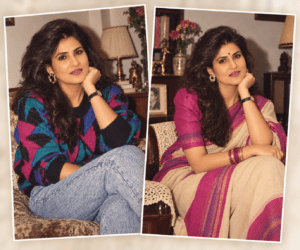
I first noticed it when TV news personality Rubika Liaquat appeared in my social-media feed, transported straight into an unmistakable 1980s world. Draped in a cotton saree in one picture, and a sweater and jeans in another, complete with a crowning glory that could have given Dimple Kapadia a run for her money and, for good measure, a maroon bindi, she looked every inch the heroine of a vintage Bollywood film. I smiled and scrolled on.
Then I began seeing friends doing it – some posing solo, others appearing with their ‘best buddies forever’, all happily stepping into their digitally reconstructed youth.
That was when it struck me: this was no longer a handful of people having fun with AI. It had become an endemic trend.
The past gets a makeover
Now and then, social media throws up a new challenge, and millions obediently fall in line, photograph in hand. This time, AI has been summoned to take us back to the 1980s – the decade of flamboyant hairstyles, bell-bottoms, impossibly broad collars, denim jackets and photographs that came out in colours ranging from slightly faded to completely mysterious.
Celebrities are joining in. Influencers are joining in. Politicians are joining in. And ordinary people, naturally, are not going to miss the opportunity to rewrite their personal history.
The instructions to AI are wonderfully specific: retain my face, face shape, skin tone and expression, but give me an authentic 1980s hairstyle, period clothing, accessories, vintage surroundings, warm analogue lighting, soft focus, muted colours and film grain.
In other words, please preserve my identity but improve everything else. And AI obediently delivers.
A gentleman who had begun losing his hair at 30 suddenly appears with a luxuriant crop worthy of Amitabh Bachchan or Shatrughan Sinha. A man who spent the decade in ordinary trousers is miraculously discovered wearing bell-bottoms. Someone who never went near a denim jacket is suddenly looking as though he had just walked out of a 1980s film set.
Then come those magnificent collars – broad enough to double as aircraft wings – and hairstyles that required considerably more maintenance than most marriages. Nobody complains, of course.
Why spoil a good memory?
Because who wants historical accuracy when nostalgia can be photogenic? The 1980s photograph in the family album may show a thinning hairline, an unflattering shirt, a rather generous waistline and a photographer’s flash making everyone look mildly startled.
The AI version has none of these inconveniences. It has hair. It has style. It has cheekbones. It even has the right amount of film grain to make the whole fabrication look authentic.
Artificial intelligence, artificial memories
The irony is irresistible. We now have technology sophisticated enough to reconstruct faces, places and entire historical environments, and we are using it primarily to establish that we had better hair in 1984 than we actually did. But perhaps that is precisely the point.
Social media has never been particularly interested in reality. It is interested in presentation. AI has merely given presentation a PhD.
We once used photographs to preserve memories. Today, we can manufacture photographs to improve them. And nobody is going to ask the awkward question: ‘Did you really look like this?’ Why would they?
If the present is considerably kinder to you than the past ever was, there is no reason to let historical truth stand in the way of a flattering photograph.
So, long live the 80s – the chiffons, bell-bottoms, dog-tongue collars, Amitabh hairstyles, Dimple Kapadia locks, maroon bindis and sepia memories.
Just don’t ask to see the original photograph. That, for sure, may contain classified information.

