



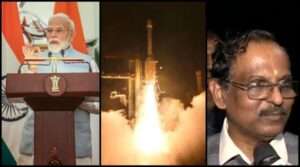
In the quiet hours before dawn on September 4, 2026, the Indian Space Research Organisation (ISRO) did more than send another rocket into the skies over Sriharikota. With the successful launch of GSLV-F17 carrying the 2,367-kg EOS-05 satellite, Bharat demonstrated something far more consequential: the ability to place a sophisticated Earth-observation spacecraft into a geosynchronous orbit and sustain an almost unblinking watch over its own neighbourhood. This is not merely another entry in ISRO’s impressive launch calendar. It is a strategic capability that can change the way Bharat observes, understands and responds to events across its vast territory and surrounding waters. EOS-05’s geosynchronous vantage point, nearly 36,000 km above Earth, gives it an important advantage over conventional low-Earth-orbit observation satellites. LEO satellites provide exceptionally detailed imagery, but their orbital movement means they periodically pass over a given region. A geosynchronous platform, by contrast, can maintain persistent observation of a defined area. That distinction matters enormously. For a country as geographically diverse and climate-vulnerable as Bharat, the ability to repeatedly observe developing situations can prove invaluable. Flash floods, cyclones, forest fires, landslides and other disasters do not wait for a satellite to make its next scheduled pass. Faster observation can mean faster warnings, better coordination and, ultimately, lives saved. The benefits extend well beyond disaster management. Agriculture, water-resource monitoring, forestry, urban development and environmental assessment can all benefit from more frequent and sophisticated Earth-observation data. But it would be naïve to look at EOS-05 purely through a civilian lens. Space today is an extension of national security. Persistent Earth observation has obvious implications for border surveillance, maritime domain awareness and strategic planning. In an increasingly contested Indo-Pacific and a neighbourhood marked by complex security challenges, Bharat needs the ability to generate critical intelligence through its own space assets rather than remain dependent on the goodwill, availability or policy priorities of other countries.
That is where EOS-05 assumes strategic significance. Its advanced imaging capabilities across multiple spectral bands potentially provide planners and agencies with a richer picture of changing activity on the ground and at sea. For Bharat, therefore, this is also about strategic autonomy. Equally important is what GSLV-F17 says about ISRO itself. The GSLV has had its share of difficult moments, particularly in the early years of mastering indigenous cryogenic technology. The successful performance of GSLV-F17 is consequently more than a successful launch—it is another affirmation that Bharat has steadily converted technological challenges into indigenous capability. The significance becomes even greater when viewed against the backdrop of recent setbacks in the launch programme. Space exploration is unforgiving. A single component failure can erase years of effort and millions of rupees in seconds. What distinguishes a mature space programme is not an unrealistic record of perfection, but its capacity to analyse failure, correct course and return stronger. That is precisely where ISRO has repeatedly distinguished itself. Bharat’s space story has also evolved dramatically. It is no longer simply about launching satellites economically or demonstrating technological prowess. It is about building an integrated space ecosystem capable of supporting communication, navigation, weather forecasting, Earth observation, disaster management, scientific research, and national security. GSLV-F17 and EOS-05 fit squarely into that larger transformation. The real achievement, therefore, is not merely that Bharat has put another satellite into orbit. Bharat has expanded the reach of its own eyes—and, with it, its ability to see events unfolding in real time and respond on its own terms. As EOS-05 begins its mission from its high-altitude perch, the message is unmistakable: Bharat’s space programme is no longer merely reaching for the skies. It is increasingly using the skies to secure, serve, and strengthen Bharat.

