



Teachers’ Day Special
Teachers in the age of technology: Creators of not only knowledge but also visions of life
The nature of education is changing today at a pace never before seen. Artificial intelligence, digital technology, online learning, virtual classrooms, and new teaching methods are reshaping the learning process. Children today can acquire information on any subject in a matter of moments. At a time like this, it’s natural to ask: what will be the role of a teacher when knowledge and information are so readily available? In fact, the expansion of technology has not diminished the role of a teacher, but rather has made it more important. In the future, teachers will not only be imparters of knowledge, but also visionaries, guides, motivators, and protectors of human values.
Traditionally, a teacher’s role has been limited to teaching and learning books and curriculum. However, today this role has expanded significantly. Teachers play a vital role in shaping students’ overall personality. Preparing them simply to score high marks in exams is not enough. They must also be taught to face life’s challenges, differentiate between right and wrong, learn from failures, be sensitive to others, and make balanced decisions in difficult situations.
The digital age has virtually erased the boundaries of knowledge. The internet and digital platforms have put a vast world of information at the fingertips of students. Artificial intelligence can answer any question in seconds. But there’s a difference between information and knowledge, and an even greater difference between wisdom and wisdom. Knowing the answer to a question is one thing, and applying it appropriately in life is quite another. Technology can provide information, but only teachers can cultivate its judicious use, ethics, and a humane perspective.
With the growing influence of artificial intelligence and the expansion of robotics and automation, the world of employment and skills is also changing. In the coming years, the nature of many traditional jobs will change. At such a time, the challenge for education will not only be what students know, but also how much they can learn, think, and solve problems in response to changing circumstances. Therefore, the teacher of the future will be a continuous learner. Only those teachers who update their knowledge, technical skills, and teaching methods over time will be able to better prepare students for the future.
The greatest need today is to strike a balance between education and skills. Simply acquiring degrees does not guarantee success in life. Qualities such as communication skills, problem-solving abilities, creative thinking, decision-making, cooperative spirit, and empathy are equally essential. Teachers must develop these abilities in students so that they become not just good students but also responsible and sensitive citizens.
In a diverse country like India, the role of a teacher becomes even more expansive. Here, education is not only a means to employment, but also the foundation of social unity, democratic consciousness, cultural understanding, and the formation of national character. Teachers can connect students with their culture, traditions, and values and develop a scientific outlook and constitutional values in them. The school classroom is truly the laboratory of the future society.
In this age of technology, a teacher’s greatest strength lies in their human empathy. Books can impart knowledge, the internet can provide information, and artificial intelligence can provide answers, but only a teacher can recognize the disappointment hidden in a student’s eyes, boost their morale in the face of failure, and inspire them to try again. A machine can answer a student’s question, but understanding the meaning of their silence still requires human empathy.
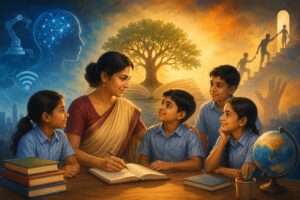
Today, the structure and lifestyle of families have also changed. Joint families are becoming more limited, and many children no longer receive the constant guidance of family elders as they once did. In such times, the teacher’s responsibility increases further. School is not just a place to teach lessons, but also a place to shape children’s personalities and outlook on life. A sensitive teacher can develop qualities such as self-confidence, discipline, patience, and responsibility within students.
The goal of education shouldn’t be merely passing exams. Education is the power that teaches a person to question, reason, make decisions, and face challenges. Education not only empowers a person but also makes them discerning and sensitive. If students achieve high degrees but lack compassion, morality, and social responsibility, education deviates from its true purpose.
Teachers are the strongest force for positive change in society. A teacher transforms a student, a student influences a family, and a family influences society. Thus, a teacher’s influence reaches an entire generation. A nation’s future isn’t shaped solely in parliaments, policies, and plans; its true creation takes place in classrooms. Students in classrooms will become the scientists, doctors, administrators, teachers, public representatives, entrepreneurs, and citizens of tomorrow.
In Indian tradition, the guru has always been held in special respect. From the gurukul tradition to modern universities, the guru-disciple relationship has fostered the tradition of values along with knowledge. Times have changed, the means of education have evolved, and technology has transformed teaching styles, but the fundamental role of the guru remains the same—to lead from ignorance to knowledge and from confusion to wisdom.
Teachers’ Day is not just an occasion to honor teachers, but also a day to reconsider the purpose of education. We must consider whether we are preparing our children only for competition or for life. Do we want them to be successful or also good human beings? The answers to these questions will determine the future direction of our education system.
In the coming eight to ten years, technological changes in education will accelerate. Artificial intelligence will accelerate student learning, enable personalized teaching, and simplify many of teachers’ administrative tasks. But amid this change, the human role of the teacher will become even more important. In the future, a teacher’s worth will be measured not by how much information they can memorize, but by how much they can inspire students to think, understand, question, and become better human beings.
Therefore, teachers need not fear technology. Technology cannot replace teachers, but rather can become a powerful ally. What is needed is for teachers to strengthen their human sensibility while using technology. A balance between machine efficiency and human sensitivity will be the most pressing need in education for the future.
In reality, a teacher isn’t just someone who delivers a curriculum. He or she is the creator of future generations. He or she not only tells students how the world is, but also empowers them to imagine how it should be. This is a teacher’s greatest power.
Therefore, on Teachers’ Day, we should not only wish teachers well, but also recognize their responsibility, respect, and social importance. Technology may change, curriculum may change, teaching methods may change, but the need to make humans human will never end.
Because machines can give knowledge, technology can give information, but it is the teacher who gives direction to life.
This is the real identity of a teacher and this will also be his greatest relevance in the future.

