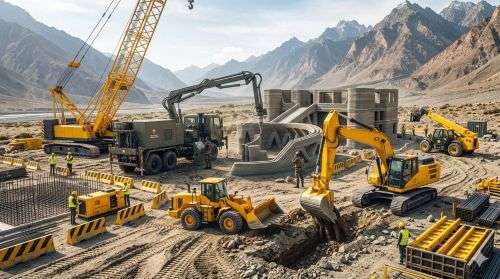
India’s infrastructure story has traditionally been written in tonnes, horsepower and machine hours. Put enough equipment on a project, keep enough people moving and, eventually, the concrete gets poured.
That model still has plenty of life in it, but it is becoming harder to rely on equipment numbers alone. Projects are being delivered in tighter urban environments, safety expectations are rising, environmental requirements are becoming more demanding and contractors have less tolerance for equipment sitting idle. The machine remains central; increasingly, however, the engineering around the machine matters just as much.
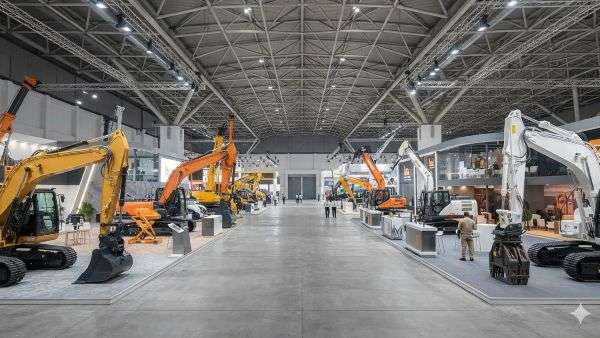
That makes bauma CONEXPO INDIA 2026, scheduled for September 15 to 18 at the India Expo Centre in Greater Noida, worth looking at through a slightly different lens. The exhibition remains firmly about construction machinery, building-material machinery, mining machinery and construction vehicles, but its exhibitor base also includes companies supplying components, systems and technologies that determine how those machines perform.
The interesting part of the show, therefore, may not always be the largest machine in the yard. Some of the more consequential developments could be sitting inside a hydraulic system, behind a gearbox, alongside a power cable or on a testing machine.
Market Dynamics
India’s construction equipment industry is entering a phase in which productivity, reliability and operating efficiency matter alongside fleet expansion. ICEMA’s Vision 2030 agenda has placed technology, localisation, skills and a stronger ecosystem among the industry’s longer-term priorities as India seeks to strengthen its position as a major construction-equipment market and manufacturing base.
For contractors, the commercial equation is relatively simple. A machine that is unavailable when a project needs it can affect more than the machine itself. It can interfere with manpower deployment, work sequencing and downstream activities.
That is making specialised technologies more relevant. A contractor may still need an excavator, crane or concrete plant, but the value generated by that equipment increasingly depends on the components, controls, testing systems and supporting technologies around it.
Bauma CONEXPO INDIA 2026 provides a useful snapshot of that wider ecosystem.
Robotic Deconstruction
Brokk India will be among the companies bringing specialised equipment into that conversation, with the Brokk 130+ demolition robot. Brokk describes the machine as a remote-controlled demolition robot designed for demanding environments and confined or difficult-to-reach areas. The 130+ uses the company’s SmartPower+ system and BHB 175 breaker.
The attraction of this approach is not difficult to understand. Demolition work can involve restricted access, limited working space and situations where keeping the operator away from the immediate work area is useful. A compact remotely operated machine offers another option where conventional equipment may be difficult to deploy.
The Brokk Group is itself a collection of specialised businesses rather than simply a demolition-machine manufacturer. It operates businesses covering remote demolition, hydrodemolition, kiln-maintenance equipment, concrete-crushing and related technologies. The group reported more than 350 employees and approximately SEK 1.4 billion in net sales in 2023.
That gives the Brokk example a useful place in the larger story. Mechanical power is not disappearing; it is being packaged differently for jobs where access and control matter.

Hydraulic Control
Enerpac represents another side of the same shift.
The company specialises in high-pressure hydraulic tools, controlled-force products and solutions for the precise positioning of heavy loads. Enerpac Tool Group is headquartered in Milwaukee, Wisconsin, and serves industrial markets in more than 100 countries.
For infrastructure work, controlled movement can be as important as lifting capacity itself. Large structural elements have to be positioned, aligned and supported during construction and maintenance, often with relatively little room for error.
Hydraulic equipment is rarely the most visible part of a major project. It can nevertheless have an outsized role when a heavy structure has to move in a controlled manner.
That is the sort of technology that fits neatly into a construction industry becoming more conscious of precision rather than relying purely on scale.
Mechanical Integrity
GPRO Drives provides another reminder that some of the most important construction-equipment technology is hidden from view.
The company is participating at bauma CONEXPO INDIA 2026 with a portfolio that includes planetary gearboxes, track drives, winch drives, hydraulic and electric winches and slewing bearings. Its stated markets include construction and material handling, alongside other demanding industrial applications.
These are not components that attract crowds in the way a new excavator does. Yet they sit directly in the chain that converts engine or motor power into controlled movement.
As machines become more specialised, the transmission system becomes part of the machine’s operating proposition rather than simply a replaceable mechanical assembly. Load handling, torque transmission and durability all have consequences for how equipment performs in the field.
It is a useful reminder that equipment productivity can depend heavily on parts most users rarely see.
Automated Testing
Associated Scientific & Engg. Works brings a different dimension to the discussion: measuring whether the materials used in infrastructure are actually performing as required.
The New Delhi-based company manufactures laboratory and material-testing equipment, including compression-testing machines for concrete. Its product range also covers testing applications involving cement, aggregates, soil and bitumen.
Testing does not have the visual drama of a crawler crane or excavator, but it sits much closer to the question of whether an infrastructure project will perform as designed.
Automation can make testing procedures more consistent and easier to document, but it does not remove the need for proper sampling, calibration, supervision and engineering judgement. That distinction is important as construction projects become larger and quality-control requirements more exacting.
The machine may build the structure. The test equipment helps establish whether the material used to build it has met the required standard.
Smart Transmission
Cavotec brings the discussion into an area that is likely to become increasingly important as heavy equipment becomes more electrified.
The company has confirmed its participation at bauma CONEXPO INDIA 2026, where it will present technologies including motorised cable and hose reels, radio remote-control systems, Human Operator Interface systems, connectors, slip rings and megawatt charging systems for battery-powered heavy-duty vehicles and machinery.
Its stated applications include construction, mining and tunnelling.
The significance goes beyond the individual products. Electrification creates a supporting engineering requirement around the machine. Power has to be delivered, cables and connections have to be managed, equipment has to be controlled and charging systems have to cope with increasingly demanding applications.
In other words, the electric machine may get the headline, but a sizeable part of the engineering challenge sits around it.
Smarter Connections
There is another kind of machinery at work at a large industrial exhibition: the machinery of making connections.
Messe Muenchen India’s Buyers’ Club is designed to connect buyers with technology and service providers from the organiser’s exhibitor community. The programme uses professional assistance and technology-driven tools, including AI and machine learning, to match buyer requirements with suppliers.
It is a practical response to a problem that grows with the size of an exhibition. More exhibitors mean more choices, but they can also mean more time spent finding the relevant ones.
For contractors, equipment manufacturers and procurement teams, the ability to reach the right supplier quickly can be almost as useful as finding a new machine.
The Bigger Shift
What emerges from the 2026 bauma CONEXPO INDIA exhibitor landscape is not a story about construction equipment becoming less important. It is almost the opposite.
The machine remains the centre of the operation, but the definition of what makes that machine productive is widening. Remote demolition changes how mechanical force can be deployed. Hydraulic systems improve control over heavy loads. Gearboxes and drive systems determine how power becomes movement. Testing equipment provides another layer of quality assurance. Cable-management, control and charging technologies become more relevant as electrification advances.
None of this means that India’s infrastructure sector is about to stop buying conventional construction equipment. The country will need excavators, cranes, loaders, concrete equipment and other heavy machinery for years to come.
What is changing is the calculation around them.
The next generation of infrastructure projects will still require muscle, but increasingly that muscle will be expected to work with better control, better information and better engineering. That is where the iron renaissance becomes interesting: the future may belong not to machines that simply do more, but to equipment systems that make every hour of machine time count for more.