


MS Shanker
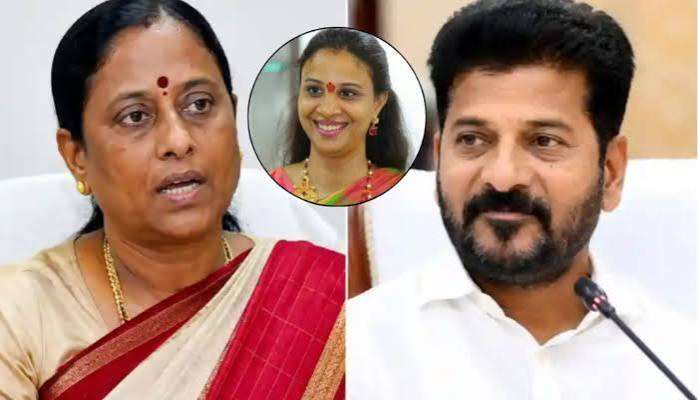
The removal of Konda Surekha from the Telangana Cabinet may, on the surface, appear to be a decisive assertion of Chief Minister A Revanth Reddy’s authority over the State Congress. But beneath that show of command lies a more uncomfortable political question: has the Chief Minister actually consolidated the Congress, or merely pushed its internal contradictions below the surface?
Surekha’s exit did not happen in isolation. The immediate trigger was the controversy surrounding public remarks by her daughter, Konda Sushmitha Patel, who had openly challenged Revanth Reddy over the political future of the Parkal Assembly constituency and made allegations concerning the Chief Minister and his family. The TPCC disciplinary committee recommended action, the Congress high command approved it and the Chief Minister advised the Governor to remove Surekha from the Council of Ministers. Governor Shiv Pratap Shukla subsequently approved the removal.
Legally, therefore, it would be inaccurate to portray the episode simply as the Chief Minister “sacking” a minister on his own. Under the Constitution, ministers hold office during the pleasure of the Governor, while the Governor acts on the advice of the Chief Minister in this matter. The political responsibility, however, clearly rests with the Chief Minister and the Congress leadership that endorsed the decision.
The larger political significance lies elsewhere.
Konda Surekha is no political lightweight. A veteran Congress politician with a substantial political following, she has also had a chequered political journey, including a stint outside the Congress before returning to the party. Her removal therefore carries a message beyond one individual: dissent against the present power structure will carry a price.
That may strengthen Revanth Reddy in the short term. But Congress politics has historically demonstrated that suppressing dissent does not necessarily eliminate it. It can merely drive discontent underground until the electoral arithmetic changes.
The simultaneous decision to rescind veteran Congress leader G Chinna Reddy’s appointment as vice-chairman of the Telangana Planning Board adds another layer to the unfolding political story. The TPCC disciplinary committee had recommended action against both leaders. Whether these measures restore discipline or deepen resentment among sections of the party will become clearer only with time.
There is another dimension that cannot simply be dismissed as political gossip. Various allegations have been circulating in public discourse against the Revanth Reddy government and members of the Chief Minister’s family, including claims relating to land transactions, contracts and alleged benami arrangements. Some complaints have reportedly been submitted to central investigative agencies. But allegations, complaints or political accusations are not evidence of guilt, and no responsible political analysis should pronounce anyone guilty unless an authorised investigation or court establishes wrongdoing.
That caveat is particularly important because Telangana has already witnessed years of political accusations surrounding major projects such as Kaleshwaram. During the 2023 election campaign, Prime Minister Narendra Modi and Union Home Minister Amit Shah had themselves politically attacked the then BRS government over allegations surrounding the project and described it as an “ATM” for the KCR family. Those were political charges; subsequent investigations and judicial or statutory findings must determine actual accountability.
The same principle should apply to allegations against the present government. If complaints exist, the appropriate agencies must examine them independently. If there is evidence, action should follow. If there is none, allegations should not be allowed to acquire the status of political fact merely through repetition.
Meanwhile, independent journalist and self-described whistleblower Bakka Judson has been making allegations of scams involving Chief Minister A. Revanth Reddy and has claimed to have lodged complaints with Central agencies. Videos and related material circulating on social media have added to the political chatter around these allegations. Whether they have any substantive bearing on the ongoing power struggle within the ruling Congress is difficult to predict at this stage. But their potential political impact cannot be dismissed, particularly if they contribute to more dissenting voices within the Congress or prompt Central agencies to examine the complaints on their merits.
Yet politically, perception can be as consequential as prosecution.
The Congress has already experienced the phenomenon of elected representatives changing political allegiance. After winning elections on one party’s symbol, legislators have crossed over when political circumstances changed. Telangana saw large-scale movement of elected representatives from Congress towards the BRS in the previous decade; more recently, the reverse migration from BRS to Congress has become a defining feature of the State’s politics.
That history offers Revanth Reddy a warning.
Fence-sitters rarely announce their departure early. They wait, calculate and move when they believe the ruling party’s electoral invincibility is weakening.
The next Assembly election is still some distance away. That gives Revanth Reddy time to repair organisational weaknesses, accommodate competing ambitions and demonstrate that disciplinary action is about institutional discipline rather than political intolerance.
Otherwise, what appears today as a display of command could eventually be remembered as the moment when the first visible cracks appeared in the Telangana Congress.
The real test, therefore, is not whether Revanth Reddy can remove dissenters.
It is whether he can prevent those dissenters from becoming the nucleus of a larger rebellion.




To be fair to him Revanth removed Congress from ICU but ironically after assuming power, he is pushing the party back into the ICU. He has now declared that he will be a slave to friendship and cannot be bulldozed by anyone. Another surprise is how the senior Congress leaders compromised with this borrowed leader from the TDP.