



Kali Khoh Temple is a sacred cave shrine dedicated to Goddess Mahakali in Vindhyachal, Mirzapur district of Uttar Pradesh. Unlike a conventional temple with a large stone-built sanctum, this shrine lies inside a natural cave in the Vindhya hills. It is one of the three important shrines of the traditional Vindhyachal Trikon Parikrama, along with Vindhyavasini Devi and Ashtabhuja Devi.
The exact age of the present shrine is not known. Its antiquity is associated mainly with the ancient sacred traditions of Vindhyachal rather than with a securely dated surviving structure. The cave itself is considered the sacred abode of the Goddess, and the shrine has continued as an important centre of Devi worship for generations.
The presiding deity is Goddess Mahakali. She is worshipped here in a fierce form and is traditionally associated with the destruction of evil forces. The image of the Goddess has a distinctive upward-facing form, traditionally described as being in Khechari Mudra. The unusual form of the image and the natural cave give the shrine a character very different from most temple sanctums.
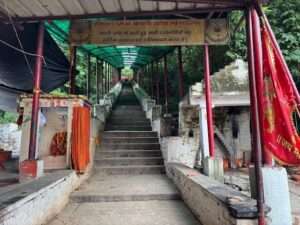
The architecture of Kali Khoh is centred around the natural rock cave. The cave itself functions as the sacred inner space, while the approach and surrounding areas have been developed for pilgrims over time. The natural rocky formation remains the defining feature of the shrine and is an important part of its religious identity.
Historically, Kali Khoh belongs to the sacred landscape of Vindhyachal, one of the important centres of Goddess worship in northern India. Vindhyachal is traditionally associated with several manifestations of the Goddess, and the three principal shrines of Vindhyavasini, Kali Khoh and Ashtabhuja form a sacred triangular pilgrimage circuit. The continued worship at these three places has preserved the religious importance of the Vindhya hills.
According to the traditional sthalapurana, there was once a terrible demon named Raktabija who had received a boon that made him extraordinarily difficult to defeat. Whenever a drop of his blood fell upon the earth, another demon like him was born from it. As the Goddess and her forces fought him, the battlefield became filled with countless manifestations of Raktabija.
Seeing that ordinary methods could not destroy him, the Goddess assumed her most fierce form. From her emerged Mahakali, dark and terrifying, with immense power and a form capable of consuming the demonic forces. Mahakali spread her tongue across the battlefield and drank the blood of Raktabija before it could touch the ground. In this way, no new demons could arise from his blood.
The battle finally came to an end when Mahakali destroyed Raktabija. After the fierce battle, the Goddess is believed to have come to the Vindhya mountains and entered a natural cave to rest. This cave became her sacred abode, and the place came to be known as Kali Khoh, meaning the cave of Kali.
The tradition further explains the unusual form of the Goddess worshipped inside the cave. Mahakali is believed to remain here in Khechari Mudra, with her face turned upwards. Because the Goddess herself is believed to have chosen this natural cave as her resting place, the cave is regarded as more than simply a shelter for the image; it is itself considered part of the sacred presence of Mahakali.
Over time, Kali Khoh became an important part of the larger Vindhyachal pilgrimage. Devotees traditionally visit Vindhyavasini Devi, Kali Khoh and Ashtabhuja Devi as part of the Trikon Parikrama, seeing the three shrines as connected manifestations of the Divine Mother. The cave of Mahakali therefore occupies a distinctive place in the sacred geography of Vindhyachal.
Navratri is the principal festival celebrated at Kali Khoh. The shrine receives large numbers of devotees during both Chaitra and Sharad Navratri, with special importance given to Saptami, associated with Kalaratri, the fierce form of the Goddess. Devotees offer prayers, flowers, lamps and other traditional offerings and seek the protection and blessings of Mahakali.

