MS Shanker
Welcome to the golden age of Indian print journalism, where methodology is a myth, reality is optional, and glossing over basic political arithmetic is standard editorial policy.
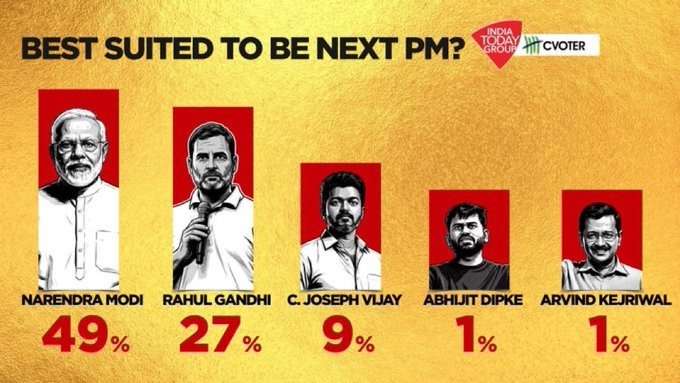
In its latest cover story, a self-proclaimed “national publication” released its flagship popularity survey. The findings? Prime Minister Narendra Modi predictably leads the chart with 49%, while the perennial star of electoral re-launches—the Leader of the Opposition, whose speeches routinely leave voters scratching their heads—clocked in at 27%.
While that rivalry is well-worn, the magazine did not stop there. In a plot twist that belongs strictly in a satirical movie, the pollsters managed to shortlist Tamil Nadu’s actor-turned-politician Joseph Vijay as a potential Prime Minister candidate.
From Silver Screen to 7 Lok Kalyan Marg?
Putting Vijay on a national PM contender list is nothing short of the “joke of the decade”.
- State vs. Nation: Vijay may carry star power in Tamil Nadu, but his political organization is barely out of its infancy.
- Pan-India Reach: Outside southern pockets, a vast portion of the electorate wouldn’t recognize his political symbol if it were printed on their voter ID.
- Math Problem: To treat a localized figure with zero national parliamentary footprint as a prime ministerial contender ignores how federal elections work.
Yet, the magazine presented this data with a straight face, elevating local celebrity status into prime ministerial viability.
A Pattern of Psephological Fiction
This isn’t an isolated misstep—it’s standard operating procedure for Indian media surveys.
Hall-of-Fame Media Survey Blunders
- The 400-Seat Hallucination: Ahead of recent general elections, exit polls uniformly projected sweeping 400-seat landslides for the ruling party, only for ground reality to deliver a sharp coalition reality check on counting day.
- The Studio Audience Poll: National channels routinely run “pan-India” surveys based on sample sizes of barely a few thousand urban respondents, extrapolating the mood of a 1.4-billion-strong nation from a few metro pockets.
- The Celebrity Dragnet: Whenever a regional actor launches a party, national media instantly drafts them into the “PM Race” simply to sell glossies and generate outrage-bait clicks.
The Death of Serious Political Reporting
When national magazines trade rigorous political analysis for clickbait headlines and celebrity hype, journalism turns into a circus. Instead of dissecting policy, governance, or ground realities, news outlets manufacture artificial races between established heavyweights and regional debuts.
If actor-politicians with hyper-local footprints are now automatic PM contenders, why stop there? The next survey might as well poll reality TV stars or IPL captains for the Union Cabinet. It makes for entertaining reading, but as actual journalism, it remains an absolute mockery.