


The battle between Drona and Arjuna raged with astonishing intensity, neither yielding victory nor suffering defeat. Their celestial weapons clashed like opposing forces of nature, filling the heavens with dazzling radiance. Yet, amid their relentless duel, both warriors perceived the terrible devastation spreading across the battlefield. Realizing that countless soldiers were perishing while they remained engaged with one another, they suspended their combat. Drona turned his wrath toward the Panchala forces, while Arjuna drove his chariot against the Kaurava ranks, scattering warriors wherever he advanced.
Elsewhere, Dushasana and Dhrishtadyumna were locked in fierce combat. Unable to withstand the Panchala prince’s relentless assault, Dushasana withdrew from the field in distress. Dhrishtadyumna, born for the very purpose of slaying Drona, immediately advanced toward the preceptor. Nakula and Sahadeva followed closely behind, guarding his rear. However, Krithavarma intercepted Dhrishtadyumna and prevented his immediate approach to Drona.
At another part of the battlefield, Duryodhana and Satyaki confronted one another. Though now enemies in war, they had once shared the affection of childhood companionship. For a brief moment, memories of earlier days softened their hearts, and they exchanged courteous words befitting noble warriors. Yet duty to their respective causes compelled them to fight. Satyaki soon shattered Duryodhana’s bow and pierced his body with a storm of arrows. Overwhelmed by pain and exhaustion, the Kaurava king withdrew from the field.
Witnessing Duryodhana’s plight, Karna rushed forward and challenged Satyaki. Instantly, Bhima came to his ally’s support and attacked Karna with tremendous force. Bhima released torrents of arrows, but Karna effortlessly countered them, smiling amid the contest. Karna then struck Bhima’s charioteer, rendering him unconscious, and shattered Bhima’s bow. Enraged, Bhima seized his mighty mace, whirled it with irresistible power, and hurled it toward Karna. The weapon crushed the head of Karna’s charioteer and smashed the chariot into fragments. Yet Karna remained undeterred. Standing firm amid destruction, he continued to release arrows like a monsoon rain. Soon divisions of the Kaurava army rushed to shield him from danger.
Meanwhile, Yudhishthira, accompanied by the Panchala and Matsya forces, launched a determined assault against Drona. The sun had reached the middle of the sky when Nakula, Sahadeva, and Bhima called out loudly to Arjuna across the battlefield. They warned him that Drona was consuming the Panchala army like a raging forest fire. They urged Arjuna to drive away the warriors protecting the preceptor so that Drona might stand isolated and become vulnerable to attack. While speaking, they themselves advanced toward Drona, who stood surrounded by countless warriors of extraordinary skill and experience.
Drona appeared unstoppable. Elephants fell beneath his arrows, chariots were shattered into splinters, horses collapsed in pools of blood, and warriors were severed limb from limb. Heads and torsos lay scattered across the battlefield. His arms flashed with the force of thunderbolts as he struck terror into the hearts of the Pandava forces. Such was his mastery that it seemed impossible for anyone to halt his advance. Yudhishthira watched the destruction with growing despair and feared that Arjuna would never consent to the death of his revered teacher.
Perceiving the turmoil within Yudhishthira’s heart, Krishna guided Arjuna’s chariot toward him. In the hearing of many warriors, Krishna spoke words of grave significance. He declared that while Drona held his bow, neither gods nor celestial hosts could defeat him. Victory against him through ordinary means was impossible. Yet there existed one path. If Drona were convinced that his beloved son Ashwatthama had died, he would abandon his weapons and cease resistance. Only then could he be overcome. Krishna stated firmly that no other method could bring about Drona’s fall.
The assembled warriors acknowledged the wisdom of Krishna’s counsel, though Arjuna remained troubled by the thought. Yudhishthira’s heart sank further, for he knew both the reverence Arjuna bore toward his teacher and the painful deception now being proposed.
At that very time, Bhima had slain a mighty elephant named Ashwatthama, a prized war elephant belonging to the king of Malava. Seizing the opportunity, Bhima hurried to Drona and shouted that Ashwatthama was dead. The words struck Drona like a thunderclap. For a moment anxiety gripped him, but his confidence soon returned. Remembering his son’s unmatched prowess and divine blessings, he refused to believe Bhima’s claim and resumed his devastating assault.
Drona’s fury grew even greater. Dhrishtadyumna and the Panchala warriors became the focus of his wrath. Thousands of soldiers perished beneath his arrows. Entire divisions of Panchala warriors were annihilated. Turning next upon the Matsya forces, he destroyed hundreds of chariots, thousands of elephants, and vast numbers of horses. Surrounded by fallen kings and shattered armies, Drona shone with terrible brilliance, like a blazing sun consuming the horizon.
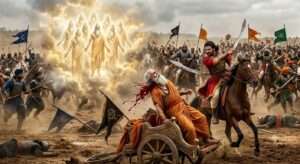
At that moment a wondrous sight unfolded. The seven great sages, headed by Kasyapa and accompanied by many holy seers, appeared before Drona. They reminded him of his noble birth as the son of the sage Bharadwaja, of his mastery of the Vedas and sacred knowledge, and of the righteousness that had once defined his life. They questioned whether it was fitting for such a Brahmin to continue participating in a slaughter so merciless and destructive. Declaring that the appointed hour of his earthly journey had arrived, they urged him to lay down his weapons and embrace peace.
Their words penetrated Drona’s heart. He reflected upon Bhima’s declaration and glanced toward Dhrishtadyumna, who stood waiting for the moment destiny had reserved for him. Though uncertainty lingered within his mind, grief had already begun to weaken his spirit. Seeking certainty, Drona resolved to ask the one man whose commitment to truth was beyond question—Yudhishthira.
When Drona approached and sought the truth, Krishna addressed Yudhishthira with urgency. He warned that if Drona continued fighting even for half a day longer, the Pandava armies would be utterly destroyed. Krishna argued that preserving countless lives outweighed adherence to literal truth in that desperate moment. Bhima reinforced the appeal, reminding Yudhishthira that the elephant named Ashwatthama had indeed been slain and that Drona had disregarded his own report. Only Yudhishthira’s words, Bhima insisted, could convince the preceptor.
The son of Dharma stood torn between truth and necessity. Krishna’s counsel and Bhima’s reasoning weighed heavily upon his conscience. At last, recognizing the terrible demands of destiny and fearing the destruction of his army, he yielded. Raising his voice so all could hear, he declared, “Ashwatthama is dead.” Then, in a much softer tone, he added, “the elephant.” Drona heard the first proclamation clearly, but the latter words escaped his ears.
Sanjaya later described to Dhritarashtra a remarkable sign that followed. Until that moment Drona’s chariot had seemed to glide above the earth with supernatural grace. Now its wheels settled upon the ground. The omen revealed that the tide of his fortune had turned and that the power sustaining his invincibility had begun to depart.
Drona’s thoughts became clouded with sorrow. He remembered the warnings of the sages and reflected upon the burdens of war. If Yudhishthira himself had declared Ashwatthama dead, how could he doubt it? The certainty shattered his resolve. Though he gazed upon Dhrishtadyumna, he no longer possessed the will to fight. The strength drained from his limbs. The fierce energy that had blazed within him throughout the battle faded into stillness. His pride, anger, and martial fervor dissolved beneath the crushing weight of grief.
Slowly Drona laid aside his weapons. His hands and legs lost their vigor. Folding himself into a posture of withdrawal, he abandoned all resistance. His face grew pale, and his spirit seemed detached from the world around him. The mighty warrior who had terrified entire armies sat motionless amid the battlefield, consumed by sorrow and resignation.
As Sanjaya narrated these events, his words carried profound emotion and clarity. The account plunged Dhritarashtra into deep anxiety and anguish. The fall of Drona was not merely the decline of a warrior; it was the unfolding of destiny itself—a solemn moment when even the greatest master of arms was compelled to surrender before the irresistible decree of time, truth, and fate.

