


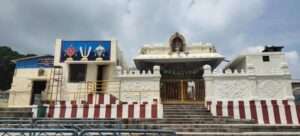
Sri Lakshmi Hayagriva Sannidhi is a historic shrine of Lord Hayagriva situated at the eastern end of North Mada Veedhi in Tirumala, facing the sanctum of Lord Venkateshwara. The shrine is associated with the Sri Parakala Mutt tradition and is especially revered by devotees seeking knowledge, wisdom, and success in education. TTD records that Tirumala has a Hayagriva shrine close to the main temple and that parents traditionally bring their children here for Aksharabhyasa, the ceremonial beginning of education.
The present shrine does not have a securely established construction date, so it is better not to assign a specific century to the present building. Its importance comes from its connection with the medieval Sri Vaishnava tradition and the Parakala Mutt. The Mutt traces its Hayagriva worship to the lineage of Vedanta Desika from the 14th century onwards. Therefore, the shrine is best described as a historic Hayagriva sannidhi rather than claiming that the present structure itself is ancient.
The principal deity is Sri Lakshmi Hayagriva, the horse-faced form of Lord Vishnu accompanied by Goddess Lakshmi. Hayagriva is regarded as the Lord of divine knowledge, wisdom and the Vedas. His horse face is traditionally associated with the power, clarity and brilliance of knowledge. Devotees worship him for education, memory, intelligence and spiritual understanding. This is why the shrine has a special connection with students and the Aksharabhyasa ceremony.
The shrine forms part of the traditional sacred streetscape of Tirumala. It stands at the eastern end of North Mada Veedhi and faces the sanctum of Lord Venkateswara. Unlike the enormous architectural complex of the main Venkateswara temple, this is a smaller sannidhi whose importance lies mainly in its deity, spiritual lineage and continuing tradition. Its location within the Mada Veedhis also places it within the ritual and processional landscape of Tirumala.
The history of the shrine is closely connected with Sri Parakala Mutt, an important Vadakalai Sri Vaishnava institution. According to the Mutt’s tradition, Vedanta Desika worshipped Sri Lakshmi Hayagriva and entrusted the sacred image to Sri Brahmatantra Swatantra Jeeyar in 1360 CE. The Jeeyar established the institution that later became the Parakala Mutt, making Hayagriva its principal deity.
The Hayagriva tradition subsequently continued through the Mutt’s various centres, including Tirumala. Historical material associated with the Mutt also records royal patronage and grants connected with Hayagriva worship in the Tirupati-Tirumala region, including a grant associated with the Tirupati hill during the reign of Mysore ruler Krishnaraja Wodeyar III.
According to the traditional Vaishnava account, Lord Narayana entrusted the Vedas to Brahma, giving him the knowledge required for creation. The demons Madhu and Kaitabha later stole the Vedas from Brahma and hid them in the cosmic waters. Without the Vedas, Brahma could not properly perform his duties.
Brahma sought the help of Lord Narayana, who manifested as Hayagriva, the divine horse-faced form of Vishnu. Hayagriva entered the waters, confronted Madhu and Kaitabha and defeated them. He recovered the Vedas and returned them to Brahma. Because of this divine act, Hayagriva became revered as the Lord who restores lost knowledge and destroys the darkness of ignorance.
The Vedas represent divine wisdom, while their loss represents the condition of ignorance. Hayagriva’s recovery of the Vedas therefore symbolizes the restoration of knowledge and the awakening of wisdom in the seeker. This is why students, scholars and devotees particularly worship Hayagriva.
The Tirumala tradition gives this belief a living expression through Aksharabhyasa. Parents bring young children before Lord Hayagriva and begin their child’s education by seeking his blessings. The ceremony expresses the belief that learning should begin with humility and divine grace.
The shrine is also connected with the tradition of Vedanta Desika, the renowned medieval scholar and poet who was a devoted worshipper of Hayagriva. The Parakala Mutt, with which this shrine is associated, considers Sri Lakshmi Hayagriva its principal deity. This connection has helped preserve the tradition of Hayagriva worship at the shrine.
Hayagriva Jayanti, observed on Shravana Purnima, is the most important occasion associated with Lord Hayagriva. Special worship is performed during Shravana, including special Thirumanjanam at the Tirumala Lakshmi Hayagriva Sannidhi. Daily Thiruvaradhanam and Goshti Prasada Viniyogam are performed, along with Azhwar and Acharya Thirunakshatram celebrations. The shrine’s connection with education also makes it especially meaningful for students and families seeking the blessings of Sri Lakshmi Hayagriva.

