
As someone associated with academics, I find it both surprising and disturbing that political parties opposed to the Narendra Modi government can make sweeping claims about the state of school education without acknowledging the hard data. The allegation that the Modi government has presided over the “closure” of schools, often repeated by sections of the Opposition, presents a distorted picture of what has actually been happening across Bharat.
The more important story is not merely about how many schools exist. It is about what is happening inside those schools—the quality of infrastructure, access to technology, opportunities for girls, inclusion of disadvantaged communities and the gradual shift towards the competency-based, experiential learning envisaged under the National Education Policy (NEP) 2020.
The transformation is visible in the numbers.
The latest UDISE+ data for 2024-25 shows that 93.6 per cent of schools now have electricity, 99.3 per cent have drinking-water facilities, 98.6 per cent have toilets, and 97.3 per cent have girls’ toilets. Internet connectivity has risen sharply to 63.5 per cent, compared with 53.9 per cent a year earlier. These are not political slogans but official government statistics.
That progress matters particularly for girls. The success of the Beti Bachao, Beti Padhao approach cannot be reduced to a publicity slogan. Creating an environment in which girls have access to toilets, safer campuses, better infrastructure and greater educational opportunities directly addresses some of the traditional barriers to their education.
The Modi government’s approach has also been to create model institutions rather than merely add buildings. The PM SHRI initiative aims to develop more than 14,500 exemplar schools aligned with NEP 2020, with modern infrastructure, technology, experiential learning, sports, arts, vocational exposure and green-school practices. More than 20 lakh students are expected to benefit directly. As of the latest dashboard update, 13,070 PM SHRI schools had been identified.
The expansion is not confined to one category of students. The government has strengthened the network of Kendriya Vidyalayas and Jawahar Navodaya Vidyalayas, while giving particular attention to children from tribal communities through Eklavya Model Residential Schools (EMRS). The latter provide residential education from Classes VI to XII for Scheduled Tribe children. The NESTS dashboard currently lists 511 functional EMRS with more than 1.64 lakh students.
There has also been substantial investment through Samagra Shiksha, which supports school education from pre-primary to Class XII. Between 2018-19 and 2024-25, more than 80,000 schools were strengthened, 1.38 lakh schools received ICT and digital interventions, 3,656 schools were upgraded and 242 new residential schools/hostels were supported.
Financial inclusion is another important component. The PM-YASASVI scheme specifically covers OBC, EBC and DNT students through pre-matric and post-matric scholarships, top-class school and college education and hostel support.
Against these facts, the charge that the Centre is simply “shutting schools” is difficult to sustain as a description of the larger national picture. There can certainly be legitimate concerns about individual school closures, mergers, teacher vacancies, regional disparities or learning outcomes. Those issues deserve scrutiny. But isolated problems cannot honestly be presented as the defining character of India’s education policy.
This is where political criticism should also acquire some intellectual honesty. Leaders such as Arvind Kejriwal and others are perfectly entitled to question the government, but criticism should be based on evidence rather than political convenience.
The same applies to Telangana. K.T. Rama Rao’s public observations on education should invite a question closer to home: what did successive state governments do to strengthen government schools and learning outcomes in Telangana? If a political leader’s own family chooses an overseas education, that is a personal choice; it cannot become an excuse to ridicule India’s entire education system.
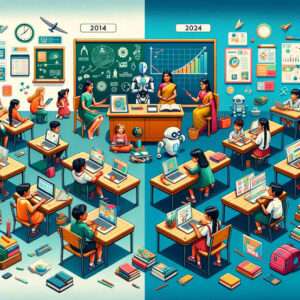
The larger reality is unmistakable. Since 2014, Bharat’s school-education policy has increasingly moved from mere access to access-plus-quality, infrastructure, technology, inclusion and learning outcomes.
The transformation is unfinished, and no responsible person should claim otherwise. But to deny the transformation altogether is to deny the evidence.
For the first time in decades, school education is being treated not merely as a welfare obligation but as a national investment in Bharat’s human capital. That is the real story—and it deserves to be debated on facts, not political fiction.