



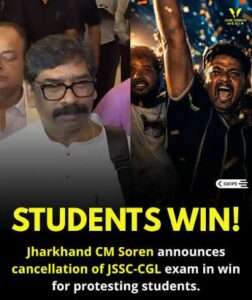
Jharkhand Chief Minister Hemant Soren may have hoped that cancelling the disputed JSSC-CGL examination and other recruitment tests would bring the student agitation to an end. Instead, the decision exposes a much deeper malaise: a recruitment system in which allegations of irregularities, questionable examinations and administrative failures have steadily eroded the trust of the very youth whose future the government claims to protect.
The government’s latest announcement may temporarily cool the streets, but it certainly does not wash away the stains on its recruitment machinery.
The decision to scrap the JSSC-CGL and all recruitment examinations conducted by the controversial private firm TDPL since 2014 is, at best, an admission that something has gone seriously wrong. The government has also ordered a comprehensive state-level probe and constituted an examination reforms committee under senior IAS officer Amitabh Kaushal. But the obvious question is: why should candidates who have already lost precious years trust yet another committee appointed and monitored by the same government whose machinery is under suspicion?
That is precisely why protesting students are demanding a CBI investigation.
The demand cannot simply be dismissed as political grandstanding. Recruitment examinations concern the careers and livelihoods of thousands of young people. When allegations of manipulation and irregularities become sufficiently serious to force the government to cancel examinations, the credibility of the entire recruitment process comes under a cloud. A state-level inquiry, however well-intentioned, may struggle to command the public confidence that an independent investigation can provide.
More damagingly, the government’s decision has created another class of victims: candidates who actually cleared the examinations. They studied, appeared for the tests and secured selections believing that the state would honour the results. Cancelling the entire process leaves them staring at uncertainty. Their anger is understandable.
This is the real tragedy of Jharkhand’s recruitment mess. The innocent aspirant is made to pay for the sins of a system he neither designed nor controlled.
For weeks, students have taken to the streets and some have resorted to hunger strikes. Such sustained agitation does not happen merely because a handful of candidates are unhappy with an examination result. It reflects a much larger collapse of confidence. Jharkhand’s youth are not demanding charity. They are demanding a transparent, credible and corruption-free route to employment.
And the Soren government cannot escape responsibility by announcing cancellations after protests become politically inconvenient.
The larger issue is governance. If recruitment examinations conducted over several years are now being questioned, the government owes the people a convincing explanation about how such a system was allowed to function for so long. Who supervised these examinations? Who approved the agencies? Who was responsible for monitoring the process? Were complaints ignored? If irregularities occurred, who benefited and who facilitated them?
These questions cannot be buried under administrative committees and press statements.
The government must understand that scrapping an examination is not the same as cleaning up the system. Nor is appointing another committee a substitute for accountability. Those responsible for wrongdoing, if established, must face exemplary punishment, while genuine candidates must be protected from being punished for administrative or institutional failures.
Soren’s government therefore faces a credibility test far bigger than the JSSC-CGL controversy. It must decide whether it wants to manage the agitation politically or confront the rot administratively.
The latter requires transparency, an independent investigation, time-bound action and iron-clad safeguards for future recruitment.
Jharkhand’s young people have every right to ask a simple question: if they cannot trust the government with a recruitment examination, how can they trust it with their future?
The cup of woes for the Soren government is clearly overflowing. Cancelling examinations may provide temporary political relief. It will not provide a permanent escape from accountability. Until the government restores credibility and answers the uncomfortable questions surrounding its recruitment machinery, the protests—and the distrust—are unlikely to disappear.

