


MS Shanker
The controversy at the Congress headquarters on Independence Day may have begun with a few seconds of a video clip, but it has quickly turned into something much larger: a political test of how Bharat’s oldest national party relates to one of the most emotive symbols of the freedom struggle.
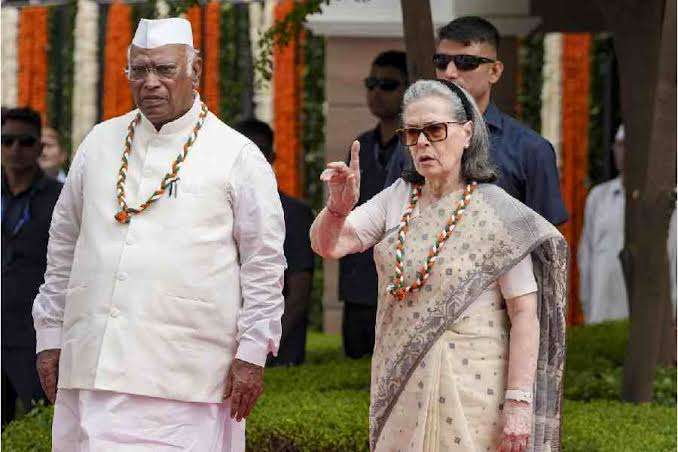
During the Congress party’s 80th Independence Day celebrations, a video showing Congress Parliamentary Party chairperson Sonia Gandhi apparently gesturing towards party president Mallikarjun Kharge while the full rendition of Vande Mataram was being sung triggered a political storm. The BJP interpreted the gestures as disapproval of the song, while the Congress has rejected that interpretation, saying Sonia Gandhi was merely asking for a chair for Kharge.
The video may remain open to interpretation. But the larger political question it has raised cannot simply be waved away.
This controversy comes at a particularly sensitive moment because Parliament has now strengthened the legal protection surrounding Vande Mataram. The Prevention of Insults to National Honour (Amendment) Bill, 2026, passed by both Houses, received the President’s assent and extends to the National Song the statutory protection already available to the National Anthem under the 1971 law. Intentional prevention of its singing or intentional disturbance of an assembly engaged in singing it can attract imprisonment of up to three years, a fine, or both.
That distinction matters. The law does not criminalise an individual simply for choosing not to sing. Nor does an ambiguous gesture automatically constitute an offence. The offence is directed at deliberate obstruction or disturbance. Therefore, it would be legally irresponsible to pronounce someone guilty merely from a television clip.
But politics is not only about criminal liability. It is also about symbolism, sensitivity and public perception.
For the Congress, this should be an uncomfortable question. Vande Mataram was not created as a contemporary BJP slogan. It was an inspirational cry of the freedom movement, evoking the motherland at a time when Bharat was fighting colonial rule. The Government’s own historical account records its role in inspiring the freedom struggle and uniting people in the quest for independence.
The irony, therefore, is difficult to miss. A party that claims the legacy of the freedom movement should be among the first to demonstrate an instinctive respect for the song that stirred generations of freedom fighters.
The Congress has a complicated history with Vande Mataram. The Constituent Assembly accorded the National Song a position of honour alongside Jana Gana Mana, while the two have retained distinct constitutional and ceremonial identities. The present legislation has now removed the statutory gap by extending the penal protection of the 1971 Act to Vande Mataram.
This is where the Congress must answer a political question rather than merely a legal one: why should a song that inspired the freedom struggle become politically uncomfortable in the very headquarters of the party that claims to have led that struggle?
The same question extends beyond the Congress. Any political party, organisation or individual that deliberately obstructs or disrupts the rendition of the National Song must now understand that Parliament has clearly laid down the consequences.
At the same time, the Supreme Court should not be dragged into every political controversy merely because a video clip creates public outrage. Courts are not instruments for settling political arguments. If there is credible evidence of an actual offence, the law has its own investigative and judicial process. The judiciary can interpret the new provision when a genuine legal dispute reaches it; it should not become an arbiter of political optics.
The real responsibility lies with political parties themselves.
Vande Mataram should not become another casualty of India’s vote-bank politics. Nor should patriotism be reduced to a weapon for scoring points against opponents. But neither should the politics of appeasement make national symbols negotiable.
The Congress may dismiss the controversy as manufactured. The BJP may continue to exploit it politically. But beyond the partisan shouting lies a simple truth: when the nation sings “Vande Mataram”, political parties should hear the history behind those words before they hear the politics of the moment.
India’s national symbols belong to no political party. But those who claim the legacy of the freedom struggle have an even greater responsibility to treat them with dignity and respect.
Meanwhile, reports have emerged that the Nirmal Collector in Telangana allegedly refused to salute the National Flag. If the allegation is true, shouldn’t the State Government take appropriate action against such an act? And if the State fails to act, should the Centre hesitate to seek an explanation from a senior public servant for conduct that could be seen as showing disrespect to the National Flag?



Your conclusion is so valid ..as a writer you have responded to the issue rising above party politics..no partisan approach but due reverence to be paid for the core philosophy of the song composed with all devotion and nationalistic values. The song is a prelude for National Freedom struggle .. symbolism of Mother Earth.. among all the countries of political world, with all conference on global warming and climate change..with due apologies of the most modernised nations.. which part of the planet earth treats a significant portion of the earth as Mother Earth and embraces an anthem glorifying her ! Legally any justification can be given for interruption but deep within the hearts they will definitely feel guilty and hope a bit of remorse also happens! Really I appreciate the way you dealt with the issue ,a satisfaction that we didn’t remain as spectators.