As Bharat celebrates its 80th Independence Day today, there is much to celebrate—and much to be ashamed of. We have every reason to take pride in a nation that has emerged as one of the world’s fastest-growing major economies, a formidable military power and a rising force in technology, manufacturing and infrastructure. Yet, on this historic day, the manner in which politics was conducted inside the temple of democracy leaves a bitter taste. The tragedy is not merely that Parliament was disrupted. The deeper tragedy is that Bharat’s political culture appears to have travelled from Samvadan—discussion and debate—to Sadak—taking every disagreement to the streets. That is not democratic evolution. It is democratic regression. The Constitution did not envisage Parliament as a battleground where shouting replaces argument, slogans replace scrutiny and political theatrics replace legislation. It created Parliament precisely because a constitutional democracy needs a forum where competing ideas can collide without the country itself being dragged into chaos. The present Opposition, particularly the Congress leadership, appears to have forgotten this elementary principle. To be fair, the BJP-led NDA was hardly unfamiliar with parliamentary protests when it sat on the Opposition benches. Its leaders disrupted proceedings and protested against governments of the day. Arun Jaitley, a legal luminary and one of the BJP’s finest parliamentary minds, often defended the Opposition’s right to protest. That democratic right was never in question. But there is a crucial difference between protest and paralysis. The Modi government has repeatedly demonstrated a willingness to accommodate Opposition demands to ensure Parliament functions. When the Congress-led Opposition demanded the resignation of Education Minister Dharmendra Pradhan over the examination controversy, the government faced the demand politically. When the Opposition later demanded discussion on alleged police high-handedness against protesting students at Jantar Mantar and raised allegations concerning the use of firearms and pellet guns in Bihar, the government was prepared to engage, debate and respond—including through a statement from the Union Home Minister. Yet the goalposts kept moving.
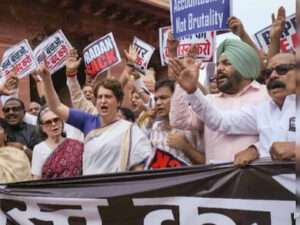
And then came the extraordinary declaration from the Leader of the Opposition: “We are not here to listen to the lectures or sermons of the Home Minister.” That sentence perhaps says more about the current state of parliamentary politics than any disruption ever could. If a statement by a Union Minister inside Parliament—a constitutional forum created precisely for such explanations—is dismissed as a “lecture” or “sermon”, what exactly does the Opposition expect? Parliament is not a street corner. The Home Minister is not addressing a rally. He is answering in a constitutional institution. One may reject his explanation. One may challenge his facts. One may demand further clarification. But refusing even to listen is not dissent. It is disdain for Parliament. Worse still is the spectacle of waving pocket-sized copies of the Constitution while disregarding its spirit. The Constitution is not a political prop to be displayed before television cameras. It is a solemn framework that demands respect for institutions, procedures, debate and accountability. The contrast could not be starker. On one side is a government that, despite possessing the numbers, has allowed Opposition demands to be raised and debated. On the other is an Opposition that appears increasingly convinced that if Parliament does not produce the political outcome it wants, the answer is to abandon Parliament and take the battle to the streets. That is a dangerous road. The Independence we celebrate today was not won so that political disagreements would be settled through intimidation, disruption or street mobilisation. It was won to establish a republic where Samvadan—not Sadak—would be the first resort of democratic politics. The 80th Independence Day should therefore be a moment of uncomfortable introspection. Bharat has grown enormously in eight decades. Sadly, a section of its political class seems to have shrunk intellectually. Parliament must return to being the place where governments are questioned, ministers are challenged, laws are debated and national issues are resolved. Otherwise, the greatest insult to the Constitution will not be tearing it up. It will be waving it in one hand while paralysing the institution it created with the other. That is perhaps the saddest Independence Day moment Bharat could witness.