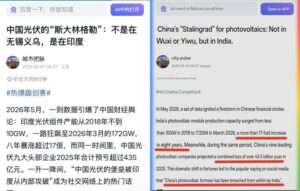
China built its solar manufacturing empire on scale, cheap capital, aggressive pricing, and an extraordinary concentration of the global photovoltaic supply chain. But the very strategy that made Chinese manufacturers dominant has now produced a painful backlash: too much capacity, too little pricing power and mounting losses. For Bharat, this is not a moment for triumphalism. It is a moment for strategic acceleration. China’s solar industry is suffering from a brutal combination of domestic oversupply and destructive price competition. Major manufacturers including LONGi, JinkoSolar, JA Solar, Trina Solar and Tongwei have remained loss-making, with several forecasting substantial losses for the first half of 2026. Tongwei, for instance, has forecast a first-half loss of as much as 5.4 billion yuan. The underlying problem is staggering overcapacity. China expanded manufacturing facilities across polysilicon, wafers, cells and modules far faster than sustainable demand. The result is factories fighting for orders, falling utilisation and manufacturers cutting prices merely to move inventory. This is classic industrial overcapacity: when everyone expands simultaneously, scale ceases to guarantee profitability. But Bharat should not mistake China’s pain for China’s defeat. China still possesses an enormous technological and cost advantage. The International Energy Agency has warned that China’s share of global manufacturing capacity in key upstream stages—polysilicon, ingots and wafers—is approaching 95%. That dominance will not disappear merely because Chinese companies are currently losing money. Yet something important has changed. The world is increasingly unwilling to remain dependent on a single country for a strategic energy technology. The United States is already considering price floors and tariffs on Chinese-dominated polysilicon and related solar products, explicitly citing concerns over subsidised Chinese overproduction and supply-chain dependence. That global diversification creates a window for Bharat. Bharat’s transformation is already remarkable. Solar-module manufacturing capacity has exploded from just 2.3 GW in 2014 to about 172 GW by March 31, 2026—an extraordinary increase of nearly 75 times. In August 2025, Bharat had already crossed 100 GW of module capacity listed under the Approved List of Models and Manufacturers (ALMM). This is where policy has mattered.
The ₹24,000-crore Production Linked Incentive scheme for high-efficiency solar PV modules is designed not merely to assemble panels but to build a deeper domestic manufacturing ecosystem. The scheme provides incentives for five years after commissioning and rewards higher efficiency and greater domestic value addition. ALMM is another important instrument. By requiring eligible manufacturers for specified government-linked and other projects to be on the approved list, Bharat has created a regulatory market for domestic producers while raising quality and reliability standards. But here lies the unfinished business. Bharat has become exceptionally good at expanding module capacity, yet upstream dependence remains a vulnerability. Polysilicon, wafers, specialised machinery and other critical inputs remain heavily concentrated in China. Aatmanirbharta cannot mean merely assembling Chinese inputs into Indian-labelled panels. The real objective must be an integrated ecosystem—from polysilicon and ingots to wafers, cells, modules, glass, backsheets, inverters, storage and eventually recycling. That is precisely why China’s present crisis should be viewed as an opportunity rather than a victory. As Chinese manufacturers struggle with excess capacity and wafer, cell and module prices remain under pressure, Bharatiya companies have a chance to acquire technology, equipment, talent and even distressed global assets at more attractive valuations. More importantly, international customers seeking supply-chain diversification will increasingly look for credible manufacturing bases outside China. Bharat should seize that opening aggressively—but intelligently. The objective should not be to replace Chinese dependence with another protected, inefficient domestic industry. Protection must be temporary and performance-linked. Bharatiyan manufacturers must be pushed towards global quality, competitive costs, technological innovation and exports. The solar race is therefore entering a new phase. China may still be the manufacturing giant, but its overcapacity has exposed the weakness of excessive concentration. Bharat now has something China did not have when it built its solar empire: the opportunity to learn from China’s mistakes while building its own industrial base. If Bharat gets the next decade right, today’s Chinese solar glut could become tomorrow’s Bharatiyan manufacturing opportunity. That would be a far more consequential achievement than simply selling more solar panels.