



Brig (retd) GB Reddi
For over 25 years, I have repeatedly highlighted three realities that India cannot afford to ignore: land is finite, resources are rapidly depleting, and technology is evolving at extraordinary speed. Yet, despite the many missed opportunities since Independence, it is equally important to acknowledge that a transformation has begun over the past decade. India has started regaining lost ground in several critical areas, and that progress deserves recognition rather than being viewed through a jaundiced political lens.
The roots of many of today’s challenges, however, lie in decades of inadequate attention. Successive governments—Congress-led as well as coalition governments—failed to address several structural weaknesses with the urgency they deserved.
Education is one such example. For decades, the emphasis was more on quantity than quality. Skill development failed to keep pace with technological transformation, contributing to the much-discussed phenomenon of brain drain. The result is a generation of young Indians aspiring for rapid change after years of frustration with a system that appeared slow, hierarchical and disconnected from their aspirations.
The challenge is enormous. Millions of young people enter the job market every year, while women increasingly demand equal opportunities and participation across professions. Government employment, however, is finite. Even private-sector employment cannot remain immune to technological disruption, particularly with Artificial Intelligence transforming virtually every sphere of economic activity.
This is where political rhetoric often falls short of reality. Almost every political party invokes the youth, unemployment and the demographic dividend. Yet few acknowledge the structural challenge of creating productive opportunities for such a vast and aspirational population.

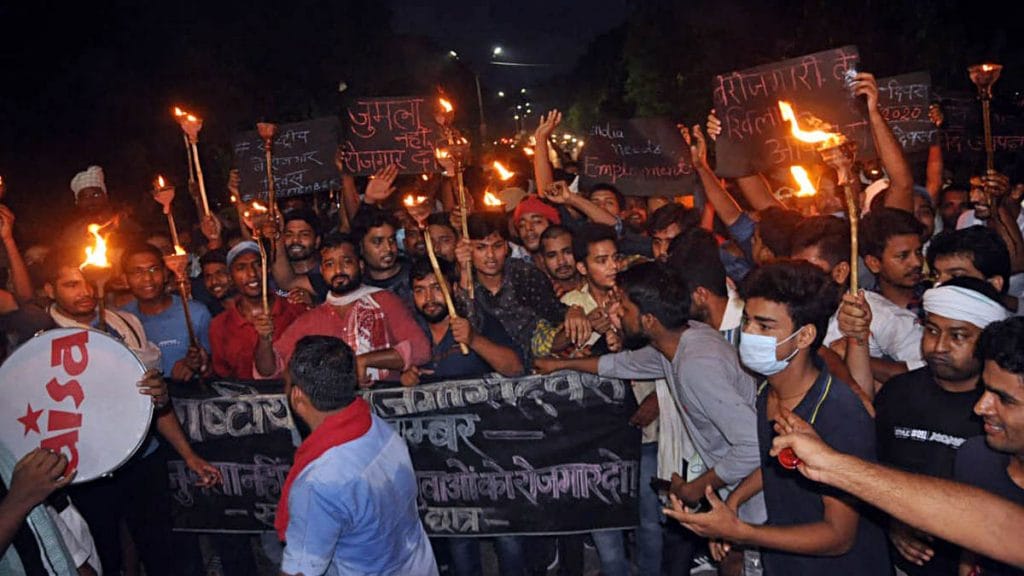
Worse still is the vicious cycle of 24×365 politics. Parties and leaders out of power frequently exploit public frustration, stir sectarian or social sentiments and encourage protests and agitations in the name of democracy. Such movements can quickly spiral into violence, destruction of public property and prolonged disruption. In extreme situations, students and young people have even taken their own lives. When law-and-order situations deteriorate, police action can result in deaths of activists, bystanders and innocents. Fringe elements then exploit the resulting anger to deepen social polarisation. The subsequent politicisation of every such incident further weakens institutions.
India’s internal-security challenges are extraordinarily complex. In my 2001 book Nation in Crisis – Dimensions of National Security and Terrorism, I had separately examined strategic security issues and operational conflicts. Many of those concerns remain relevant even today.
Among the most serious strategic challenges is demographic transition—the “mother” of internal-security challenges. Closely following it is corruption—the “foster mother.” Added to these are crises of national values, leadership and institutional credibility. Religious conflict, regional chauvinism, terrorism, organised crime, security-force overstretch and unresolved problems in different parts of the country add further layers of complexity.
The fundamental challenge is to convert India’s demographic transition into an opportunity rather than allowing it to become a source of instability. That requires a holistic strategy encompassing population management, prevention of illegal migration, rational settlement policies and large-scale human-resource development. The asymmetry between population, resources and technology must be addressed before it becomes unmanageable.
Demography and politics are inseparable. Electoral outcomes are influenced by caste, community, class, gender and regional identities. Any alteration in the traditional social equilibrium can produce political and social tensions. Vote-bank politics can consequently obstruct long-term structural reforms. If demographic pressures are not managed intelligently, today’s opportunity could become tomorrow’s security challenge.
The second major challenge is corruption. No society has ever been completely free of it, and history shows that both authoritarian and democratic systems can suffer from corruption. But in India, its deep penetration into public life has particularly damaging consequences. Corruption erodes institutions, distorts governance, undermines merit and creates a parallel system in which influence and money can matter more than law.
As I wrote in my 2001 book, the real issue is not merely corruption but the opportunity it creates for those willing to exploit public office. Political leaders routinely proclaim “zero tolerance” for corruption, yet corruption continues to thrive wherever institutions are weak, accountability is delayed and political patronage shields the powerful.
The numbers suggest that the problem has not disappeared. India’s position in Transparency International’s Corruption Perceptions Index has improved only marginally between 2013 and 2025, according to the figures cited in this article.
The uncomfortable conclusion is that successive political establishments have failed to adequately confront both the “mother” and “foster mother” of India’s internal-security challenges. Population pressures are rising, resources remain finite and the demands of a young, aspirational society are growing exponentially.
There has undoubtedly been change since 2014, and it would be unfair to deny the progress made. But laws alone cannot transform governance. Institutions and enforcement agencies must become more effective, independent and uncompromising in dealing with corruption and other threats to public order.
India does not lack talent, technology or aspiration. What it needs is institutional capacity, political maturity and a long-term national strategy that rises above electoral calculations.
The time has come for a holistic restructuring of systems, institutions and processes. India cannot afford to merely manage crises as they emerge. It must anticipate them, address their root causes and act before today’s warning signs become tomorrow’s national-security emergencies.



Indian economy is going through a very peculiar turbulence – “perversion”
Yes – we find perversion in the thought process of certain political parties and their members – to create a disturbance and disrupt the functioning of government by instigating the innocent students through protests on various issues. This leads to the sudden diversion of time and energy of the key people in governance from most important matters to these internal issues.
Freedom of speech and expression doesn’t mean “degrading” or “stopping” to any level to garner attention and if possible some political mileage.