Shekhar Maramraju
Infrastructure is not built overnight. It is the product of vision, policy, execution and sustained political commitment. While roads, railways, ports and power projects invariably take years to complete, there are certain periods in a nation’s history when the pace of development accelerates dramatically. India’s infrastructure story since 2014 is one such chapter.
Despite this visible transformation, a section of political critics, self-styled intellectuals and sections of the media continue to downplay the scale of development that has taken place over the past decade. Facts, however, make for a far more compelling argument than political rhetoric.
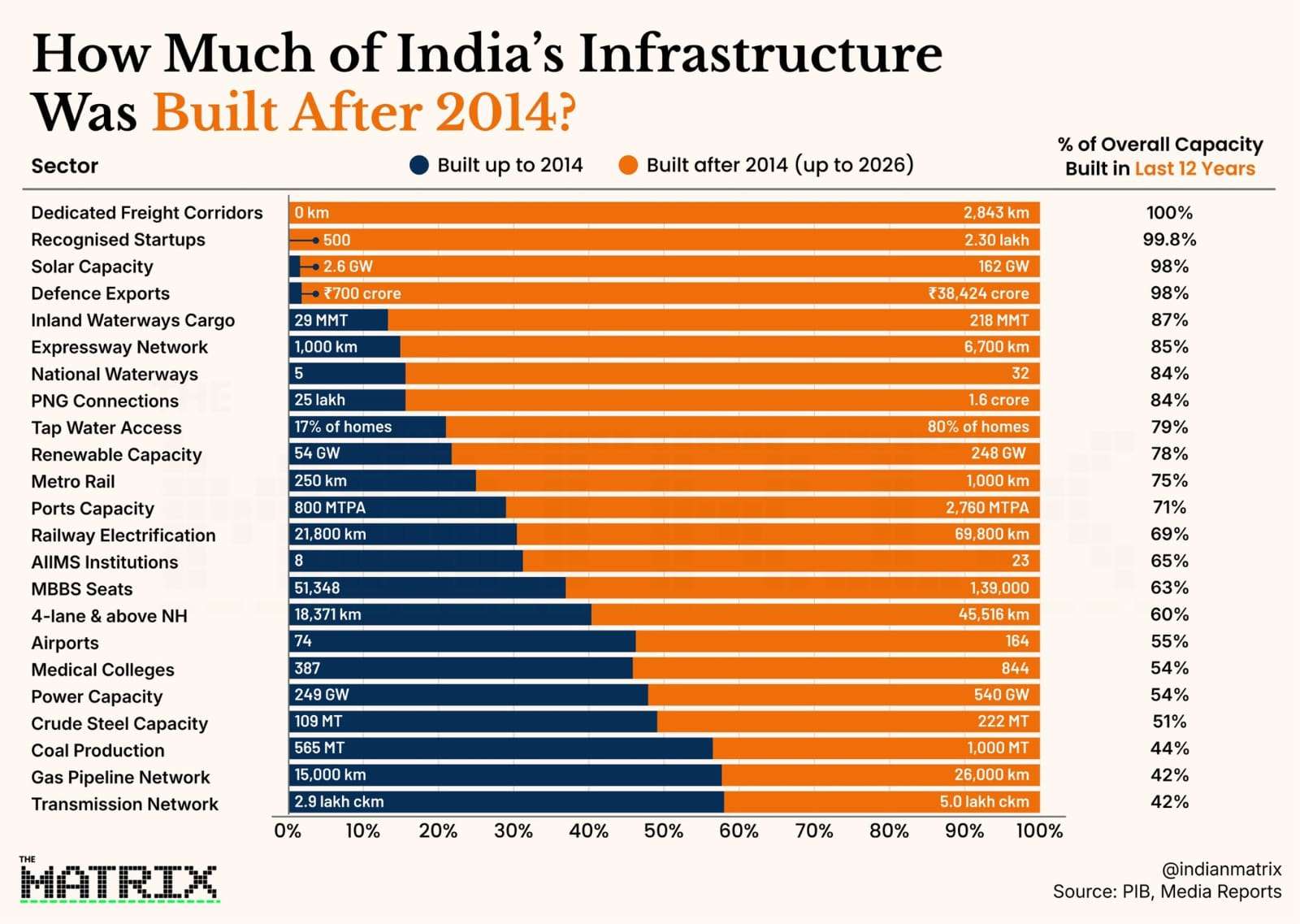
The numbers tell an extraordinary story.
Since 2014, India has added virtually 100 per cent of its Dedicated Freight Corridors, a game-changing railway logistics project conceived decades ago but finally brought to fruition. The Eastern and Western Dedicated Freight Corridors are transforming freight movement, reducing transit time, lowering logistics costs and freeing up passenger rail capacity. They form the backbone of India’s ambition to become a global manufacturing hub.
India has also installed 98 per cent of its present solar power capacity during this period. From being a relatively modest player in renewable energy, the country has emerged among the world’s leading solar energy producers. Massive solar parks, rooftop installations and policy reforms have significantly expanded clean energy generation, reducing dependence on fossil fuels while strengthening energy security.
Equally remarkable is the expansion of India’s expressway network. Nearly 85 per cent of the country’s expressways have been built in the last decade. Modern access-controlled highways such as the Delhi-Mumbai Expressway, Purvanchal Expressway, Samruddhi Mahamarg and several others are reducing travel time, improving logistics efficiency and integrating regional economies in ways previously unimaginable.
Urban mobility too has witnessed an unprecedented transformation. Nearly 75 per cent of India’s Metro Rail network has been added after 2014. Cities across the country—from Delhi’s continuing expansion to Hyderabad, Pune, Nagpur, Ahmedabad, Kochi and several others—now boast modern rapid transit systems that reduce congestion, cut pollution and improve the quality of urban life.
One of the most impactful social infrastructure initiatives has been the Jal Jeevan Mission. Today, 79 per cent of India’s tap water access has been created in the last decade, bringing clean drinking water directly into millions of rural households. Beyond convenience, the programme has improved public health, reduced the burden on women and children who earlier spent hours fetching water, and enhanced overall quality of life.
India’s maritime infrastructure has expanded substantially as well. About 71 per cent of the nation’s present port handling capacity has been created during this period. Modernisation of major ports, improved cargo handling, coastal shipping initiatives and logistics integration have significantly strengthened India’s trade competitiveness.
Railways have also undergone a historic transformation. Nearly 69 per cent of railway electrification has been completed after 2014. Electrified railway lines reduce dependence on imported diesel, lower operating costs, improve efficiency and contribute towards India’s environmental goals.
The road sector presents another striking achievement. Approximately 60 per cent of India’s four-lane National Highway network has been built over the last decade. Better highways are not merely concrete corridors; they connect markets, hospitals, educational institutions, industrial centres and tourism destinations while generating employment and stimulating economic growth.
Infrastructure has always been a long-term national investment rather than a short-term political exercise. Every bridge, airport, freight corridor, metro line and expressway creates economic opportunities that endure for generations. It enhances productivity, reduces logistics costs, attracts investment and improves the daily lives of ordinary citizens.
Healthy democratic debate is essential, but it must rest on facts rather than selective narratives. The data clearly demonstrates that while infrastructure development is a cumulative national effort spanning decades, some governments accelerate that journey far more decisively than others.
The last decade stands out as one of the most intensive periods of infrastructure creation in independent India’s history. These achievements are visible not merely in official statistics but in the everyday experiences of millions of Indians travelling on better roads, accessing cleaner water, using modern metros, benefiting from electrified railways and participating in a rapidly modernising economy. On this count, the government led by Prime Minister Narendra Modi has fundamentally altered India’s infrastructure landscape, creating assets that will continue to power the nation’s growth for decades to come.