Shrikant Rao
A Czech tractor icon is ending nearly eight decades of manufacturing in Brno and moving production to India. The decision is about far more than costs. It reflects the changing economics of global manufacturing, strengthens VST’s international standing and reinforces India’s emergence as one of the world’s most important tractor manufacturing ecosystems.
For almost eighty years, the name Zetor and the city of Brno were inseparable. The Czech manufacturer survived political upheavals, changing ownership, the collapse of traditional markets and intensifying global competition, all while continuing to build tractors in the city where the company was born in 1946.
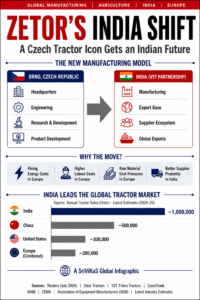
That chapter is now drawing to a close. Zetor has announced that it will end tractor production in Brno and shift manufacturing to India, while retaining its headquarters, engineering, research and development, product development, spare parts and distribution operations in the Czech Republic.
The immediate explanation is straightforward. According to Chief Executive Róbert Harman, producing small and medium-sized tractors in Europe has become increasingly difficult because of high energy prices, rising labour costs and expensive raw materials. Equally important is the need to be closer to suppliers of key components, allowing the company to improve efficiency and accelerate the expansion of its product portfolio. Zetor has already indicated that it intends to export around 5,000 tractors annually from India within the next five years, making the move considerably more strategic than a simple production transfer.
Look beyond the factory gates, however, and the announcement begins to tell a much larger story. It illustrates how manufacturing competitiveness is increasingly being determined not by a single plant but by the industrial ecosystem surrounding it. Companies today compete through supplier networks, logistics, component availability, engineering capability and production efficiency as much as through the products they manufacture. In that respect, Zetor’s decision says as much about India as it does about the Czech Republic.

Market Gravity
India’s position within the global tractor industry has quietly become extraordinary. Annual tractor sales are now approaching one million units, making the country comfortably the world’s largest tractor market. China accounts for roughly half that volume, the United States about one-third, while the combined European market is estimated at roughly one-fifth of India’s annual sales. Those figures are rounded industry estimates, but they underline a reality that manufacturers have recognised for several years.
Scale creates ecosystems.
India’s tractor industry today extends well beyond domestic demand. Around the country’s manufacturing clusters has evolved an extensive network of foundries, engine manufacturers, transmission specialists, hydraulic companies, precision engineering firms, electronics suppliers and logistics providers capable of supporting production for both domestic and international markets. That industrial depth explains why almost every major global tractor manufacturer now has a significant manufacturing presence in India.
Mahindra has emerged as the world’s largest tractor manufacturer by volume, while TAFE has built one of the industry’s largest global businesses through its long association with Massey Ferguson. Escorts Kubota continues expanding its product portfolio, Sonalika has established itself as one of India’s largest tractor exporters, and international companies including John Deere, CNH, AGCO, Kubota, CLAAS and SDF all manufacture products in India for domestic and overseas markets.
Against that backdrop, Zetor’s announcement reinforces a trend that has been developing steadily over the past decade. India is no longer viewed merely as the world’s largest tractor market. It is steadily strengthening its position as one of the industry’s preferred manufacturing platforms.
Strategic Shift
That changing landscape also places VST Tillers Tractors in an interesting position.
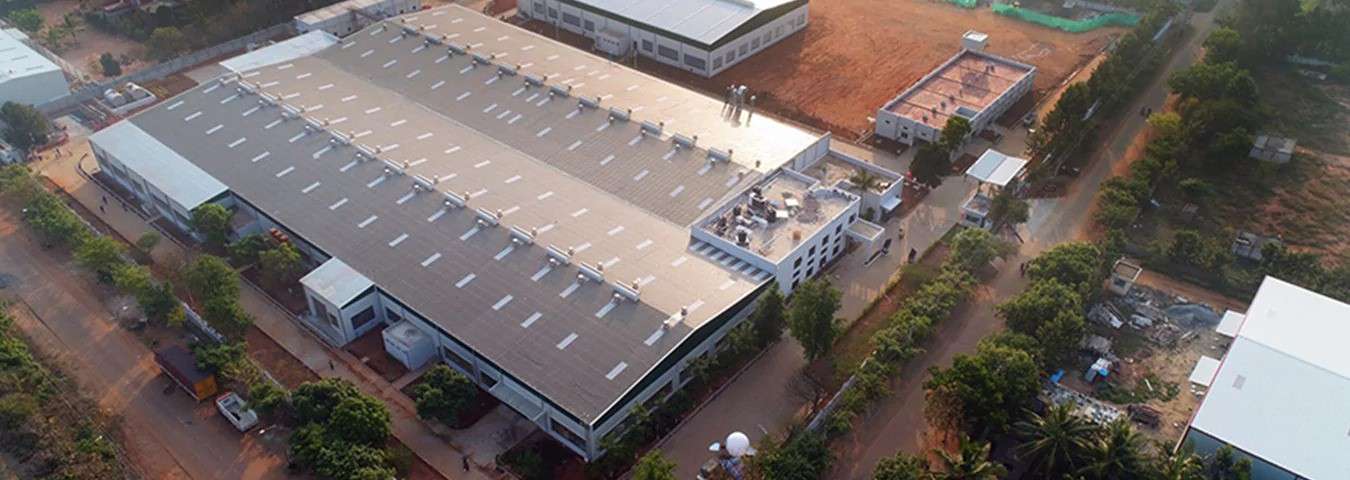
The relationship between Zetor and VST is not new. Since 2020, the Czech company has been manufacturing tractors in India in collaboration with the Bengaluru-headquartered manufacturer, a partnership that subsequently expanded through VST Zetor Private Limited. Until now, however, the arrangement largely complemented manufacturing in Brno. With Czech production ending, the dynamics inevitably change.
VST moves from being a manufacturing partner to becoming the production base for one of Europe’s oldest tractor brands.
That distinction matters.
For decades, VST has built its reputation through compact tractors, four-wheel-drive tractors and power tillers, establishing a leadership position in specialised farm mechanisation rather than competing directly in the high-volume segments dominated by larger manufacturers. That strategy has allowed the company to develop strong engineering capabilities, manufacturing discipline and export-oriented quality systems within clearly defined product categories. Zetor’s decision now gives those capabilities a much larger international stage
Changing Leagues
Manufacturing an eighty-year-old European engineering brand demands far more than available production capacity. It requires consistent quality systems, dependable supplier networks, rigorous process control and the ability to meet customer expectations across multiple export markets. Those capabilities inevitably strengthen the wider organisation. More importantly, they enhance credibility. In manufacturing, reputation travels quickly. When an established European company entrusts production to an Indian partner, other equipment manufacturers inevitably take notice. They begin evaluating not only the factory, but also the supplier ecosystem that supports it.
That is where the implications become much broader than Zetor alone.
Every additional export programme strengthens India’s industrial supply chain. Companies producing castings, forgings, transmissions, hydraulic systems, engines, electronics, sheet metal components, tyres and precision-machined parts all become participants in a larger manufacturing ecosystem. As export volumes grow, suppliers invest in better technology, tighter quality systems and higher production capacities. Those investments rarely benefit a single customer. They raise the competitiveness of the entire manufacturing base.
Viewed from that perspective, the real winners may extend well beyond VST.
Historical Circle
There is another dimension to this story that deserves attention.
India and Zetor have shared a relationship stretching back more than half a century. Between the 1960s and the 1980s, the Czech manufacturer exported tens of thousands of fully built tractors to India, helping introduce modern mechanised farming during an important phase of agricultural development. The relationship deepened in 1971 when Hindustan Machine Tools (HMT) began manufacturing tractors under licence based on Zetor technology. The facility eventually reached a production capacity of around 20,000 tractors annually, making Zetor one of the significant contributors to India’s agricultural mechanisation during the Green Revolution years.
History has an interesting habit of returning in unexpected ways. Half a century ago, India manufactured tractors derived from Zetor designs. Today, India is preparing to manufacture tractors carrying the Zetor badge for customers around the world. Truly, the relationship has come full circle, although under very different industrial circumstances.
New Geography
It would be easy to interpret Zetor’s decision purely as another example of manufacturing leaving Europe in search of lower costs. That would be an incomplete reading of the story.
The company is not relocating its engineering capability. Brno will continue to remain home to headquarters, research and development, product development and brand stewardship. What is moving is manufacturing, supported by an industrial ecosystem capable of delivering scale, supplier integration and competitive production economics.
That distinction matters because it reflects a broader restructuring taking place across global industry. Increasingly, companies are separating engineering from manufacturing, allowing each activity to develop where it performs best. Europe continues to contribute design, research, and technical expertise. India increasingly provides the manufacturing platform capable of converting those ideas into globally competitive products.
Zetor’s decision therefore represents more than the movement of an assembly line. Veritably, it reflects the changing geography of industrial confidence.
For India, the announcement reinforces a position it has quietly been building over many years. The country is no longer attracting manufacturing simply because costs are competitive. It is attracting manufacturing because it possesses the supplier networks, production capability, engineering talent and industrial maturity that global companies increasingly require.
If for VST, it marks entry into a different league, for Zetor, it opens up a new chapter.
For the tractor industry, it may become another milestone in the steady movement of global manufacturing towards Asia.