Lakshmanrao Upadhyayula
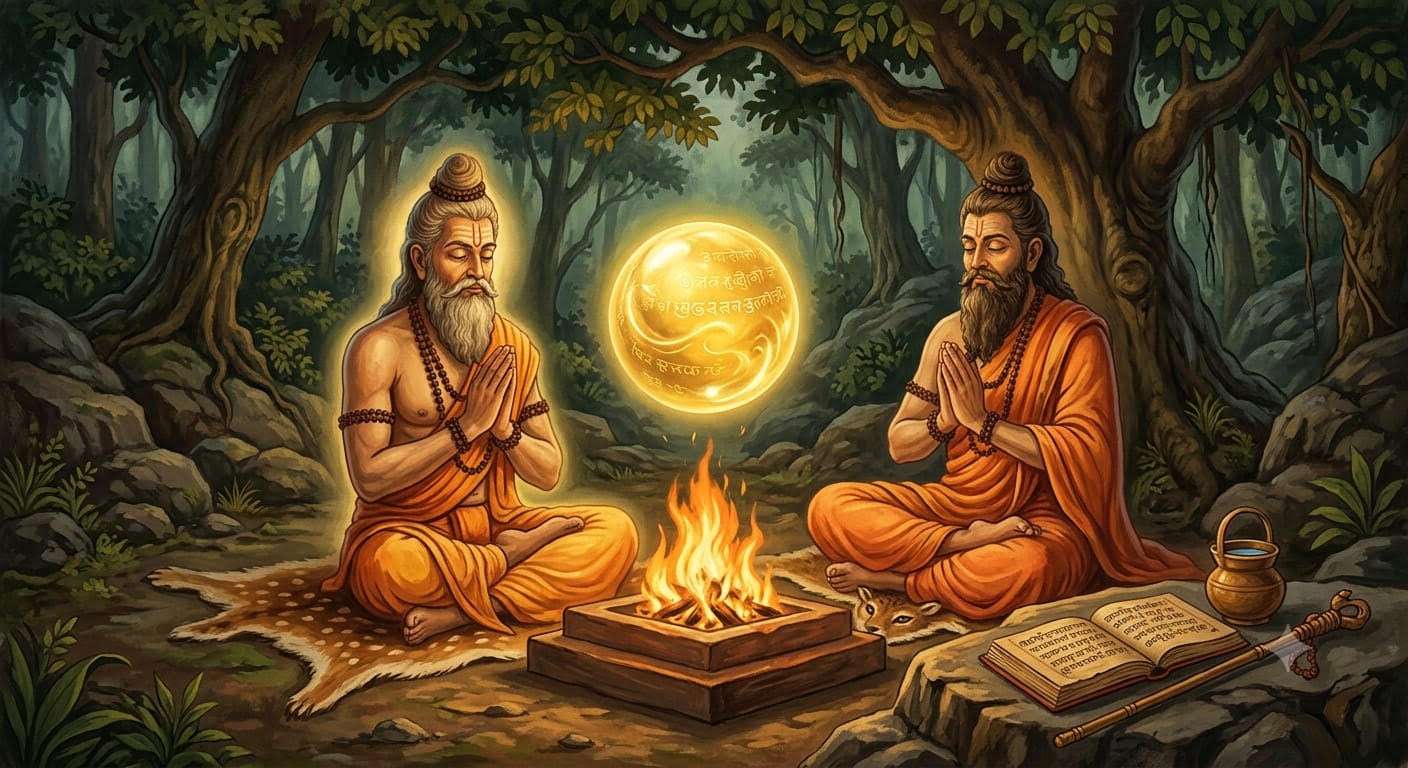
In the sacred cadence of the Anuṣṭubh metre, expanded through the grandeur of Mahāpaṅkti and Mahābṛhatī, the revered sage Agastya raises a profound invocation to the radiant Sun, the all-seeing witness of existence. Surrounded by forces both subtle and manifest—those less venomous and those intensely potent, born of earth and water—he perceives himself encircled within a sphere of hidden toxicity. These forces are not merely physical poisons but represent the unseen afflictions that infiltrate the human body and mind. With clarity of insight, the sage turns not to fear, but to knowledge and divine alignment, recognizing that the same cosmic intelligence that allows the rise of toxins also provides their remedy.
He contemplates the healer, the divine administrator of medicine, who neutralizes harmful organisms dwelling within the body. Time itself, ever-moving and unceasing, acts as an unseen physician, strengthening the body while dissolving subtle toxic accumulations. Within the human frame, life persists through a delicate balance, and when aligned with natural and cosmic rhythms, even the gravest threats lose their dominion. External remedies, when applied with wisdom, complement this inner purification, revealing a harmony between the outer sciences and inner awareness.
The sage then reflects upon the hidden poisons embedded in sacred grasses such as sara, kusa, and dharbha—elements revered in ritual yet capable of harboring subtle harm. Like silent thieves of the night, these toxic entities operate unseen, observing all while remaining invisible themselves. This metaphor extends to the unseen dangers of existence, urging humanity to remain vigilant, disciplined, and aware. The cosmos is then invoked as a living family: the heavens as father, the earth as mother, Soma as brother, and Aditi as sister. These eternal principles, though invisible, maintain equilibrium and observe all without bias, embodying the impartiality of natural law.
In the stillness of night, when deer rest in the forest, cows in their enclosures, and humans in sleep, the venomous forces emerge, surrounding the unaware. The sage identifies that certain poisons reside within vital systems—the shoulders, the organs, and particularly the digestive channels—making them more dangerous due to their intimacy with life processes. Questioning their purpose, he commands these unseen entities to depart, to withdraw beyond distant shores, emphasizing the power of conscious will aligned with cosmic truth.
With the rising of the Sun in the east, a transformation begins. The radiant orb becomes the destroyer of all hidden toxins, the silent and invisible purifier. The Sun perceives all realms without obstruction and annihilates unseen demonic forces that symbolize disease, decay, and imbalance. Its rays, carriers of life and energy, act as both illumination and purification, dissolving poisons and restoring vitality. In this vision, the Sun is not merely a celestial body but a conscious force of universal healing.
The sage declares that just as one discards a vessel after consuming its contents, he casts his poison into the vast radiance of the Sun, where it is rendered harmless. The Sun, mounted upon its celestial chariot, transcends all threats and transforms toxicity into nourishment. This is the doctrine of honey—the profound Vedic insight that even poison, when processed through the right principle, becomes nectar. Transformation, not destruction alone, is the essence of cosmic intelligence.
He recalls a small bird that consumed poison, expelled it, yet remained alive, symbolizing resilience and the body’s innate capacity to survive and adapt. Likewise, humanity, under the guidance of cosmic forces, need not succumb to poison. The Sun, as the divine charioteer, continuously performs this alchemy, dissolving harmful elements and converting them into beneficial essence through its subtle operations.
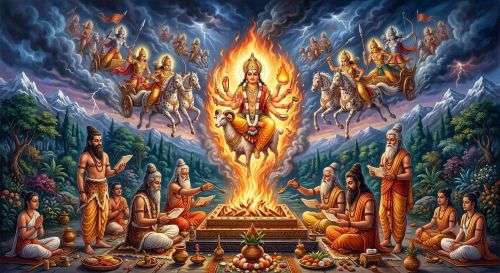
The imagery expands further to Agni, whose seven tongues—white, black, and red—represent diverse transformative energies within nature. These living flames signify metabolic and energetic processes that sustain life. Just as Agni transforms offerings into subtle essence, the human body, aligned with these principles, can withstand and overcome toxic influences.
The sage invokes the ninety-nine rivers, symbols of flowing purification, praying that their currents wash away all toxins. The Sun, once again, is called upon to dissolve impurities at a distance, converting them into sweetness, much like honey gathered with care. The body is addressed directly, as a sacred vessel, capable of renewal and restoration through alignment with these forces.
He speaks of twenty-one birds and seven rivers—symbols of natural agencies—that remove toxins, just as women draw water to fill their pots. Even a small mongoose, known for its resistance to venom, is invoked as a remover of poison. If it fails, the sage asserts his determination to overcome the toxin through forceful means, illustrating the human will to survive and conquer adversity.
Finally, the mongoose itself becomes a messenger of truth, declaring that the scorpion’s poison holds no essence, no real power. This ultimate realization reflects a profound Vedic insight: that fear magnifies poison, while knowledge diminishes it. What appears deadly loses its force when understood in the light of cosmic law.
Thus, the hymn unfolds as both spiritual revelation and proto-scientific observation. It recognizes toxins as biological realities while also interpreting them as metaphors for ignorance and imbalance. Through the combined forces of nature, consciousness, time, and cosmic order, poison is not merely removed but transformed. The narrative affirms that life, when aligned with universal principles, transcends danger and attains harmony, where even the most destructive forces become instruments of renewal.