



The celestial sage Narada, having unfolded a long and profound narration of ancient kings and their destinies, paused and observed the face of King Srunjaya. The king remained composed, his countenance undisturbed by outward emotion. Yet the sage, ever perceptive, wondered whether his elaborate discourse had borne fruit in the king’s heart or had fallen barren like seeds scattered upon unyielding rock. With gentle curiosity, Narada inquired whether the deeper meanings of those histories—the rise and fall shaped by action and consequence—had truly been grasped.
With folded hands and a voice softened by humility, Srunjaya replied that by the sage’s grace, the sorrow arising from his son’s loss had been dispelled. The narratives had not merely instructed him but had purified his mind and lightened his grief. Pleased by this transformation, Narada, who cherished the king as a dear friend, invited him to seek a boon. The king, overwhelmed by gratitude, declared that no measure could bound the sage’s compassion and that his very guidance was itself a blessing beyond compare.
Narada then spoke with quiet assurance, revealing that the king’s son, who had fallen into the hands of thieves, would soon be restored to life. Even as the words left his lips, wonder unfolded before all assembled: the prince Suvarna Shtevi appeared, alive and radiant, and bowed reverently to his father and to the sage. The king, filled with renewed purpose, trained his son in the arts of warfare and established him in the duties of life, guiding him through righteous conduct, sacrifice, charity, and devotion.
The sage explained that the prince, in his former state, had departed prematurely without merit—untrained in arms, unacquainted with sacred rites, and devoid of lasting renown. It was for this reason that he had been brought back, so that he might fulfill the fourfold path of human existence and attain honor through valor and discipline. A warrior who meets his end in righteous battle, adorned with courage and virtue, ascends to higher realms; such an end is no misfortune but the culmination of a noble life.
Thus spoke the venerable Vedavyasa to Dharmaraja, reminding him that the fallen hero Abhimanyu had surpassed many kings in glory and merit. Grief, therefore, was unworthy of such a departure. He urged the king to steady his mind and attend to his duties. Having imparted this counsel, the sage departed, leaving Dharmaraja strengthened yet burdened with a lingering चिंता—how he might convey this grievous truth to Arjuna.
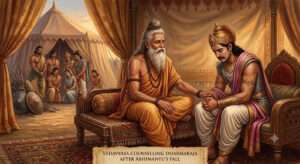
This unspoken concern was later conveyed by Sanjaya to Dhritarashtra, who listened with keen interest. The blind monarch, restless with curiosity, questioned how Arjuna had responded upon learning of his son’s fate, and who had borne the sorrowful message to him. He wondered what storm of emotion had arisen within that unconquerable warrior.
Meanwhile, Arjuna, having decimated the united forces of his adversaries like a blazing fire consuming dry forests, returned from battle. Yet amidst victory, an unshakable unease took hold of him. Turning to Krishna, he spoke of ominous signs that troubled his spirit—his mind grew heavy, his body faltered, and an unnameable dread clouded his thoughts. Though Krishna assured him of his brothers’ safety, he hinted at a dark moment drawing near. Together they completed their evening rites to the Sun and proceeded toward the camp.
As they approached, an unnatural stillness enveloped the surroundings. The camp, once vibrant with life, seemed drained of its spirit, like a painting faded and torn. Soldiers moved in silence, their heads bowed. The melodies of flute and veena, which once filled the air with joy, were absent. Observing this desolation, Arjuna questioned Krishna, unable to fathom the cause. A deeper anxiety seized him when he noticed that Abhimanyu, his beloved son, had not come forth to greet him.
His heart trembled, his breath grew uneven, and his thoughts darkened with foreboding. Receiving no reply from Krishna, his unease turned into dread. Hastening toward Dharmaraja’s quarters, he beheld his elder brother surrounded by grieving kin. The absence of Abhimanyu was glaring, and sorrow hung heavily in the air. With a voice choked by anguish, Arjuna demanded to know the truth.
He spoke with rising intensity, recalling how none but Abhimanyu could penetrate the formidable battle formation devised by Dronacharya. He lamented that the young warrior knew only the art of entering such a formation, not of emerging from it. Was it, he asked, their desperate counsel that had sent the boy into certain peril? Had they, in their helplessness, sacrificed him to an inescapable fate?
Arjuna’s grief deepened as he extolled his son’s virtues—his courage, humility, and radiant prowess in warfare. He wondered how such a warrior could fall to a single foe, concluding that only a multitude, united in treachery, could have brought about his end. He recalled Abhimanyu’s gentle nature, his respect for elders, his noble bearing, and his brilliance in arms, seeing in him the very embodiment of valor and grace.
Images of his son’s former splendor now turned into visions of sorrow. The child who had rested upon silken beds now lay upon the harsh earth; the prince once sheltered beneath royal canopies was now covered in dust; the boy nurtured with tenderness now lay abandoned among beasts. These thoughts pierced Arjuna’s heart, and he cried out that fate was cruel, for it never allows great treasures to endure.
Overcome by anguish, his voice faltered and tears flowed freely. Unable to bear the weight of his sorrow, Arjuna sank to the ground, consumed by grief, as the shadow of Abhimanyu’s loss engulfed his soul.

