



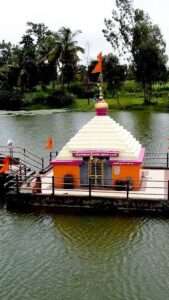
Seshanarayan Temple is situated in the peaceful village of Bahireshwar in Karveer Taluka of Kolhapur district, Maharashtra. The temple stands uniquely in the middle of the sacred Palash Tirtha pond and is connected to the shore by a narrow bridge. Surrounded by lush greenery, agricultural fields, and lotus-filled waters, the temple offers a serene and picturesque setting for devotees. In earlier times, pilgrims reached the temple by boat, making the visit a unique spiritual experience.
Based on its architectural style, the temple is believed to date back to the late Chalukya or early Shilahara period (11th–12th century CE), making it nearly 900–1,000 years old. Although minor restoration works have been carried out over the centuries, the sanctum and the principal deity continue to retain their ancient character and spiritual significance.
The temple is dedicated to Lord Vishnu in his Sheshashayi (Sheshanarayan) form, where the Lord is depicted reclining peacefully on the divine serpent Adishesha. The beautiful idol is carved from a single sacred Shaligram stone, one of the most revered forms of Lord Vishnu in Vaishnavism. The deity represents Lord Vishnu resting in Yoganidra upon the cosmic waters while preserving and protecting the universe.
The finely sculpted idol showcases Lord Vishnu resting gracefully on the coils of Adishesha beneath the serpent’s protective hood. Devotees believe that worshipping Sheshanarayan removes obstacles, brings prosperity, family harmony, peace of mind, and divine protection. Pilgrims visiting the Mahalakshmi Temple in Kolhapur also visit this shrine, as it is regarded as one of the sacred guardian temples of the Karveer region.
The temple is built in the late Chalukya style using stone and stands uniquely in the middle of the sacred Palash Tirtha pond. It consists of a simple Garbhagriha (sanctum) housing the reclining Shaligram idol of Lord Vishnu, crowned by a stepped Shikhara with an Amalaka and Kalasha. The temple’s simplicity, ancient stone construction, and beautiful reflection in the surrounding waters make it architecturally distinctive. Ancient Veergals (Hero Stones) and Sati Stones found nearby further indicate the antiquity of the site.
Bahireshwar was once part of the ancient settlement known as Kasba Beed, an important centre during the rule of the Shilahara King Bhoja I. The temple has served as an important Vishnu shrine for several centuries and has remained closely associated with the religious traditions of the Karveer region.
The temple is mentioned in the sacred Karveer Mahatmya, which describes the glory of the sacred places surrounding Kolhapur. The well-known Marathi version of this text was composed by the scholar Dajiba Joshirao between 1821 and 1832 CE, preserving the traditional significance of this ancient shrine for future generations.
According to the sacred Karveer Mahatmya, the holy region of Karveer, where Goddess Mahalakshmi resides, is divinely protected by four guardian forms of Lord Vishnu positioned in the four cardinal directions. Seshanarayan of Bahireshwar is revered as one of these sacred guardian deities, protecting the western side of the sacred region.
The scripture describes Lord Vishnu reclining on Adishesha in the sacred waters while holding the Sudarshana Chakra, eternally safeguarding the holy land of Karveer from all negative forces. Since the temple stands in the middle of the sacred Palash Tirtha pond, devotees believe the waters symbolize the divine cosmic waters upon which Lord Vishnu rests before creation.
Local tradition also holds that Lord Sheshanarayan blesses the surrounding villages with prosperity, fertile lands, and abundant agricultural produce. Even today, many farmers visit the temple before the beginning of the farming season to seek the Lord’s blessings for a successful harvest.
Daily worship is performed throughout the year, with Mondays attracting many devotees. The most important celebration is the annual Jatra held on the last Monday of Shravan, featuring special Abhishekams, Bhajans, Kirtans, and Maha Prasadam. Vaikuntha Ekadashi, Krishna Janmashtami, Rama Navami, and Narasimha Jayanti are also celebrated with special pujas and devotional programmes.


