



Kalyaneshwar Ganesh Temple is situated in Nandurbar in Nandurbar District of Maharashtra.
The origins of the temple are traditionally traced back to the Dwapara Yuga, with local belief attributing its establishment to King Nanda, after whom Nandurbar is believed to have derived its name. The present shrine is associated with a 13th-century temple, which was later renovated by Punyashlok Ahilyabai Holkar. Over time, the temple became buried beneath layers of earth and remained hidden until it was rediscovered and excavated in 1985, when it was restored to worship.
The presiding deity is Lord Ganesha, worshipped as Shri Kalyaneshwar Ganesh, a highly revered and wish-fulfilling form of the Lord. The main idol is a sindoor-anointed stone murti. The upper hands hold the Pasha (noose) and Ankusha (goad), one lower hand holds a Modaka, while the other is in Abhaya Mudra, blessing devotees with protection and prosperity. The deity is adorned with a silver crown. The sanctum also houses a Shiva Linga, a shrine of Goddess Parvati, and nearby shrines dedicated to Lord Kartikeya, along with several ancient Shiva Lingas and Nandi idols, reflecting the temple’s combined Shaiva and Ganapatya traditions.
One of the most remarkable features of this ancient temple is its roofless sanctum (Garbhagriha). While the Sabha Mandapa has a dome-shaped superstructure crowned with a Kalasha, the sanctum remains completely open to the sky. Devotees believe that this allows Surya Deva (the Sun God) to perform a daily Surya Abhisheka, while Varuna Deva (the Rain God) naturally performs Jala Abhisheka on the deities. The temple features an open courtyard, an entrance with a Nandi idol, a semicircular gateway, beautifully arranged Shiva Lingas protected by five-hooded brass Nagas, and an atmosphere of serene antiquity enhanced by large shade-giving trees within the complex.
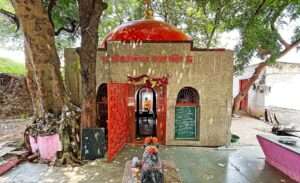
According to local tradition, the city was once known as Nand Darbar, the royal court of King Nanda, which later evolved into the name Nandurbar. It is believed that King Nanda himself consecrated Lord Kalyaneshwar Ganesh, giving the temple an origin linked to the Mahabharata era. Historical records indicate that the shrine received patronage and renovation during the reign of Maharani Ahilyabai Holkar. Another cherished tradition states that Chhatrapati Shivaji Maharaj, while proceeding on his famous Surat campaign, visited this temple to seek Lord Ganesha’s blessings before continuing his journey. Over the centuries, the temple was buried beneath accumulated soil and was rediscovered through excavation in 1985, after which it was restored for public worship.
The sacred legend of Kalyaneshwar Ganesh is deeply connected with King Nanda, whose kingdom is believed to have flourished in this region. The temple is revered as a place where Lord Ganesha has continuously protected devotees since the Dwapara Yuga. A unique belief associated with this shrine is that because the sanctum has no roof, the Sun God personally offers Surya Abhisheka every day, while the Rain God performs Jala Abhisheka during the rains, symbolizing that nature itself worships the Lord. Devotees firmly believe that sincere prayers offered before Kalyaneshwar Ganesh are fulfilled, making the temple one of the most spiritually significant Ganesh shrines in northern Maharashtra.
Ganesh Jayanti, Ganesh Chaturthi (Bhadrapada Ganeshotsav), and Maha Shivaratri are celebrated with great devotion. A Panchakundi Yajna is conducted during Ganesh Jayanti, while Maha Abhisheka, Bhajans, Kirtans, and Pravachans are organized during the major festivals. The temple also attracts large numbers of devotees on Sankashti Chaturthi, Vinayaki Chaturthi, Purnima, as well as every Tuesday and Sunday for special prayers.


