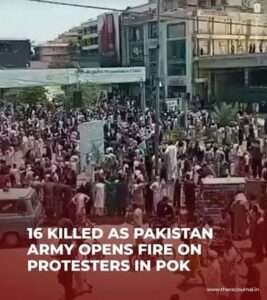
When peaceful protesters are met with bullets instead of dialogue, the world has a moral obligation to speak. Yet, once again, the international community appears to have chosen silence over principle. Reports emerging from Pakistan-occupied Jammu and Kashmir (PoK) of security forces using lethal force against demonstrators demanding basic necessities such as subsidised food supplies, electricity relief and other civic grievances should have triggered global outrage. Instead, the response has been muted, if not invisible. This silence is neither accidental nor inconsequential. It raises uncomfortable questions about the selective application of human rights standards by global institutions that routinely lecture sovereign democracies while appearing reluctant to confront military-backed regimes. For decades, Pakistan has projected itself as a champion of the so-called “Kashmir cause” on international platforms. It spares no effort in raising allegations of human rights violations in India’s Union Territory of Jammu and Kashmir before the United Nations and other forums. Yet, when unrest erupts within territories under its own control, the script changes dramatically. Protesters cease to be citizens exercising democratic rights and are instead treated as security threats. If reports of indiscriminate firing on peaceful demonstrators are accurate, they deserve an independent international investigation. The people of Pakistan-occupied Jammu and Kashmir are human beings with the same rights guaranteed under universally accepted human rights principles. Their demands for food, affordable utilities and accountable governance cannot be dismissed through the barrel of a gun. Equally disturbing is the deafening silence of the United Nations. The organisation has often found the time and inclination to discuss Pakistan’s allegations against India. Yet, when allegations emerge against Pakistan itself, the urgency appears to evaporate. Such inconsistency weakens the UN’s credibility and reinforces the perception that geopolitics often outweighs justice. One cannot ignore the broader geopolitical backdrop. Do diplomatic compulsions drive this silence? Are strategic calculations involving major powers discouraging tougher scrutiny of Pakistan? Does China’s strategic footprint in Pakistan-occupied territories and its investments under the China-Pakistan Economic Corridor make influential nations reluctant to raise uncomfortable questions? These are legitimate questions that deserve honest answers.
The United States, too, cannot escape scrutiny. Washington has frequently positioned itself as a global defender of democracy and civil liberties. If those principles are universal, they cannot become optional depending on the country involved. Human rights lose their moral authority when they are invoked selectively. It is worth recalling that several parliamentarians in the United Kingdom had previously raised concerns over the human rights situation and democratic deficit in Pakistan-administered Kashmir. Their voices demonstrated that not everyone is willing to ignore uncomfortable realities. Unfortunately, such concerns have not translated into sustained international pressure or meaningful institutional action. The irony is impossible to miss. India, despite being a vibrant democracy with an independent judiciary, a free media and robust constitutional safeguards, is routinely subjected to international scrutiny. Pakistan, where the military continues to wield extraordinary influence over civilian affairs, often escapes comparable examination. Such double standards only embolden authoritarian tendencies and erode faith in international institutions. The people of Pakistan-occupied Jammu and Kashmir deserve better. They deserve the right to protest peacefully without fear of bullets. They deserve transparent governance, economic dignity, and political representation. Above all, they deserve to know that their lives matter as much as those of people anywhere else in the world. Human rights cannot be divisible. They cannot depend on geography, ideology or strategic alliances. If international institutions genuinely believe in the principles they proclaim, they must apply them consistently. Otherwise, every sermon on democracy, every resolution on civil liberties and every report on human rights risks being viewed not as a defence of universal values, but as an instrument of geopolitical convenience. The silence over Pakistan-occupied Jammu and Kashmir is becoming increasingly difficult to defend. The world must stop looking away. Justice delayed may be tolerated by diplomats, but for ordinary people living under repression, justice denied carries a far heavier cost.