Lakshman Rao Upadhyayula
In the measured cadence of the Tristubh metre of the Rigveda, the sage Agastya raises his contemplative voice to Agni, the radiant mediator between the mortal and the divine. Agni is not merely the physical flame that consumes the oblation, but the luminous intelligence that pervades all spheres of knowledge, the guiding principle that leads human aspiration toward righteous prosperity. In this invocation, the seer seeks not wealth alone, but the wisdom to pursue it along the path of harmony, where suffering born of distortion and moral deviation finds no entry.
Agni is addressed as ever-fresh, eternally युवा in essence, symbolising the regenerative principle embedded in nature itself. The hymns offered are not mere poetic utterances but structured vibrations aligned with cosmic rhythm, reflecting an early scientific temperament wherein sound, intention, and natural law converge. The plea for release from inexcusable sins reveals an ethical consciousness deeply rooted in accountability, recognising that human error disrupts both inner balance and universal order. Thus, Agni becomes the purifier, transforming both matter and mind through the sacred act of yajña.
The aspiration extends beyond the individual to the collective domain, where the land is envisioned as उत्कृष्ट and the settlement as distinguished among peoples. This reflects a socio-spiritual ecology in which prosperity is inseparable from righteousness. The prayer for progeny and contentment signifies continuity of life and culture, while also hinting at the biological and psychological dimensions of well-being. In invoking protection from disease, the hymn subtly acknowledges the vulnerability of the human body and the necessity of maintaining harmony between internal systems and external environment, an idea resonant with early holistic health principles.
The invocation further seeks insulation from forces that disrupt order—those who reject sacred discipline, those driven by harmful intent, and those embodying chaos in subtle or manifest forms. These references, whether to venomous creatures or destructive beings, may be read both literally and symbolically, representing natural dangers as well as psychological and social threats. Agni, as the vigilant force, is invoked to maintain boundaries, preserving the sanctity of life and thought.
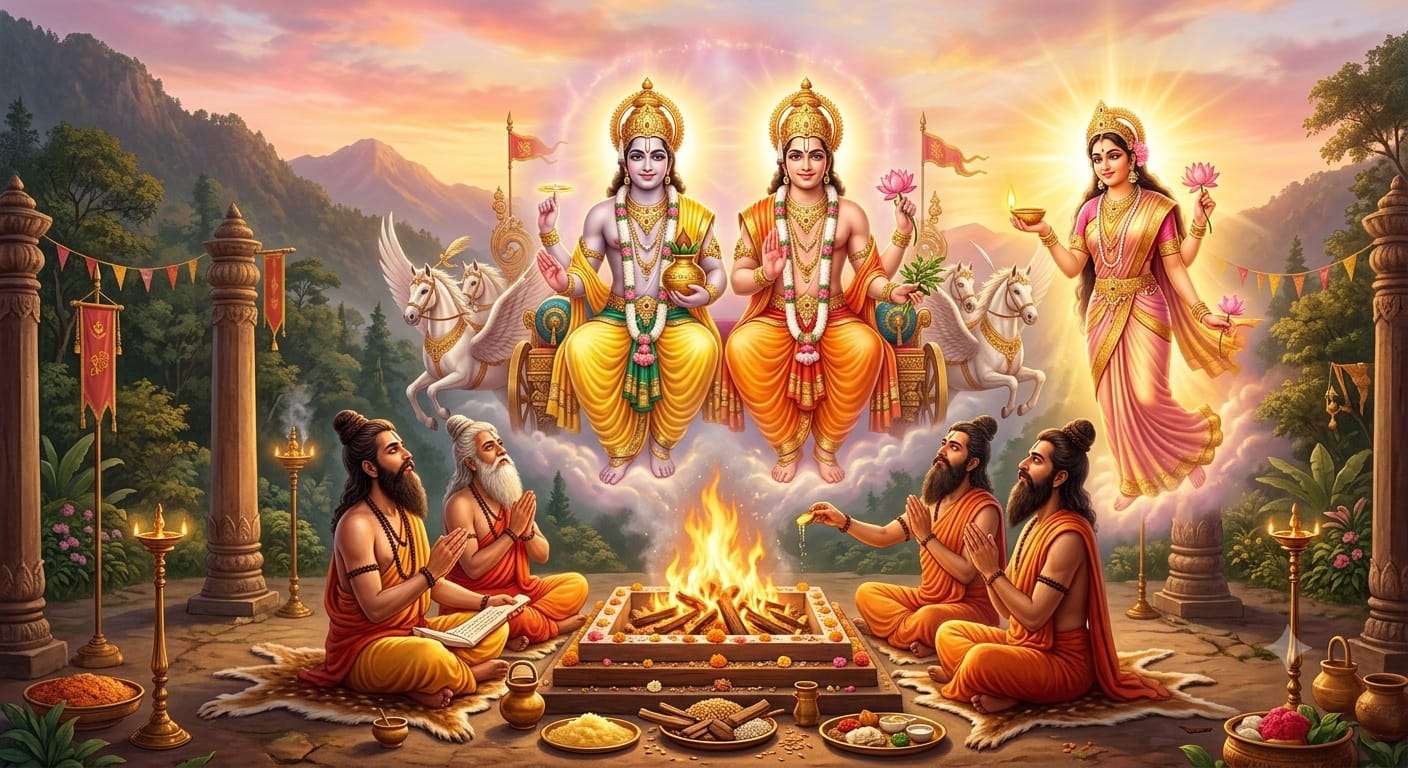
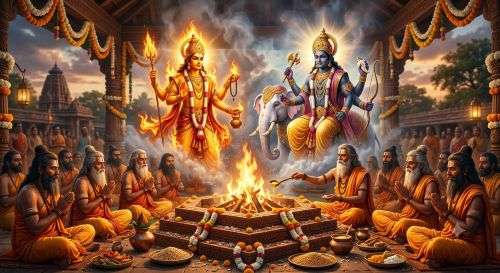
In the sacred enclosure of yajña, Agni is welcomed along with the immortal hosts, affirming the ritual as a convergence point of visible and invisible energies. The fire altar becomes a laboratory of transformation, where offerings are transmuted into subtle energies, reflecting a proto-scientific understanding of conservation and conversion. The repeated invocation for auspicious outcomes underscores the belief that disciplined action, when aligned with cosmic law, yields harmonious results.
Agni is also the refuge, the sheltering presence that illuminates the ritual space from all directions, symbolising the diffusion of awareness across the field of existence. The absence of fear before Agni reflects a state of inner clarity, where the individual, aligned with truth, no longer trembles before the forces of nature or conscience. The prayer to be protected from violent beings, venomous threats, and destructive tendencies signifies a comprehensive desire for safety—physical, moral, and spiritual.
As the producer and sustainer of yajña, Agni occupies a central role in the Vedic worldview, bridging effort and outcome. Those who honour this principle through disciplined action are said to gain strength, protection, and fulfilment, while the crooked and deceitful are naturally dissolved by the very law they violate. The distinction between those who perform yajña and those who neglect it reflects not ritual exclusivity, but a deeper division between those who live in alignment with order and those who stray into dissonance.
Finally, the hymn culminates in a profound offering of devotion, where the seer presents these verses as embodiments of transcendental light. Agni is invoked as the nourisher, the giver of food, vitality, strength, and longevity, encompassing both material sustenance and subtle ऊर्जा. In this synthesis of reverence and reason, the hymn stands as a testament to a civilisation that perceived no division between spirituality and science, but rather saw in Agni the unifying flame that illuminates both the outer world and the inner self.