



The profound and subtle nature of Mruthyu was once expounded by the divine sage Narada to King Akampana, whose heart was burdened with grief. The sage spoke of Vayu, the cosmic breath, whose roaring force and terrible stride move in sovereign independence. Majestic, unmatched in valor and brilliance, he is at once the protector and the destroyer of embodied life. As the unseen lord of vitality in every living being, he governs the ceaseless rhythm of existence, for the subtle movement of life—its departure and return—is no novelty to him, but rather his eternal function. Thus, the entry into life and the exit from it are but the natural duties of this divine wind, performed without attachment or pause.
Narada, with serene wisdom, further revealed that beings rise and fall according to the measure of their merit. Men, by righteous deeds, ascend to divine realms, while the gods themselves, upon the exhaustion of their merit, descend again into mortal existence. This grand interchange between the human and the divine is no accident but the ordained play of the Creator, a cosmic balance that sustains the order of the universe. Therefore, he counseled the grieving king not to despair for his departed son, who, having fallen in valor, must surely have attained the immortal realm reserved for martyrs. “Why grieve,” said the sage, “for one who dwells now amidst celestial joys, honored by the denizens of heaven, while you remain bound to sorrow on earth?”
In this teaching, the venerable Vyasa subtly affirmed that the fruits of righteousness alone secure one’s ascent to higher worlds. The noble Abhimanyu, pure in spirit and heroic in deed, had attained celestial honors through his sacrifice. Yet, even such exalted states are not eternal; upon the waning of accumulated merit, the soul must once more return to the mortal plane. Thus, the interplay between the human and the divine is an unbroken cycle, binding all beings—whether earthly or celestial—to the wheel of existence.
Narada continued, reminding the king that the world is inherently woven with sorrow, while his son had reached a realm untouched by grief, dwelling forever among noble souls. Hearing this, King Akampana came to understand the inscrutable design of Brahma, and his heart was freed from anguish. With humility and gratitude, he addressed the sage: “O best among seers, your timely narration of ancient truths has dispelled my sorrow. My mind is now at peace, convinced by your grace.” Having thus consoled the king, Narada departed for his celestial abode, known as Asokavana, a realm of perpetual joy and freedom from sorrow.
Thereafter, Vyasa declared that whoever hears or reflects upon the sacred account of King Akampana shall be blessed with tranquility of mind, strength of body, enduring prosperity, and a life free from affliction, as ordained by Narada himself. He recounted how Abhimanyu, unwavering and fearless, fought valiantly without retreat, wielding many weapons against overwhelming foes, and thereby attained the glory of a hero’s heaven adorned with divine honors. Therefore, none should grieve for such a soul. Reflecting upon this, Yudhishthira resolved that the highest duty of a king lies in steadfast adherence to righteousness.
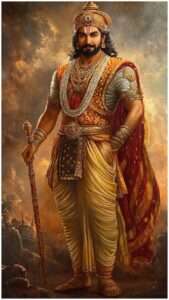
Yet, filled with inquiry, Dharmaraja addressed Vyasa, seeking to understand how the great kings of old, who perished in battle, had performed grand sacrifices, upheld dharma, and attained their exalted states. Vyasa, discerning the intent behind his question, replied that the king sought to compare the merits of Abhimanyu with those of the ancient rulers. Dharmaraja, in reverence, acknowledged the sage’s insight, declaring that his divine mind ever moved in paths of inspiration, and that his thoughts and words were inseparable in their truth.
The sage then explained that those who perform sacrifices, shine through austerities, give generously, uphold character under all trials, and embrace heroic death in battle attain the heavenly realms. Yet, the destiny of Arjuna’s son was of a higher order still, surpassing even these merits. To illuminate this truth further, Vyasa began recounting the lives of illustrious kings, reminding Dharmaraja that even the greatest among them did not remain on earth forever.
The spoke of King Srunjaya, a sovereign embodiment of virtue and glory, who ruled the earth bounded by the oceans and honored Brahmins, scholars, and sages with unwavering devotion. The celestial sage Narada shared a close companionship with him, and they often conversed on the principles of righteous governance and the duties of kings. Whenever faced with intricate dilemmas, the king sought guidance from Narada, whose wisdom illuminated even the most obscure paths.
On one occasion, the learned Brahmins prayed to Narada that King Srunjaya might be blessed with a son to secure the future of the kingdom. Pleased with their foresight, Narada invited the king to express his desire. Srunjaya, filled with reverence, spoke of his longing for a son endowed with righteousness, strength, and beauty, and who’s very being would bring prosperity, even wishing that the child’s excretions might turn to gold. Granting this extraordinary boon, Narada blessed him with a son named Suvarnashthivi. The kingdom flourished, for the prince brought forth gold daily, and joy filled the hearts of all.
Yet, destiny took a grim turn. A band of cruel thieves, driven by greed and delusion, believed the boy’s body to be filled with gold. In their madness, they slew him and cut him into pieces, only to find no trace of the treasure they had imagined. Disillusioned and cursed by their own sin, they turned upon one another, and their mutual cruelty led to their complete destruction. Thus, the inexorable law of karma unfolded before the eyes of the world, demonstrating its universal and impartial nature through the rise and fall of lives.
In this manner, Vyasa prepared to reveal the next phase of this tale, wherein the deeper currents of destiny and righteousness would be further unveiled, guiding the mind toward a clearer understanding of the eternal law that governs all beings.

