

Energy has always been the backbone of economic growth. Every industrial revolution, technological leap and manufacturing boom has been driven by abundant, reliable and affordable power. As Bharat marches towards becoming a developed nation by 2047, ensuring uninterrupted energy security has become as important as safeguarding its borders. It is in this larger context that the uranium partnership between India and Australia assumes historic significance. Often viewed merely as a bilateral trade arrangement, the Australia-India uranium deal is, in reality, a strategic milestone that could fundamentally transform India’s civil nuclear energy landscape. It also reflects Prime Minister Narendra Modi’s broader foreign policy doctrine of building trusted partnerships across continents while placing India’s long-term national interests at the centre. Australia possesses nearly 28 per cent of the world’s known recoverable uranium reserves—the largest globally. For decades, India, despite possessing an advanced nuclear programme, faced limitations in accessing international uranium supplies because of geopolitical restrictions. Those constraints eased following the India-US Civil Nuclear Agreement and India’s waiver from the Nuclear Suppliers Group. The subsequent operationalisation of uranium exports from Australia has now strengthened India’s fuel security considerably. Reliable access to uranium removes one of the biggest bottlenecks confronting India’s ambitious nuclear expansion plans. The country currently has an installed nuclear power generation capacity of around 8 GW, contributing roughly three per cent of its total electricity generation. While modest today, the future roadmap is far more ambitious. India aims to scale nuclear capacity to nearly 22 GW by 2032 and eventually around 100 GW by 2047 as part of the Viksit Bharat vision. Such an expansion would dramatically alter India’s energy mix. Unlike solar and wind power, nuclear energy provides stable, round-the-clock baseload electricity independent of weather conditions. As India witnesses unprecedented growth in manufacturing, semiconductor fabrication, artificial intelligence infrastructure, electric mobility, metro rail networks and massive data centres, dependable power will become indispensable. Nuclear energy can complement renewable sources by providing uninterrupted electricity to industries and urban centres. The Australian partnership therefore strengthens not merely India’s energy basket but also its economic competitiveness. Every additional gigawatt of clean nuclear energy reduces dependence on imported fossil fuels, improves energy affordability and contributes towards India’s climate commitments. It also enhances resilience against global oil and gas price shocks that have repeatedly unsettled international markets.
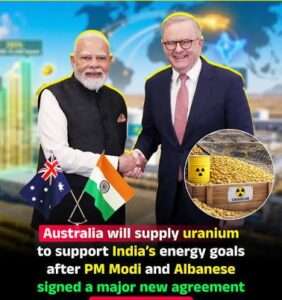
Importantly, uranium exports from Australia are governed by stringent International Atomic Energy Agency safeguards. The material supplied is exclusively meant for India’s civilian nuclear reactors, reaffirming New Delhi’s impeccable record as a responsible nuclear power committed to global non-proliferation norms. Equally significant is what the agreement says about India’s evolving diplomacy. Under Prime Minister Modi, New Delhi has pursued deeper engagement with countries across ideological and geographical divides. Whether strengthening strategic partnerships through the Quad, expanding defence cooperation, signing comprehensive economic agreements or securing critical mineral supply chains, India has demonstrated an ability to build bridges without compromising its strategic autonomy. Australia occupies a special place in that framework. Beyond uranium, bilateral cooperation today spans defence, maritime security, education, technology, critical minerals, cybersecurity and trade. The Indian diaspora in Australia—numbering over one million people of Indian origin and forming one of the country’s fastest-growing migrant communities—has emerged as a vibrant bridge connecting the two democracies. Indian students, professionals, entrepreneurs and researchers have significantly enriched Australia’s multicultural fabric while simultaneously strengthening people-to-people ties. The uranium partnership is therefore symbolic of a much larger transformation. It underscores growing trust between two Indo-Pacific democracies that increasingly share common strategic interests in ensuring regional stability, secure supply chains and economic resilience. Critics may argue that renewable energy alone should dominate India’s future. Solar and wind will undoubtedly remain central pillars of India’s green transition. However, a nation aspiring to become a $30 trillion economy cannot depend solely on intermittent sources of electricity. Nuclear power offers stability, scalability and carbon-free generation, making it an indispensable component of the country’s future energy architecture. History often judges governments not merely by political victories but by decisions that shape national destiny for decades. The India-Australia uranium partnership belongs in that category. It secures fuel for India’s expanding nuclear programme, strengthens bilateral trust with an important strategic partner and reinforces the larger vision of an energy-secure, technologically advanced and globally respected Bharat. For a nation determined to power its development while reducing carbon emissions, this is not merely a uranium deal. It is an investment in India’s energy independence, economic prosperity and strategic future.