



India’s cities are rapidly transforming. Wide roads, elevated flyovers, expressways, metro networks, and smart city projects are being hailed as symbols of modern development. But amidst this dazzling growth, a fundamental question has consistently been neglected—are our cities built for humans or solely for vehicles? Does a citizen truly have the right to walk safely, respectfully, and comfortably?
The ‘Right to Walk’ is not just a transportation issue, but a serious question of spatial justice, social equality, and human dignity in modern urban landscapes. Equal access to public spaces should be a fundamental right of every citizen in any democratic society. If a person cannot walk safely on the street, it is not just a traffic problem but a sign of a limitation of their civil rights.
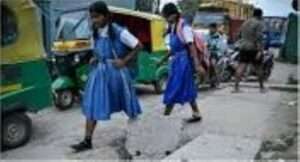
Millions of people in India still travel a significant portion of their daily journeys on foot. Schoolchildren, the elderly, women, the disabled, laborers, small shopkeepers, and most people who use public transport all walk at some stage or another. Despite this, pedestrians are given the lowest priority in our urban planning. Footpaths either exist, are encroached upon, or are in such poor condition that people are forced to walk on the road. As a result, pedestrians account for a significant portion of road accidents.
Ironically, those without private vehicles are the ones who face the greatest risks. Wider roads are built for those who own cars; those without vehicles are denied even safe sidewalks. This inequality is not just an example of economic injustice, but also of spatial injustice.
Spatial justice means that all citizens have equal access to a city’s public resources, spaces, and amenities. If a city’s public space is devoted to vehicles, and there are insufficient facilities for pedestrians, cyclists, and people with disabilities, this reflects an unequal distribution of public space.
Most roads in Indian cities have been developed with a vehicle-centric mindset. The primary objective of traffic management is considered to be increasing vehicle speeds, whereas the true purpose of a road should be to safely transport people from one place to another. This is why sidewalks end abruptly, electricity poles, transformers, or carts are found standing in the way, and parking lots occupy entire spaces.
Safe pedestrian paths for women are not just a matter of convenience, but of freedom. If a woman has to navigate a dark, deserted, or broken road in the evening, her mobility is limited. Similarly, high sidewalks, crossings without ramps, and high-speed traffic pose serious obstacles for the elderly. People with disabilities are often unable to use public spaces at all.
This is why the United Nations’ Sustainable Development Goals (SDGs) place special emphasis on inclusive, safe, and accessible cities. Cities will be inclusive when every citizen—regardless of income, age, gender, or physical ability—can use public spaces with equal respect.
A major irony in urban development today is that progress is often evaluated based on how fast vehicles can travel on the roads. When the true measure of a developed city should be how safe, comfortable, and easy it is to walk there.
Many countries around the world have adopted the concept of the “walkable city” over the years. They have realized that excessive vehicle dependence increases pollution, energy scarcity, mental stress, road accidents, and social isolation. In contrast, walkable cities strengthen health, the environment, the local economy, and social interaction.
When people walk, they shop more at local markets, small businesses benefit, community ties strengthen, and cities become more vibrant. Walking is also highly beneficial for public health. Regular walking reduces the risk of many lifestyle diseases, such as obesity, diabetes, high blood pressure, and heart disease. If cities encourage people to walk, public spending on health could also be reduced.
The “Right to Walk” is also crucial from an environmental perspective. Most of India’s major cities face serious problems of air pollution, carbon emissions, and traffic congestion. If people start walking even short distances, it will reduce fuel consumption, decrease pollution, and help address the challenge of climate change.
The concept of a smart city shouldn’t be limited to digital technology or surveillance systems. A truly smart city is one where children can safely go to school, the elderly can access parks without fear, women can walk confidently even at night, and people with disabilities can use public spaces without obstacles.
The challenge of road safety in India is also deeply linked to the “right to walk.” Speeding, illegal parking, encroachment, chaotic traffic, and a lack of pedestrian crossings claim thousands of lives each year. Many accidents occur simply because people lack safe access to cross the road.
It’s often seen in cities that footbridges and subways are built, but their usability, distance, and accessibility are not adequately addressed. Often, the elderly, women, or the disabled are unable to use them, forcing them to cross the road. Therefore, simply building a structure is not enough; it’s essential to make it human-centric.
The right to walk is also linked to social justice. Economically weaker sections of society rely more heavily on public transport and walking. If cities are not safe for pedestrians, these sections will suffer the most. On the other hand, those who own private vehicles will enjoy relatively safe and convenient travel. Thus, urban infrastructure inadvertently deepens social inequalities.
The need today is to consider pedestrians as the primary users when planning roads. Sidewalks should be wide enough, level, barrier-free, and continuous. Safe zebra crossings, traffic signals, ramps, tactile paths, and disabled-friendly facilities should be mandated at every major intersection. Effective control of illegal roadside parking and encroachment is equally important.
Urban local bodies should develop a system such as a Pedestrian Impact Assessment (PIA) with every road project to ensure that new roads are built for citizens, not just vehicles. The concept of “Complete Streets” needs to be widely adopted in urban planning, ensuring balanced space for pedestrians, cyclists, public transport, and motor vehicles.
Special “pedestrian safety zones” should be developed around schools, markets, hospitals, and public institutions, where vehicle speeds are limited and pedestrians are given priority. Even small steps like safer school routes for children, better lighting for women, and comfortable seating for the elderly can make cities more humane.
Furthermore, changes in citizens’ behavior are essential. Parking on sidewalks, stopping at zebra crossings, failing to yield to pedestrians, and speeding are not only violations of traffic rules but also infringes on the rights of other citizens. The street is a shared public space, where everyone has equal rights.
Ultimately, the “right to walk” isn’t a luxury. It’s a fundamental civil right linked to life, equality, dignity, safety, health, and the environment. If cities develop solely for cars, they may appear economically modern, but they will remain socially unequal and humanly incomplete.
The hallmark of a civilized and sensitive city isn’t its widest roads or tallest buildings, but rather the safety, ease, and dignity with which even the most vulnerable citizens can walk. Therefore, the time has come to shift the direction of urban development from a vehicle-centric approach to a human-centric one. Because only when every citizen can walk without fear, without hindrance, and without discrimination will democratic public spaces truly belong to all, and the “right to walk” will become not just a slogan but a living reality.

