



Coincidence is often the first refuge of those unwilling to examine patterns. Every now and then, India witnesses an extraordinary convergence of controversies that, though unrelated on the surface, somehow erupt simultaneously, dominate headlines, flood social media, and become the ammunition of a relentless political campaign. The alleged NEET paper leak, renewed attacks on the Ayodhya Ram Temple Trust, protests over development projects, orchestrated slogans against the ruling party, and familiar faces returning to the centre stage of political agitation—all arriving together—invite a question that deserves consideration rather than ridicule.
Is this merely the normal functioning of a noisy democracy, or does it reflect a well-crafted political strategy designed to keep the government perpetually on the defensive?
One need not subscribe to every theory circulating in the political arena to acknowledge that timing matters. Politics is seldom accidental. Narratives are built, amplified, and sustained with remarkable precision. Those who dismiss every suggestion of coordinated political messaging as paranoia are often the very people who celebrate political campaigns when they serve their own ideological preferences.
Take the alleged NEET paper leak. If there has been malpractice, those responsible deserve the severest punishment. Students who spend years preparing for one examination deserve justice, transparency, and accountability. No government should hesitate to expose wrongdoing if it exists.
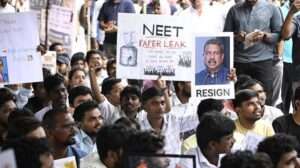
But there is an equally important distinction that many critics deliberately blur. Seeking justice for students is one thing; converting a genuine grievance into a nationwide political spectacle before investigations have reached their conclusion is quite another. The objective appears less about protecting students and more about projecting institutional collapse.
The same script seems to unfold with Ayodhya.
If any individual associated with the Ram Temple Trust has indulged in financial impropriety, let the law deal with them firmly. Accountability strengthens institutions; it does not weaken them. However, what deserves condemnation is the calculated attempt to portray isolated allegations against individuals as proof of corruption within the entire institution. Those who opposed the construction of the temple, questioned the judicial verdict, or dismissed the sentiments of millions now appear eager to exploit every allegation, however small, to diminish one of independent India’s most significant civilisational achievements.
This is not scrutiny. It is selective outrage.
Equally revealing is the familiar ecosystem that springs into action whenever such controversies emerge. Opposition politicians, activist groups, sections of the media, professional commentators, and digital influencers often appear remarkably synchronized in amplifying the same narrative. That does not, by itself, prove a conspiracy. But neither should every observation of such synchronization be dismissed as irrational.
Politics has always relied on narrative management. To pretend otherwise is intellectual dishonesty.
It is also worth asking why developmental initiatives such as the Great Nicobar Project routinely attract intense political campaigns, while comparable environmental concerns elsewhere seldom receive similar attention. Environmental protection is essential. Equally essential is consistency. Selective activism inevitably invites questions about whether ideological preferences sometimes outweigh environmental principles.
Supporters of the government, however, would do well to resist the temptation of emotional overreaction. Every allegation need not be answered with outrage. If irregularities have occurred within the Ayodhya Trust, they should be investigated thoroughly by the competent authorities. Those responsible, irrespective of position or influence, must face legal consequences.

What should be firmly resisted, however, is the demand that every controversy become an excuse for greater governmental control over autonomous religious institutions. The solution to alleged misconduct is better governance and stricter accountability—not dismantling institutional independence.
India’s democracy thrives not because controversies disappear but because institutions remain capable of investigating them. Public confidence is strengthened when due process prevails over trial by television studios and verdicts delivered through social media hashtags.
Perhaps the greatest disservice to democracy today is the growing tendency to substitute perception for proof. Repetition has become evidence. Headlines have become judgments. Viral posts have become convictions. In this environment, facts struggle to compete with outrage.
The Indian electorate has repeatedly demonstrated that it is far wiser than political strategists often assume. Citizens can distinguish between genuine accountability and manufactured indignation, between principled criticism and relentless political theatre. They understand that every controversy deserves investigation, but not every controversy deserves to be weaponised.
The loudest voices are not necessarily the most credible. Nor does the frequency of an allegation determine its truth. Democracies flourish when citizens question everyone—governments, opposition parties, activists, media houses, and institutions alike.
India deserves robust debate. It deserves fearless journalism. It deserves accountability wherever wrongdoing exists.
But it also deserves protection from those who mistake perpetual outrage for patriotism and political theatre for public service.
The nation’s future will not be secured by those who manufacture crises. It will be secured by citizens who refuse to become captive audiences to narratives crafted for political convenience, regardless of who writes the script.


This article presents a well-structured and thought-provoking political perspective, connecting a series of contemporary events into a broader strategic narrative. It encourages readers to think beyond isolated headlines and consider possible geopolitical and domestic dimensions behind public controversies. Notably, it distinguishes between interpretation and verified fact by acknowledging that several key claims remain contested, which adds balance to the discussion. Whether or not one agrees with its conclusions, the article succeeds in stimulating critical thinking and invites readers to evaluate complex political developments with patience and discernment.