


Ramu Chilimella
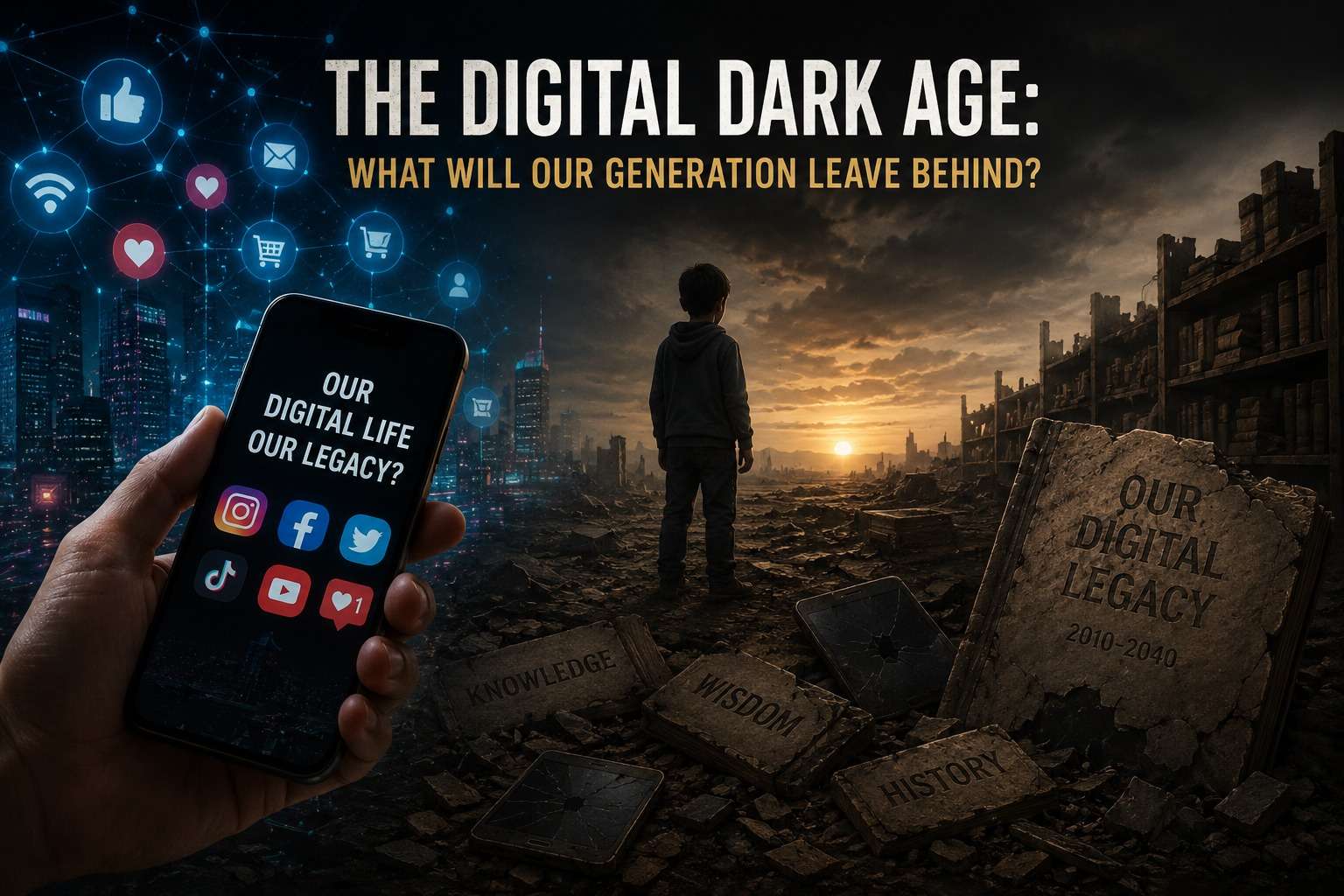
We have documented more of our lives than any generation before us—yet much of it could vanish without a trace.
Our ancestors carved stories into stone, preserved knowledge in manuscripts, and built monuments that endured for centuries. Because of their efforts, we can still hear their voices across time, learning from their beliefs, achievements, and mistakes.
But here is the unsettling question:
Will future generations know anything about us at all?
Ironically, we are perhaps the most educated and technologically advanced generation in human history. We produce more information in a single day than many ancient civilizations produced in centuries.
Yet we may become the generation that leaves behind the least accessible historical record.
From Stone to Silicon
Consider the evolution of information storage.
Stone inscriptions have lasted thousands of years.
Ancient manuscripts have survived for centuries.
Printed books, when properly preserved, can remain readable for generations.
But what about our digital records?
Twenty-five years ago, we stored photographs on film rolls and CDs. Movies were watched on LaserDiscs, VCDs, and DVDs. Important files were saved on floppy disks.
Today, many young people have never even seen a floppy disk. Finding a computer capable of reading one has become almost impossible.
A famous example occurred in 2010 when engineers at NASA struggled to access data from the Viking missions because it had been stored on decades-old magnetic tapes and depended on obsolete hardware and software. The data had not been destroyed—it had simply become difficult to read.
The technology did not fail.
The technology became obsolete.
The same fate will eventually befall today’s storage devices.
USB drives, external hard disks, SSDs, cloud platforms, and even modern file formats will one day disappear or become incompatible with future systems.
The challenge is not storing information.
The challenge is ensuring that future generations can still access it.
The Fragility of the Digital World
Most people assume that because something is stored digitally, it will last forever.
The reality is almost exactly the opposite.
Digital information is remarkably fragile.
A book can sit untouched on a shelf for 200 years and still be read.
A hard drive left unused for 20 years may fail completely.
A cloud account may disappear if the company shuts down.
Passwords are forgotten.
Software becomes unsupported.
File formats become unreadable.
Servers are switched off.
Entire digital ecosystems vanish.
We have already seen this happen. Large portions of the early internet disappeared when services such as GeoCities shut down, taking millions of personal websites with them. Although archivists managed to preserve some of the content, much of it was lost forever.
Millions of photographs, emails, documents, and videos are created every day, yet there is no guarantee they will remain accessible a hundred years from now.
Future historians may ultimately know more about the Roman Empire than about ordinary families living in the twenty-first century.
The Coming Digital Dark Age
Some historians and technologists have coined a worrying phrase:
“The Digital Dark Age.”
It describes a future in which vast amounts of today’s information become inaccessible because the technologies required to read them no longer exist.
Imagine discovering a box of storage devices from the year 2025.
Inside are SSDs, memory cards, old smartphones, and encrypted cloud backups.
The data may still exist.
But without the right hardware, software, passwords, operating systems, and file formats, retrieving it could prove impossible.
This is not merely a theoretical concern. In 1986, the BBC’s Domesday Project—a massive digital survey of Britain stored on LaserDiscs—became nearly unreadable within a few decades because the specialized computers needed to access it had become obsolete. Considerable effort was later required to recover and preserve the information.
Information that is never physically destroyed can still be effectively lost forever.
Our Ancestors May Have Been Wiser
Ancient civilizations understood something we sometimes forget:
Important knowledge should outlive its creators.
That is why kings carved their achievements into stone.
That is why scriptures were copied by hand, generation after generation.
That is why great libraries were built.
The medium itself was chosen for longevity.
Today, we prioritize convenience, speed, and storage capacity.
Rarely do we prioritize permanence.
We have become extraordinarily good at creating information, but far less capable of preserving it for the long term.
Encouragingly, successful recovery efforts also show that preservation is possible when societies choose to invest in it. The restoration of ancient manuscripts from damaged archives and the long-term work of organizations such as the Internet Archive demonstrate that deliberate preservation can rescue knowledge that might otherwise disappear.
What Should We Leave Behind?
Perhaps the answer is not to reject technology but to balance it with permanence.
Family histories should be printed.
Important photographs should become albums.
Personal memoirs should become books.
Scientific discoveries should be preserved in multiple formats.
National archives should maintain both digital and physical records.
The most important stories of our lives should not exist solely on cloud servers owned by corporations.
Because corporations come and go.
Technologies come and go.
Formats come and go.
Human stories deserve to survive.
A Question for Our Generation
Thousands of years later, we can still read inscriptions carved into stone by civilizations long gone.
Will people 500 years from now be able to read our emails?
Will they see our photographs?
Will they understand our culture, our beliefs, our struggles, and our dreams?
Or will humanity discover that the most connected generation in history became the most forgotten?
Our ancestors left us monuments, manuscripts, and memories.
The question is no longer whether technology can preserve our lives.
It is whether we will choose to preserve them.
Every photograph you print, every story you record, every archive you protect is a vote against forgetting.
Do not leave your legacy to chance, to obsolete devices, or to companies that may not exist tomorrow.
Act now to preserve what matters most.
Because centuries from today, someone may search the past to understand who we were.
What they find—or fail to find—will depend on the choices we make today.
Let our generation be remembered not merely for the information it created, but for the wisdom to ensure that information endured.
The greatest risk is not losing our data. It is losing humanity’s memory.




The concern about a digital dark age is valid, but it overlooks humanity’s greatest strength—our ability to innovate when challenges arise. Every generation has faced the fear of losing its knowledge, yet each has developed better ways to preserve it. The future is unlikely to be defined by digital loss, but by smarter preservation.
Emerging technologies such as artificial intelligence, self-healing storage systems, quantum computing, DNA data storage, decentralized archives, and open digital standards can ensure that information remains readable across centuries. Intelligent systems will be able to migrate old files into new formats automatically, preventing valuable knowledge from becoming obsolete.
The missing perspective is that history is not preserved by technology alone, but by human intention. If governments, libraries, researchers, and individuals work together to create permanent, open, and verifiable digital archives, our generation may become the one that leaves behind the richest and most accessible record in human history—not a digital dark age, but a digital legacy.
Akshara symbolic of eternity, undying needs preservation. With changing times effective ways of digital preservation have to be discovered. Again human will and assistance alone will help in this enormous task .