



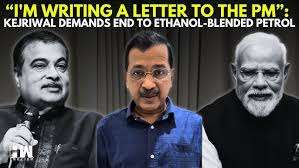
For decades, India’s Opposition has perfected one political skill—opposing almost every transformative reform, irrespective of its merit. Whether it was the Goods and Services Tax, the abolition of triple talaq, the abrogation of Article 370, Digital India, UPI, or infrastructure expansion, the reflex has remained the same: manufacture fear first, verify facts later. Their latest target is Bharat’s ethanol blending programme. The campaign against E20 petrol is not merely politically motivated; it is also remarkably unscientific. Union Minister Nitin Gadkari has emerged as one of the strongest advocates of cleaner fuels, consistently leading by example by using ethanol-based fuel in his own vehicles. His commitment stems from a larger national vision—reducing dependence on imported crude oil, cutting carbon emissions, strengthening farmers’ incomes, and making Bharat more energy secure. Instead of appreciating such forward-looking leadership, sections of the Opposition, led by the politically desperate Arvind Kejriwal ahead of the Punjab elections, have chosen to convert a scientific and economic initiative into yet another election slogan. The misinformation campaign has been relentless. Viral videos and social media posts have falsely claimed that E20 fuel destroys engines, causes severe damage to vehicles, and poses a grave threat to the automobile industry. None of these sensational claims stand the scrutiny of science. The facts tell an entirely different story. The Union Government, petroleum experts, and India’s leading automobile manufacturers—including Maruti Suzuki, Hyundai, Toyota, and Bajaj Auto—have categorically stated that E20 fuel is safe for regular use. Extensive testing by the Automotive Research Association of India (ARAI) has found no compatibility issues with standard vehicle components. Even millions of older vehicles have been running without any evidence of widespread engine failures. Yes, ethanol contains slightly less energy than pure petrol, resulting in a marginal reduction of around 3 to 3.5 percent in mileage. But this is a universally accepted scientific characteristic of ethanol blends, not an engineering defect. Every cleaner fuel technology involves certain trade-offs. The larger question is whether those trade-offs are outweighed by the national benefits. In this case, the answer is an emphatic yes. The benefits are substantial. Ethanol blending has already saved the country over ₹1.9 lakh crore in foreign exchange by reducing crude oil imports. It has opened new revenue streams for sugarcane farmers and grain producers, strengthening rural incomes while reducing stubble burning and agricultural waste. Most importantly, it contributes significantly to lowering carbon emissions, making India’s transport sector cleaner and more sustainable.
Ironically, many of the same political voices that endlessly lecture the government about climate change and environmental responsibility are now opposing one of the most practical and globally accepted measures to reduce vehicular emissions. No serious nation can aspire to become a five-trillion-dollar economy while remaining perpetually dependent on imported fossil fuels. Energy security is not merely an economic issue; it is a strategic necessity. Every litre of domestically produced ethanol reduces India’s vulnerability to volatile global oil prices and geopolitical disruptions. Certainly, legitimate consumer concerns deserve attention. Older vehicles may require periodic inspection of rubber seals and fuel lines, and consumers should receive clear information at fuel stations regarding ethanol blends. Better public awareness and transparent labelling are sensible improvements. But these issues call for better implementation—not abandonment of the policy itself. Unfortunately, facts have become casualties in today’s politics. Every reform now faces an organised ecosystem determined to sow confusion, amplify isolated concerns, and portray every developmental initiative as a national disaster. Such obstructionism neither serves consumers nor strengthens democracy. Bharat today stands at the threshold of becoming a global manufacturing, economic, and energy powerhouse. That journey demands innovation, technological adaptation, and bold policymaking—not fearmongering masquerading as public interest. Those who instinctively oppose every reform are not protecting the people. They are merely exposing their own allergy to development and their unwillingness to see Bharat emerge as a self-reliant, environmentally responsible, and economically powerful nation. Every litre of ethanol blended into India’s fuel tank is one less litre of imported crude, one more rupee in a farmer’s pocket, one step towards cleaner air, and one decisive stride towards an energy-secure, self-reliant Bharat. Those who seek to derail this journey are not merely opposing a fuel—they are opposing the nation’s march towards economic sovereignty.Top of Form

