



The reported joint appeal by the National Conference and the People’s Democratic Party urging Prime Minister Narendra Modi to revive dialogue with Pakistan is not merely ill-timed; it is profoundly disconnected from the national mood. At a time when Pakistan continues to shelter, sponsor and export terrorism into Bharat, any proposal for “normalisation” without demonstrable action from Islamabad deserves outright rejection. For decades, the National Conference and the PDP have dominated the politics of Jammu and Kashmir. Yet, instead of introspection over the region’s turbulent past, they continue to prescribe the same failed formula—peace talks with a neighbour that has repeatedly weaponised terrorism as an instrument of state policy. Their latest appeal only reinforces the perception that these parties remain unwilling to acknowledge the fundamental reason relations between the two countries have collapsed. The scars of Pakistan-sponsored terrorism are too deep to be erased by diplomatic slogans. From the exodus of Kashmiri Pandits in the 1990s to the attacks on Parliament, Mumbai, Uri, Pulwama and, most recently, Pahalgam, the list is painfully long. Every attempt at dialogue has been undermined by another act of terror. That is precisely why the Modi government adopted a clear doctrine: talks and terror cannot go together. Successive governments experimented with confidence-building measures, ceasefires and back-channel diplomacy. None altered Pakistan’s strategic calculus. Instead, Bharat witnessed repeated infiltrations, cross-border terrorism and attacks on innocent civilians and security personnel. It is difficult to understand why political leaders continue to advocate engagement without first demanding that Pakistan dismantle its terror infrastructure. The timing of the letter is equally puzzling. Reports of unofficial Track-II interactions involving former officials and strategic thinkers have already been clarified by the Union government. The Ministry of External Affairs made it unequivocally clear that such discussions have no official endorsement and do not represent the government’s policy. Yet the National Conference and PDP appear eager to use these unofficial conversations to push for a reversal of New Delhi’s firmly articulated position.
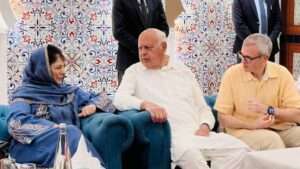
Prime Minister Narendra Modi’s government has fundamentally altered India’s response to cross-border terrorism. Whether through the 2016 surgical strikes, the 2019 Balakot air strikes or the military response following the Pahalgam attack under Operation Sindoor, the message has been unmistakable: terrorism will invite consequences. The government has repeatedly maintained that any meaningful engagement with Pakistan can begin only after terrorism ends, not before. One must also ask a simple question: who exactly is Bharat expected to negotiate with? Is it Pakistan’s elected government, whose authority is widely perceived to be constrained by the military establishment, or the security apparatus that has long been accused by India of nurturing terrorist groups? Dialogue for the sake of dialogue has never produced peace. It has merely bought time for terror networks to regroup. Meanwhile, Pakistan faces serious internal challenges—from economic distress to unrest in regions such as Balochistan and Pakistan-occupied Kashmir. Those are Pakistan’s internal matters to resolve. Bharat neither seeks instability across the border nor has any obligation to rescue Islamabad from the consequences of its own policies. New Delhi’s priority must remain national security, economic growth and the vision of Viksit Bharat. The overwhelming public sentiment in Bharat today is clear. Peace is welcome, but not at the cost of national security. Friendship cannot be built upon the graves of terror victims. Any government that ignores this reality would betray the sacrifices of the Armed Forces and countless innocent citizens. Farooq Abdullah and Mehbooba Mufti may continue to invoke the language of reconciliation. However, reconciliation without accountability is an illusion. Until Pakistan verifiably abandons terrorism as an instrument of policy, dismantles the infrastructure that enables cross-border violence and demonstrates sincerity through action rather than rhetoric, New Delhi would be entirely justified in maintaining its present course. Peace remains the ultimate objective. But history has taught Bharat a hard lesson: lasting peace cannot emerge from wishful thinking. It can only be secured through strength, vigilance and an uncompromising commitment to national security.

