



India is today among the world’s fastest-growing urbanizing countries. Economic growth, industrialization, the expansion of the service sector, and the continued migration from rural areas to cities have rapidly transformed the face of Indian cities. From metropolises to smaller towns, multi-story buildings, commercial complexes, coaching institutes, hotels, hospitals, and mixed-use buildings have emerged as new symbols of development. But behind this growth lies a serious reality—negligence in urban planning, neglect of safety standards, and administrative laxity. As a result, many urban buildings, while being centres of economic progress, are also becoming potential “fire traps.”
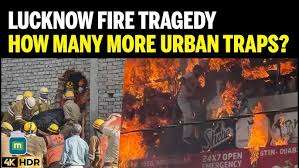
Fire accidents in various parts of the country in recent years have exposed the magnitude of this crisis. Fires in coaching institutes in Delhi, coaching centres in Surat, hotels in Kolkata, commercial buildings in Hyderabad, hospitals in Mumbai, and numerous markets have plunged hundreds of families into untimely grief. Most incidents revealed similar deficiencies—unauthorized use of buildings, lack of fire safety equipment, blocked or obstructed emergency exits, narrow roads, illegal parking, and gross negligence in enforcing regulations. This clearly indicates that the problem is not limited to a single building, a single city, or a single department, but to our entire urban development model.
The number of mixed-use buildings is steadily increasing in India. It is now common for a single building to have shops on the ground floor, offices on the ground floor, coaching institutes on the upper floor, and residential accommodation on the upper floor. This arrangement may seem economically beneficial, but it poses a significant safety risk. The presence of flammable materials, electrical equipment, gas cylinders, large numbers of people, and limited escape routes in such buildings make a fire devastating. If a building was originally constructed for residential purposes and later converted to commercial activities without structural modifications, the risk increases manifold.
Unplanned urbanization is the root cause of this problem. Most Indian cities have expanded without a long-term master plan. Populations have grown, but roads haven’t; buildings have grown taller, but fire service capacity hasn’t evolved in the same proportion. Fire engines can’t even enter many old markets and densely populated areas. In many places, a network of electrical wires, illegal parking, and encroachments make fire control even more difficult. Under such circumstances, even small fires can escalate into major tragedies within minutes.
Another important reason for this crisis is policy contradiction. While the government is simplifying the permitting process to promote business through “Ease of Doing Business,” it is simultaneously not placing sufficient emphasis on compliance with safety standards. In many states, buildings up to a certain height are exempt from the mandatory Fire No Objection Certificate (NOC). As a result, thousands of such buildings continue to operate without regular fire safety inspections. Often, building construction permissions are granted for one purpose, but over time, their intended use changes completely. Unfortunately, no robust system has been developed to effectively monitor this change.
Lack of administrative coordination also complicates the situation. Building permits are granted by the Municipal Corporation, land use changes are handled by the Development Authority, business licenses are issued by another department, and fire safety is the responsibility of the Fire Department. Lack of proper information sharing between these departments prevents effective compliance with regulations. Often, all formalities are completed at the time of building construction, but subsequent illegal alterations remain unnoticed for years.
Corruption and lack of accountability are also significant aspects of this problem. If inspections are limited to paperwork and certificates are issued without actual inspection, regulations become mere formalities. After several accidents, it was revealed that fire extinguishers were installed in buildings, but they were not regularly inspected. In many places, sprinkler systems were not working or emergency exits were locked. This is not just a technical failure, but also an administrative and moral failure.
Lack of citizen awareness also contributes to this crisis. Most people do not inspect fire safety systems when buying or renting a building. Businesses neglect safety equipment to reduce costs. Regular mock drills, disaster management training, and emergency evacuation drills are considered unnecessary. In developed countries, fire safety culture is promoted from the school level.
India’s disaster management system has strengthened significantly over the past two decades, but prevention of urban disasters like fires still hasn’t received the necessary attention. Our agencies perform remarkable work in post-disaster relief and rescue operations, but if equally serious investment is made in prevention and risk reduction, many tragedies can be averted. The fundamental principle of disaster management is that every rupee spent on prevention saves many times the amount spent on relief and rehabilitation.
What’s needed now is not just punitive action, but comprehensive structural reforms. First, urban planning must be scientific and forward-looking. Land use, population density, road widths, water sources, fire station locations, and emergency access routes should be re-evaluated in each city. Separate safety standards should be set for mixed-use areas, and building approvals should be made in accordance with these standards.
Second, the National Building Code and fire safety standards should be enforced with uniform, rigorous compliance across the country. Safety standards should be based on the number of occupants, the nature of the activity, and the fire risk, rather than the height of the building. Automatic sprinklers, smoke detectors, fire alarms, emergency lighting, and clear exit routes should be mandatory in all public and mixed-use buildings.
Third, building approvals, business licenses, fire NOCs, and inspections should be integrated into a unified digital platform. If a building is found to be used for a different purpose than its approved purpose or if its safety certificate expires, relevant departments should receive automatic notifications. Risk areas can be identified using artificial intelligence and geospatial technology.
Fourth, modernization of fire services is essential. Modern equipment, hydraulic ladders for high-rise buildings, adequate water sources, trained human resources, and rapid response systems should be developed. Even in small and medium-sized cities, firefighting infrastructure should be strengthened in proportion to the population and number of buildings.
Fifth, citizen participation should be made an integral part of policy. Regular fire safety training and mock drills should be made mandatory in schools, colleges, coaching institutes, markets, hospitals, and residential societies. Just as the Swachh Bharat Mission encouraged public participation, a national fire safety awareness campaign should be launched.
Ultimately, ensuring accountability in governance is paramount. If an accident results from a violation of regulations or negligence in inspection, clear accountability should be established not only for the building owner but also for the relevant officials. Transparency, regular social audits, and independent safety audits can be effective steps in this direction.
India’s cities are not just centres of economic activity, but the foundation of the lives, dreams, and futures of millions of people. If urban development is devoid of safety, planning, and accountability, this model of development will continue to lead to human tragedies. The need is to develop an urban culture in which building safety is prioritized over building height, human life is prioritized over commercial profit, and adherence to rules is considered a social responsibility, not an obligation.
A truly smart city will be one where citizens feel safe, where buildings are both symbols of development and standards of safety, and where every construction conveys the message that human life is more valuable than any economic gain. If India is to build safe, sustainable, and disaster-resilient cities of the future, it must move beyond reactive actions and prioritize long-term reforms based on visionary urban planning, rigorous regulatory frameworks, modern technology, transparent governance, and conscious citizen participation. Only then will it be possible to eliminate the traps hidden behind the glitter of development and build a safe and sensitive urban India.


